RezaAslansoutrage

  • Subscribe to our RSS feed.
  • Twitter
  • StumbleUpon
  • Reddit
  • Facebook
  • Digg

Saturday, 26 January 2013

I is for infidel

Posted on 01:05 by Unknown

The Gospel of Slavery: A Primer of Freedom, written by a Unitarian minister and published in Philadelphia in 1864. More information at Slate's new history blog, The Vault.

This argument, interestingly, that faith was undermined by contorted arguments about slavery, was often made by the other side, by those supporting the positive good of the institution of slavery. Christian abolitionists were regularly condemned for not reading the Bible literally, and betraying true, orthodox Christianity in their (radical) attempts to abolish slavery. One standard argument, from the South, was that the pro-slavery forces were actually preserving Christianity against the corruptions of those who had been influenced by rationalists, atheists, and so on.

It was the case, after all, that "Revivals of religion and revivals of the slave-trade go hand in hand together."

The prominent presence of non-traditional Christians and even non-Christians, such as this Unitarian Universalist, in the anti-slavery coalition was regularly cited as evidence that abolitionism couldn't really be Christian.

As one Confederate famously argued, the armed defense of slavery was a defense against the evils of revolutionary atheism:
For 'Liberty Equality, Fraternity,' we have deliberately substituted Slavery, Subordination and Government. Those social and political problems which rack and torture modern society we have undertaken to solve for ourselves, in our own way, and upon our own principles. That among equals equality is right;' among those who are naturally unequal, equality is chaos; that there are slave races born to serve, master races born to govern. Such are the fundamental principles which we inherit from the ancient world, which we lifted up in the face of perverse generation that has forgotten the wisdom of its fathers: by those principles we live and in their defence we have shown ourselves ready to die. Reverently we feel that our Confederacy is a God sent missionary to the nations, with great truths to preach.
It's exactly in this context that Frederick Douglass argued that there were two types of Christianity in America, the severity of the split between them being such that, as historian Mark Noll argues, the American Civil War actually began within the internal divisions of American Christianity.
Read More
Posted in abolitionists, American religion, arguments, Children's literature, Christianity, Civil War, gospel, slavery, Unitarians | No comments

Thursday, 24 January 2013

Posted on 04:13 by Unknown
Winter fields
Read More
Posted in | No comments

Wednesday, 23 January 2013

Getting clearer on David Foster Wallace's religious experiments

Posted on 03:36 by Unknown
The shroud around David Foster Wallace's engagements with religion has lifted a bit, thanks to the efforts of an emeritus English professor at Goshen College.

In August, I wrote that "no one in the position to find out more about [Wallace's] religious beliefs or practices seems to have been interested in doing so." Ervin Beck was in a position to find out more about Wallace's reported interaction with a Mennonite church during his time in Normal, Ill., and has now done so, in a piece called "David Foster Wallace Among the Mennonites."

Several articles on Wallace from that time say that he was attending a Mennonite church, marking that experience as a part of the important ethical turn in Wallace's writing, as he became increasingly interested in and focused on the ways in which fiction, and in particular experimental fiction, could serve the function of a kind of "technology of the self," which, as Michel Foucault wrote, "permit individuals to effect by their own means or with the help of others a certain number of operations on their own bodies and souls, thoughts, conduct, and way of being, so as to transform I themselves in order to attain a certain state of happiness, purity, wisdom, perfection, or immortality." The extent of Wallace's connection to a church in Normal was somewhat cryptic, though. In one version he attended regularly as part of his acclimation to the Midwest. In another, he was there as research. In a third, he was seriously considering joining and becoming a Mennonite.

Most of this seems to have stemmed from a misrepresentation, which Wallace either perpetuated or allowed.

Wallace was an active part of an Alcoholics Anonymous group that included some Mennonites and involved him in a Mennonite family's life, but due to his own need for privacy and the group's strictures on publicity, Wallace either told several reporters or allowed several reporters to believe that he knew this family through "a Mennonite house of worship."

Frank Bruni of the New York Times and David Streitfeld of Details Magazine both reported this. Bruni wrote:
Back in Illinois he began to attend services at various churches around town—there is something about religious faith, which was missing from his rearing by two atheists, that entices and calms him—and he formed his closest social relationship with an older married couple, Doug and Erin Poag. They met at a Mennonite house of worship.
Streitfeld similarly reported that: "Recently he found a Mennonite house of worship, which he finds sympathetic even if the hymns are impossible to sing."

It turns out, though, that whether or not he had trouble with the hymns, Wallace only went to a Mennonite church a few times. Ervin Beck interviewed the various members of the Mennonite family, and has concluded that "during his years of friendship with the Poags, Wallace attended the Mennonite Church of Normal, with the Poags, only about four times."

One detail of those rare occurrences of church attendance captures both aspects of Wallace's struggle with what he considered the great moral potential and also moral danger of writing: his obsession with and respect for language and his fight to, as it is said, "get out of his own head."

A member of the Poag family says:
He was very distracted by a large sign that hung in the sanctuary that read, 'Other foundation can no one lay than that which is laid, which is Jesus Christ.' He just couldn't believe that intelligent people could have such a grammatically incorrect sentence up on the wall, front and center. He was almost unable to concentrate because he kept trying to figure out what it really meant, and how he would re-write it.
Some of this information is conveyed in D.T. Max's biography. Max and Beck both make the case that, to whatever extent Wallace had a faith, it was grounded in AA, rather than any Christian tradition. Beck does a great service to those of us who are interested specifically in this aspect of Wallace's writing, by really going into the details of this period.

Some might conclude that since Wallace wasn't as religious in this period as had been thought, and wasn't religious in the sense of being affiliated with a church, that that should dispel any interest what might be called Wallace's ethical-moral investigations. Max -- referring to me, actually, albeit obliquely -- suggested people are wrong to try to "turn David into some kind of Thomas Merton figure." He shouldn't, it's been argued, be made to seem more spiritual or religious than he was. That's obviously true, but may be ultimately a misunderstanding of what it is that those of us who are interested in Wallace's religious history are actually interested in. It wouldn't make sense to try to claim him for one or another particular church, nor, really, would it be worthwhile for the project of understanding the ethical endeavors of Wallace's latter works.

Understanding how and to what extent Wallace engaged in a Mennonite church adds interesting and important context to the religious themes that develop in his work. For example, his unfinished novel, The Pale King, is nothing if not a kind of religious experiment. Characters, after all, undergo conversions and religious experiences at key moments, explicitly religious questions are central to the book, and the textual evidences of structure indicate that the novel was being constructed (like some of the short stories in Oblivion) as an interregnum moment of deferred parousia. In an addition to all that, the book, like a lot of Wallace's work, seems designed to affect the reader religiously, to provoke the reader in specifically ethical ways.

Which is a lot like Merton, I think.

"David Foster Wallace Among the Mennonites" was exactly what I was hoping for when I wrote about how Wallace's religion was being ignored. This is really helpful, adding important information to the sketchy facts that were publically available, and correcting some misinformation. Beck's work, along with a short but growing list of other articles, such as Maria Bustillos' excellent piece, "Inside David Foster Wallace's Self-Help Library," helps to clear away the fog that obscured Wallace's investigations into various "technologies of the self" and the various personal ethical experiments that were or weren't in the background when he wrote.
Read More
Posted in D.T. Max, David Foster Wallace, ethics of writing, experimental fiction, Mennonites, The Pale King | No comments

Tuesday, 22 January 2013

The "nones" of 87 years ago

Posted on 02:37 by Unknown
Most of the debates about the "nones" have had to do with interpretation. The question is, who are they? The question is, what does it mean?

A question that hasn't been so prominently raised is whether this new thing is really so new.

Charles Richter, of (Ir)religion in America, has turned up some evidence it's not. From the University of Illinois student newspaper in 1926, a letter from a student questioning the interpretations of a survey of university students' religious affiliations. According to the letter, only one student out of more than 10,000 identified as an atheist, but there were more than a few that were religiously unaffiliated.

The letter writer, who signs A.B.C, argues:
Shall we say that only one is an atheist and the rest are religious, but merely indifferent to church attendance, or shall we take into consideration the deadliness of Christian intolerance and admit that some of the 1,828 did not register as atheists for fear of ostracism? I am an atheist, but when I registered I did not admit that fact because I knew the registers would be made public, and some enthusiastic religionist might bring the information to the attention of the Great Christian Majority, to my discomfort.
There's a familiarity of this argument -- atheists need to "come out," and so on. This is a very contemporary debate, happening 87 years ago. While clearly the ranks of the unaffiliated have swelled since the days when less than two percent of university students said they didn't belong to any specific religion, the category of those who don't fit comfortably into a religious demographics survey, it turns out, is not new.

It's just that they didn't have a clever name for it in 1926.
Read More
Posted in America, atheism, history, nones, pluralism, religious data, secularization | No comments

'This right of privacy . . . is broad enough to encompass a woman's decision whether or not to terminate her pregnancy'

Posted on 01:00 by Unknown
Roe vs. Wade, the federal case that legalized abortion, thus determining one critical line of political battle and cultural division for generations to come, was handed down by the Supreme Court 40 years ago today.

The decision, writing by Justice Harry Blackmun, focused on the question of whether privacy was a right guaranteed by the constitution. That's not normally the core of the debate as it's debated day to day in American culture, but that was the central question of the legal issue.

A key excerpt of the decision, on the matter of a constitutional right to privacy:


The Constitution does not explicitly mention any right of privacy. In a line of decisions, however, going back perhaps as far as Union Pacific R. Co. v. Botsford, (1891), the Court has recognized that a right of personal privacy, or a guarantee of certain areas or zones of privacy, does exist under the Constitution. In varying contexts, the Court or individual Justices have, indeed, found at least the roots of that right in the First Amendment, Stanley v. Georgia, (1969); in the Fourth and Fifth Amendments, Terry v. Ohio, (1968), Katz v. United States, (1967), Boyd v. United States, (1886), see Olmstead v. United States, (1928) (Brandeis, J., dissenting); in the penumbras of the Bill of Rights, Griswold v. Connecticut, ; in the Ninth Amendment, (Goldberg, J., concurring); or in the concept of liberty guaranteed by the first section of the Fourteenth Amendment, see Meyer v. Nebraska, (1923). These decisions make it clear that only personal rights that can be deemed "fundamental" or "implicit in the concept of ordered liberty," Palko v. Connecticut, (1937), are included in this guarantee of personal privacy. They also make it clear that the right has some extension to activities relating to marriage, Loving v. Virginia, (1967); procreation, Skinner v. Oklahoma, (1942); contraception, Eisenstadt v. Baird, (WHITE, J., concurring in result); family relationships, Prince v. Massachusetts, (1944); and child rearing and education, Pierce v. Society of Sisters, (1925), Meyer v. Nebraska, supra.

This right of privacy, whether it be founded in the Fourteenth Amendment's concept of personal liberty and restrictions upon state action, as we feel it is, or, as the District Court determined, in the Ninth Amendment's reservation of rights to the people, is broad enough to encompass a woman's decision whether or not to terminate her pregnancy. The detriment that the State would impose upon the pregnant woman by denying this choice altogether is apparent. Specific and direct harm medically diagnosable even in early pregnancy may be involved. Maternity, or additional offspring, may force upon the woman a distressful life and future. Psychological harm may be imminent. Mental and physical health may be taxed by child care. There is also the distress, for all concerned, associated with the unwanted child, and there is the problem of bringing a child into a family already unable, psychologically and otherwise, to care for it. In other cases, as in this one, the additional difficulties and continuing stigma of unwed motherhood may be involved. All these are factors the woman and her responsible physician necessarily will consider in consultation.

On the basis of elements such as these, appellant and some amici argue that the woman's right is absolute and that she is entitled to terminate her pregnancy at whatever time, in whatever way, and for whatever reason she alone chooses. With this we do not agree. Appellant's arguments that Texas either has no valid interest at all in regulating the abortion decision, or no interest strong enough to support any limitation upon the woman's sole determination, are unpersuasive. The Court's decisions recognizing a right of privacy also acknowledge that some state regulation in areas protected by that right is appropriate. As noted above, a State may properly assert important interests in safeguarding health, in maintaining medical standards, and in protecting potential life. At some point in pregnancy, these respective interests become sufficiently compelling to sustain regulation of the factors that govern the abortion decision. The privacy right involved, therefore, cannot be said to be absolute. In fact, it is not clear to us that the claim asserted by some amici that one has an unlimited right to do with one's body as one pleases bears a close relationship to the right of privacy previously articulated in the Court's decisions. The Court has refused to recognize an unlimited right of this kind in the past. Jacobson v. Massachusetts, (1905) (vaccination); Buck v. Bell, (1927) (sterilization).

We, therefore, conclude that the right of personal privacy includes the abortion decision, but that this right is not unqualified and must be considered against important state interests in regulation.
Read More
Posted in abortion, culture war, politics, Roe vs. Wade, Supreme Court | No comments

Monday, 21 January 2013

Religion at the inauguration

Posted on 01:48 by Unknown
God is all over inauguration
Obama family goes to church
Sermon uses Obama campaign theme, 'Forward'
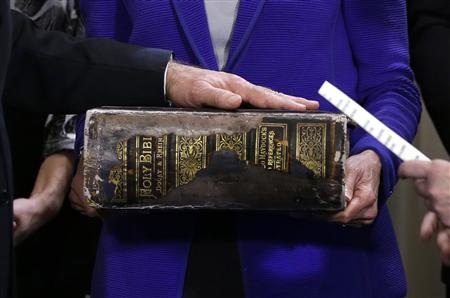
Commentary: Obama's inauguration Bibles
Historic Bibles used in ceremonies 
The tradition of inaugural prayer
Presidential oaths, from Washington to Obama
Adding "So help me God" to the Constitution:
... there was a myth that the tradition of adding God to the oath began with George Washington. It didn’t, say experts at the Library of Congress, the U.S. Senate Historical Office and the first president’s home, Mount Vernon. Although the phrase was used in federal courtrooms since 1789, the first proof it was used in a presidential oath of office came with Chester Arthur’s inauguration in September 1881.
Newdow v. Roberts, the 2008 lawsuit over "So help me God"
Court declines to hear case over "So help me God"
Why doesn't every president use the Lincoln Bible? (And what did John Adams swear on instead of a Bible?)
Biden takes the oath:
Biden used his family Bible for today's ceremony, a 5-inch-thick tome featuring a Celtic cross on the cover. It has been in the Biden family since 1893. He used it each time he was sworn in as a senator and when he was sworn in as vice president in 2009. His son Beau used it when he was sworn in as Delaware's attorney general.
The Biden family Bible, in use
Special piece of art Biden had hung for inauguration
Official & unofficial inauguration prayers
Evangelical pastor's 90s sermon stirs controversy after inauguration invitation
Unpacking the Giglio imbroglio
Commentary: Stop politicizing inaugural prayers
Commentary: Pastor's dis-invitation to inauguration is new moral McCarthyism
Commentary: A wry congratulations to the LGBT community
Commentary: I don't care who prays at the inauguration
Discussing the Giglio controversy & its wider implications
Political/religious tensions in prayer invitations
Farewell, Louie Giglio?
Does Giglio controversy mean the end of publican role for evangelicals?
Obama may have disagreed with how Giglio controversy was handled
Benedictions not offered
When was the last time a rabbi prayed at a presidential inauguration?
1,500 to pray for president, government, military, media & business. Also: Great Awakening.
Methodist pastor Adam Hamilton to preach at inauguration
Widow of civil right's icon to deliver invocation
Episcopal priest to close inauguration
Commentary: Obama should invoke Puritan vision of 'City on a Hill'
Commentary: Civil religion holds country to higher moral standard
Inauguration is 'worship of the nation'
Inaugurations & America's 'civil religion':
President Obama’s [2009] inaugural address contains a muted expression of the American civil religion that Robert Bellah first recognized in Kennedy’s speech of 1961. The reference to God as the transcendent source of values, the activist faith, the trust in God’s providence and grace, notions of sacrifice and rebirth, the appeal to sacred events and heroes of the past (recall, too, Obama’s use of Lincoln’s Bible during the swearing-in ceremony), are all enduring aspects of this tradition, and Obama placed special emphasis on the civil republican dimension 
Yet, the God that Obama appeals to feels more remote, less directly involved in history than in earlier inaugural addresses. Remarkable, too, is Obama’s stress on the nation’s shortcomings, his mention of religious traditions beyond the so-called “Judeo-Christian” faiths, his outreach to Muslims and inclusion of non-believers. The latter represents a real and significant innovation ....
Update: 
Myrlie Evers-Williams delivers inaugural invocation 
The text of Obama's inaugural address
Cornel West's critique of Obama's use of Martin Luther King Jr.'s Bible
Pastor Mark Driscoll's critique of Obama's use of the Bible
Richard Blanco's poem, "One Day"
Richard Blanco reading
Kelly Clarkson performs "My Country Tis of Thee"
Rev. Luis Leon delivers benediction
The text of Leon's benediction

Update 2:
Obama swears on two Bibles
Read More
Posted in American religion, civil religion, links, politics, religion and politics, teaching | No comments

Posted on 00:08 by Unknown

Some facts about women who have had abortions. Tomorrow marks the 40th anniversary of the supreme court decision that legalized abortion in the United States. 


Read More
Posted in abortion, America, culture war, politics, Roe vs. Wade, statistics | No comments
Newer Posts Older Posts Home
Subscribe to: Posts (Atom)

Popular Posts

  • The Derrida point
    "I was wondering myself where I am going. So I would answer you by saying, first, that I am trying, precisely, to put myself at a point...
  • How New Atheists are like Victorian-era bishops
    The secularization thesis -- the most traditional version, rather crude, which predicted religion would disappear from the modern world -- i...
  • On exorcism
  • Happy birthday Billy Graham
    Billy Graham turns 94 today. One of the odder moments of Graham's very public career -- though there are many, and many more than one ...
  • The courts' disagreement over corporations having religion
    Can corporations practice religion? The courts disagree. In two different federal courts, in two different cases where for-profit companies ...
  • The religious shape of capitalism
    A new study published in Management Science is making a very Max Weber-like claim about the essential differences of religions affecting eng...
  • 'Christianity is not a religion'
    Watch the latest video at video.foxnews.com I don't know whether it's really possible to have a meaningful, reasonable debate about ...
  • Reza Aslan's outrage
    Among scholars of religion, there's no consensus on the relevance of scholar's personal religious beliefs and practices to their sch...
  • Teaching: History of American Atheism
    I'm in the process of preparing a class on the history of American Atheism, which, as far as I can tell, is more or less uncharted terri...
  • Snake handlers embrace media attention
    The National Geographic channel is planning a show on two Tennessee men and their communities struggling to keep the snake-handling faith. T...

Categories

  • "sacred steel" (1)
  • #PrayforBoston (1)
  • 1848 (1)
  • 1916 (1)
  • 2012 (4)
  • 2013 (1)
  • 4th of July (1)
  • 9/11 (1)
  • A Christian Manifesto (1)
  • AAR (1)
  • Aaron Schock (1)
  • abolitionists (1)
  • abortion (6)
  • Abraham Kuyper (2)
  • Abraham Lincoln (1)
  • abuse (4)
  • academia (22)
  • academica (1)
  • Acton Institute (1)
  • aesthetics (2)
  • African-American religion (3)
  • Al Mohler (1)
  • Albert J. Raboteau (1)
  • Alex Grenier (1)
  • aliens (1)
  • Alton Lemon (1)
  • Amazon (1)
  • ambition (1)
  • ambivalence (1)
  • America (21)
  • America’s Blessings: How Religion Benefits Everyone (1)
  • American (1)
  • American religion (128)
  • American Revolution (1)
  • Amish (1)
  • anabaptists (1)
  • Andrew Hamblin (1)
  • Andrew Sullivan (1)
  • Angela Zimmann (1)
  • animation (1)
  • Ann Taves (1)
  • Anti-Catholicism (1)
  • Anti-Mormonism (1)
  • apocalyptic (3)
  • apocalypticsm (2)
  • apologetics (1)
  • Appalachian (1)
  • Archdiocese of Philadelphia (1)
  • arguments (5)
  • Arizona Republic (1)
  • ark (1)
  • art (12)
  • Art Gish (1)
  • Art Young (1)
  • astrophysics (1)
  • asylum (4)
  • Aten Reign (1)
  • atheism (28)
  • audience (1)
  • authors (1)
  • Baby Doe (1)
  • bad faith (2)
  • baptism (1)
  • Baptists (2)
  • Baron d'Holbach (1)
  • Barry Hankins (1)
  • bars (1)
  • baseball (1)
  • bear market in God (2)
  • beer (1)
  • belief (13)
  • Ben-Hur (1)
  • Benedict XVI (4)
  • bible (4)
  • Big Mountain Jesus (1)
  • big Other (1)
  • Bill O'Reilly (1)
  • Billy Graham (4)
  • Billy Sunday (1)
  • birds (1)
  • birth control (10)
  • bishops (1)
  • Black Mountain Poets (1)
  • blasphemy (2)
  • blues (1)
  • Bob Dylan (2)
  • Bob Grenier (1)
  • book (4)
  • book culture (6)
  • book review (1)
  • bookshelf (1)
  • bookstore (3)
  • Boston (2)
  • Boz Tchividjian (1)
  • Brennan Manning (2)
  • Brethern (1)
  • Broderick Rice (1)
  • buddhism (1)
  • Bulldogs (1)
  • Calvary Chapel (2)
  • calvinism (12)
  • Canada (1)
  • capitalism (9)
  • cardinals (1)
  • Cardus (1)
  • Carl F. H. Henry (1)
  • Catholic hierarchy (1)
  • Catholicism (19)
  • Chance The Rapper (1)
  • charity (2)
  • Charlemagne (1)
  • Charles Chaput (1)
  • Charles Darwin (1)
  • Charles Fox Parham (1)
  • Charles Olson (2)
  • Charles Taylor (3)
  • Chicago (2)
  • child molestation (1)
  • children (2)
  • Children's literature (1)
  • Chris Rock (1)
  • Chris Stedman (1)
  • Chris Sullivan (1)
  • christian fiction (14)
  • Christian Hedonism (1)
  • Christian music (5)
  • Christian publishing (7)
  • Christian Reconstructionism (2)
  • Christianity (15)
  • Christianity Today (1)
  • Christmas (7)
  • Chuck Colson (2)
  • Chuck Smith (1)
  • church (7)
  • church suppers (1)
  • churches (6)
  • churches in bars (1)
  • citations (1)
  • civil religion (7)
  • Civil War (4)
  • Clarence Darrow (1)
  • clergy (2)
  • Cloud Ten (2)
  • cognitive minorities (1)
  • Col. Sanders (1)
  • comedians (1)
  • comedy (1)
  • commodification (1)
  • Conestoga Wood Specialties vs. Sebelius (1)
  • congress (1)
  • Constantin Volney (1)
  • Consuming Spirits (1)
  • conversation (3)
  • conversion (4)
  • Cotton Mather (1)
  • Courageous (1)
  • cover-up (2)
  • creationism (2)
  • creativity (1)
  • creeds and confessions (1)
  • crime fiction (2)
  • crime writing (1)
  • criticism (5)
  • crucifixion (2)
  • cubicle (1)
  • culpability (1)
  • cultural relevance (3)
  • cultural studies (10)
  • culture war (8)
  • D.G. Hart (1)
  • D.T. Max (3)
  • Dale McGowan (1)
  • Dan Fincke (1)
  • Daniel Dennett (2)
  • Darwin (1)
  • David Foster Wallace (3)
  • David Lipsky (1)
  • David Silverman (3)
  • David Tamayo (1)
  • de (1)
  • death (5)
  • Declaration of Independence (1)
  • definition of religion (3)
  • demons (6)
  • denominations (2)
  • depression (1)
  • Derrida (2)
  • Descartes (1)
  • Detroit (1)
  • digital humanities (1)
  • discourse analysis (1)
  • documentary (3)
  • dominionism (1)
  • Doomsday Preppers (1)
  • Dorothy Day (1)
  • doubt (2)
  • Dutch Calvinist (3)
  • e-books (2)
  • e-readers (1)
  • Eastern Orthodox (3)
  • economics (6)
  • ecstatic prayer (4)
  • Ed Gass-Donnelly (1)
  • Edith Schaeffer (1)
  • election (4)
  • Elmbrook v. Doe (1)
  • end times (4)
  • Episcopal Church (3)
  • epistemology (1)
  • Erasmus (1)
  • Eric Hobsbawm (1)
  • Errorl Morris (1)
  • ethics (5)
  • ethics of writing (1)
  • evangelicalism (38)
  • Every Love Story is a Ghost Story (2)
  • evil (2)
  • evolution (5)
  • exorcism (1)
  • experimental fiction (2)
  • faith (4)
  • Family Life Faith and Freedom v. Lynda Serrano (1)
  • Family Research Council (1)
  • fasnet (1)
  • Faulkner (1)
  • Fenway (1)
  • fiction (6)
  • film (8)
  • financial crisis (1)
  • fireworks (1)
  • First Amendment (26)
  • First Things (4)
  • folk art (1)
  • forgiveness (1)
  • fortune telling (1)
  • FOX news (1)
  • France (1)
  • Francis Schaeffer (4)
  • Frank Peretti (1)
  • Freedom From Religion Foundation (1)
  • freedom of religion (14)
  • French Revolution (1)
  • Front Porch Republic (1)
  • Fundamentalist-Modernist (4)
  • funerals (2)
  • gender (1)
  • George Beverly Shea (1)
  • George McGovern (1)
  • German (1)
  • German Reformed Church (1)
  • Germany (9)
  • giving (2)
  • Good Friday (1)
  • gospel (4)
  • gothic (1)
  • government (1)
  • grace (1)
  • Grammys (1)
  • Gravity (1)
  • Greece v. Galloway (1)
  • Greg Abbott (1)
  • Greg Brown (1)
  • Gruppe 91 (1)
  • Habermas (2)
  • Hagee (1)
  • Halakha (1)
  • Halloween (1)
  • Harry Crews (1)
  • HCA (4)
  • health care (3)
  • Heidelberg (2)
  • Heidelberg Catechism (1)
  • hell (3)
  • Henry Luce (1)
  • Herbert Rösler (1)
  • Herman Miller (1)
  • hermeneutics (1)
  • Hinduism (1)
  • Hispanic (1)
  • history (24)
  • Hitchcock (1)
  • Hobby Lobby Inc. vs. Sebelius (7)
  • Hobby Lobby Inc. vs. Sebillius (1)
  • holiness (1)
  • Hollingsworth v. Perry (1)
  • holy roller (1)
  • homemaking (1)
  • homeschooling (4)
  • homosexuality (2)
  • horseshoe (1)
  • Hosanna-Tabor (2)
  • hospitality (1)
  • Houndmouth (1)
  • houses of worship (2)
  • How's that working out for you -- being clever? (1)
  • Howard Phillips (1)
  • HR 1627 (1)
  • HSLDA (4)
  • humanism (2)
  • Hume (1)
  • icon (1)
  • icons (3)
  • ideology (1)
  • immigration (4)
  • In God We Trust (1)
  • In the Year of Dreaming Dangerously (1)
  • incarnation (1)
  • Including Atheists (1)
  • infanticide (1)
  • Intelligent Design (3)
  • Ira Glass (1)
  • Iraq (1)
  • Islam (3)
  • J. Gresham Machen (1)
  • Jack Chick (1)
  • James D. Bratt (1)
  • James Turner (2)
  • James Turrell (1)
  • James W.C. Pennington (1)
  • Jamie Coots (1)
  • Jason Molina (1)
  • Jehovah's Witnesses (1)
  • Jerry Jenkins (2)
  • Jesus (3)
  • Jesus People (1)
  • Jim Bakker (1)
  • Jodi Arias (1)
  • Joe Biden (1)
  • Joel Barlow (1)
  • Joel Osteen (1)
  • John Bunyan (1)
  • John Jay Institute (1)
  • John Piper (1)
  • John Reist (1)
  • John Roberts (2)
  • John Weiners (1)
  • John Wesley (1)
  • John XXIII (1)
  • Jonathan Cahn (1)
  • Jonathan Edwards (3)
  • Jonathan Smith (1)
  • Joseph M. Bauman (1)
  • journalism (4)
  • Juan Mendez (1)
  • Judaism (1)
  • Judge Carol E. Jackson (1)
  • Judge Sarah Evans Barker (1)
  • Justin Taylor (2)
  • Justin Townes Earle (1)
  • Kathryn Jean Lopez (1)
  • Kathryn Lofton (1)
  • Kenneth D. Royal (1)
  • kerfuffle (1)
  • language theory (1)
  • Lauren Green (1)
  • law (12)
  • Lawrence Krauss (3)
  • Lecrae (2)
  • Lee Braver (1)
  • Left Behind (2)
  • Lemon Test (1)
  • let's be serious (1)
  • Lew Wallace (1)
  • liberal (5)
  • liberalism (1)
  • life in Germany (2)
  • Linda Rios Brooks (1)
  • links (1)
  • literary studies (2)
  • living in Germany (15)
  • Local Religious Beliefs and Mutual Fund Risk-Taking Behaviors (1)
  • logic (1)
  • Logical Positivism (1)
  • luck (1)
  • M.S. Simkin (1)
  • maps (1)
  • Marc Ouellet (1)
  • marijuana (1)
  • Mark Driscoll (1)
  • Mark Hatfield (1)
  • marriage (2)
  • married life (1)
  • Martin Luther King Jr. (1)
  • Marx (4)
  • Marxism (3)
  • material conditions (3)
  • Matthew S. Hedstrom (1)
  • Matthew Sutton (1)
  • Max Weber (1)
  • Mayan calendar (1)
  • megachurch (3)
  • Megan Phelps-Roper (1)
  • Mennonites (1)
  • metafiction (2)
  • metaphysics (3)
  • Methodists (1)
  • Metropolitan Jonah (2)
  • Michael Farris (4)
  • Michael W. Cuneo (1)
  • Michele Bachmann (1)
  • Michio Kaku (1)
  • Mike Huckabee (2)
  • minimalism (1)
  • misreading (1)
  • Mitt Romney (6)
  • modern conservatism (13)
  • monasticism (1)
  • Mormonism (2)
  • mural (1)
  • music (1)
  • my life (28)
  • names (1)
  • narratives (5)
  • Nate Silver (1)
  • Nathan Hitchen (1)
  • Natural Law (1)
  • natural theology (1)
  • Nazis (3)
  • Neil Carter (1)
  • Neil DeGrasse Tyson (1)
  • Neo-Calvinism (1)
  • networks (1)
  • New Atheists (4)
  • New New Atheists (1)
  • new religious movements (1)
  • ngrams (1)
  • Nibiru (1)
  • Nicolas Cage (1)
  • Nikolaevsk (1)
  • Nils Frahm (1)
  • Noah (1)
  • non-denominational (1)
  • non-profit (1)
  • nones (11)
  • not fiction (18)
  • notes on reading (4)
  • novel (2)
  • Obama (13)
  • obit (8)
  • obits (1)
  • OCA (2)
  • Old Believers (1)
  • Old North Church (1)
  • ontology (1)
  • P.T. Anderson (1)
  • pacifism (1)
  • patriots (1)
  • Paul Ryan (1)
  • peace activists (1)
  • Peggy Gish (1)
  • pentecostal (14)
  • pet funerals (1)
  • Peter Lalonde (1)
  • Peter Stormare (1)
  • phenomenology (1)
  • philosophy (11)
  • photographs (41)
  • photography (1)
  • Pilgrim's Progress (1)
  • platform (1)
  • pluralism (4)
  • poetry (4)
  • political debate (11)
  • politics (37)
  • politics of distraction (3)
  • poll (1)
  • Pope (6)
  • poverty (1)
  • practice (2)
  • prayer (8)
  • preaching (3)
  • priests (1)
  • printing (2)
  • pro-life movement (1)
  • processing (1)
  • proselytization (1)
  • Protestantism (3)
  • Psalm (1)
  • public service announcement (1)
  • public square (4)
  • publishing (3)
  • pulpit freedom (1)
  • Puritans (4)
  • Quakers (1)
  • quote (2)
  • quotes (1)
  • race (2)
  • racing (1)
  • Ragamuffin Gospel (2)
  • Ralph Reed (1)
  • rap (3)
  • Raymond Burke (1)
  • Reformed theology (3)
  • religion (11)
  • religion and politics (20)
  • religion and science (8)
  • Religion and the marketplace (27)
  • Religion for Atheists (1)
  • Religions in America survey (1)
  • religious data (19)
  • religious experience (1)
  • religious journalism (12)
  • religious marketplace (5)
  • religious practice (27)
  • religious right (6)
  • Religious Studies Project (1)
  • repost (1)
  • Republican Party (2)
  • Rev. Peyton's Big Damn Band (1)
  • revolutions (1)
  • Reza Aslan (1)
  • Rich Mullins (1)
  • Richard Buel Jr. (1)
  • Richard Dawkins (2)
  • Rick Warren (1)
  • rites (2)
  • ritual (4)
  • Rob Bell (2)
  • Robert Bellah (3)
  • Robert D. Putnam (1)
  • Robert Ingersoll (4)
  • Robert Randolph (1)
  • Rodney Stark (2)
  • Roe vs. Wade (2)
  • Romeike (4)
  • Ron Hansen (1)
  • Rosa Parks (1)
  • Ryan Hunter (1)
  • Saddleback (1)
  • saints (3)
  • Salmon Chase (1)
  • same-sex marriage (2)
  • Sandy Hook Elementary (1)
  • satanic panic (1)
  • scandal (4)
  • scholarship (3)
  • scientisim (2)
  • Scientology (1)
  • Scopes trial (2)
  • Searching for the Wrong-Eyed Jesus (1)
  • secularism (19)
  • secularity (15)
  • secularization (8)
  • self-publishing (1)
  • separatism (1)
  • Shane Claiborne (1)
  • sharia (1)
  • sketch (1)
  • Skewby (1)
  • slavery (1)
  • Slovoj Zizek (3)
  • Small Town Murder Songs (1)
  • snake handling (2)
  • Social Gospel (1)
  • social imaginaries (1)
  • social justice (1)
  • socialism (1)
  • sociology (1)
  • solidarity with the oppressed (1)
  • Sovereign Grace Ministries (3)
  • Spirit of Capitalism (1)
  • spirit phography (1)
  • spiritual warfare (2)
  • spirituality (2)
  • sports (1)
  • St. Francis (1)
  • statistics (6)
  • Stephen C. Meyer (1)
  • Stephen King (1)
  • student life (1)
  • Suess (1)
  • supernatural (1)
  • Supreme Court (5)
  • Susan Jacoby (2)
  • suspension of disbelief (4)
  • T.D. Jakes (1)
  • taxes (2)
  • teaching (8)
  • Ted Cruz (2)
  • televangelists (3)
  • Ten Commandments (1)
  • Terry Gross (1)
  • testimony (1)
  • Texas (1)
  • Thanksgiving (1)
  • The Birds (1)
  • The Color of Christ (1)
  • The Columbiad (1)
  • The Conjuring (1)
  • The Exorcist (1)
  • The Harbinger (1)
  • The Pale King (1)
  • the secular (5)
  • the South (2)
  • the work we do (3)
  • theodicy (1)
  • theology (3)
  • theory (1)
  • thinking (16)
  • This American Life (2)
  • Thomas Kincade (1)
  • Thomas Nagel (1)
  • Tim LaHaye (1)
  • Timothy Dolan (2)
  • Tony Perkins (1)
  • Tosca Lee (2)
  • tracts (1)
  • transatlantic (1)
  • travel (1)
  • Travis Alexander (1)
  • Treaty of Tripoli (1)
  • Tübingen (3)
  • Tulsi Gabbard (1)
  • TV (3)
  • Tyndale House (1)
  • Tyndale House vs. Sebelius (2)
  • UFOs (1)
  • UK (1)
  • unbelief (3)
  • Unitarians (1)
  • United Church of Christ (2)
  • United States v. Windsor (1)
  • USA Today (1)
  • utopia (1)
  • V.P. Roychowdhury (1)
  • Valerie Weaver-Zercher (1)
  • Van Orden v. Perry (1)
  • Vatican II (1)
  • violence (3)
  • Virgin of Guadalupe (1)
  • voting guides (1)
  • Walter Owens (1)
  • war (2)
  • weekend music (7)
  • welfare (1)
  • Westboro Baptist (1)
  • why philosophy? (4)
  • William F. Buckley (1)
  • William J. Lynn (1)
  • William James (1)
  • William Jennings Bryan (1)
  • Willow Creek (1)
  • women (1)
  • worldview (1)
  • worship (4)
  • WPA (1)
  • writing (4)
  • Zealot (1)
  • Zurich (1)

Blog Archive

  • ▼  2013 (147)
    • ▼  August (5)
      • Snake handlers embrace media attention
      • Robert Bellah and the 'religious turn'
      • Religious art's religious (?) evocations
      • No title
      • Robert Bellah, 1927 - 2013
    • ►  July (21)
    • ►  June (15)
    • ►  May (21)
    • ►  April (18)
    • ►  March (23)
    • ►  February (20)
    • ►  January (24)
  • ►  2012 (153)
    • ►  December (33)
    • ►  November (17)
    • ►  October (21)
    • ►  September (29)
    • ►  August (29)
    • ►  July (22)
    • ►  June (2)
Powered by Blogger.

About Me

Unknown
View my complete profile