RezaAslansoutrage

  • Subscribe to our RSS feed.
  • Twitter
  • StumbleUpon
  • Reddit
  • Facebook
  • Digg
Showing posts with label religious journalism. Show all posts

Thursday, 8 August 2013

Snake handlers embrace media attention

Posted on 01:13 by Unknown

The National Geographic channel is planning a show on two Tennessee men and their communities struggling to keep the snake-handling faith. Titled Snake Salvation, it's scheduled to debut in September.

Bob Smietena of the Tennessean reports:
A crew from National Geographic Television followed the two preachers in the fall of 2012 and the spring and summer of 2013. Sixteen episodes are planned so far, said executive producer Matthew Testa.

Testa said that because their faith is dangerous and illegal to practice in most states, serpent-handing congregations have been wary of the media in the past. By getting to know [Jamie] Coots and [Andrew] Hamblin, he said, viewers will get a view into a unique religious culture.  
'We live at a time when, because of the Internet and television, we are all becoming more and more alike,' he said. 'To find a really distinct American subculture is incredibly rare.'
Coots, for his part, told the Tennessean that he hopes the show helps people realize there's more to snake-handling churches than handling snakes, featuring the day-to-day struggles of living out their faith.

Only about 15 percent of church members actually handle snakes, according to Ralph W. Hood Jr. and W. Paul Williamson, psychology professors who have extensively studied snake handling churches. They write, "All members believe in handling, but some have not yet been called by God to do so or have not experienced sufficient anointing to practice the sign."

Snake handlers believe the religious practice demonstrates the power of God, their commitment to God, and their commitment to a literalist hermeneutic of scripture. A.J. Tomlinson, one of the founders of the Church of God (Cleveland, Tenn.), a church which stopped practicing snake handling by the 1940s, once wrote, "you say that the disciples did not handle serpents? You cannot read it anywhere in the Bible? I wonder what kind of reader you are!"

A desire to demonstrate that commitment has driven these Tennessee pastors -- part of a younger generation of snake handlers seeking to revitalize the movement -- to open their arms to the media. In a profile of the believes last year, Smietena noted that "these younger believers welcome visitors and use Facebook .... They want to show the beauty and power of their extreme form of spirituality."

For them, the show is part of an evangelization effort.

"If one person sees it," Coots said, "and it converts them or causes them to go to a church, then it will be worth it."
Read More
Posted in American religion, Andrew Hamblin, Jamie Coots, pentecostal, religious journalism, religious practice, snake handling, TV | No comments

Saturday, 13 July 2013

'He beat out a cadence with his fist'

Posted on 23:22 by Unknown

A Detroit News Tribune illustration of Billy Sunday's preaching, published Oct. 29, 1916. Sunday preached in Detroit from September to November, that year, in part advocating for prohibition, which was on the ballot. 

A description of one of his Detroit sermons, from historian Larry D. Engelmann:
He appeared on the platform high above the sea of clean shining faces like a wispy cross between a businessman and an angel. Attired in a light gray suit and white shoes, a white negligee shirt of the finest linen and a white silk tie to match, Sunday feinted, walked and ran, crouched and jumped, from one end of the stage to the other, sweating from his gyrations until he was wet as a rag held under a pump. 
By his actions he kept the audience transfixed, hanging upon his every word and movement. He jumped on a chair; down on the floor again. He beat out a cadence with his fist upon the platform in order to emphasize a series of points; on top of the pulpit, he tore off his coat and collar and threw them to the stage .... 
Wild-eyed at the climax of his address, like an addict going cold turkey, Sunday told his God to help old Detroit. Throw your arms around her. Go into her barber shops, Lord, into the hotels, factories, and saloons. Help the man in the street, the floater, and drunkard. The devil has him almost out. He's on the ropes and groggy, Lord. One more stiff uppercut will finish him. Help him, Lord, to square his shoulders, raise his dukes and cry, Yes, Lord, I'll come when Bill gives the call.
The texts of some of Sunday's sermons can be read at biblebelievers.com. There is also video of his preaching from a period later in his life. The energy and style are still there, though.

The statewide ban on sale of alcohol passed in 1916. It was the first in nation. In 1933, Michigan also became the first state to ratify the twenty-first amendment to the Constitution, which overturned federal prohibition.
Read More
Posted in 1916, American religion, Billy Sunday, Detroit, evangelicalism, preaching, religious journalism | No comments

Friday, 12 April 2013

What 'Mormon' means to the media when you're murdered

Posted on 04:18 by Unknown
Travis Alexander was a Mormon.

He converted to the Church of Jesus Christ of Latter-day Saints in high school. He did his two-year mission in Denver. He abstained from alcohol, tobacco and caffeine, in keeping with the common understanding of the church's health codes, and cared about eating nutritional meals, which isn't always true for financially successful 30-year-olds. He wanted to live in a community with a strong Mormon presence. That was part of why he moved to Mesa, Az. He wrote a spiritual self-help book, titled Raising You, and was trying to get it published when he died.

When he died, the Arizona Republic said Alexander was a "a devout Mormon." It was the first sentence of their first story about how he was murdered in his shower: "Travis Alexander was a young, successful businessman, a well-known motivational speaker and a devout Mormon."

It's never really clear what news reports mean by "devout." It's often a kind of content-free intensifier, like "really" or "literally." The stylebook for religion reporters discourages use of the word, since "It's a subjective term without a precise meaning to all readers." Sometimes it seems to mean the person adheres more to a religion's teachings than others do (with the journalist sweeping right by the always-present internal struggles over the right understanding of a religion's teaching). Sometimes it seems to mean measurable practices, like prayer or proselytizing, are practiced by this person -- practiced, sometimes, vaguely more, or a lot, or even at all. Sometimes it doesn't even mean anything observable, but is a gesture at how the person presented themselves as if religion and religiousness were important. Or maybe the word works to justify religion's inclusion in a story, since after all the vast majority of people in America identify with

In any case, it's all very hand-wavy.

When Travis Alexander was murdered, though, the Arizona Republic made mention of his Mormonism and did the hand waving, and dubbed him "devout."

That was five years ago, though. In more recent stories, covering the high-profile trial of Alexander's girlfriend, who is charged with murdering him, the man's Mormonism has been described a bit differently. On Jan. 2, for example, as the trial began, the paper summed up the court case this way:
An outwardly religious young man is shot down and slashed apart by the angry young woman who was his secret sex partner. Prosecutors call it first-degree murder; [...] defense attorneys call it self-defense. The network TV news magazines call it the trial of the year.
On Jan. 30, as the defense phase of the trial began, the Arizona Republic repeated the description of the murdered man as an "outwardly religious Mormon." The story reads:
[Jodi] Arias is on trial in the 2008 killing of Alexander, 30, an outwardly religious Mormon who was found shot and stabbed in the shower of his home. Arias, his secret sex partner, admits killing Alexander but claims it was in self-defense.
Presumably Alexander's piety -- his Mormon-ness -- has not changed in five years of being dead. How the major Arizona paper describes that piety has changed, however.

Why?

It is still true that Alexander converted in high school, did a mission, didn't smoke or drink alcohol or caffeine, wanted to live in a place where there were lots of other Mormons, wrote a spiritual self-book, etc., etc. What's different now is that with the trial, information about Alexander's relationship with Arias have come out, and there's lots of evidence that lots of that relationship did not conform with his church's teachings. There's evidence, too, that he lied about the church's teaching in order to manipulate his girlfriend, a new convert, to perform certain sex acts.

As the Associated Press reported, "Alexander's religion and sex life have been a constant theme throughout the trial."

More precisely: the contradiction between how this man apparently believed he should live and how he did live, have been a critical aspect of the accused's defense. And a critical aspect of the trial. The very first witness called in this case -- herself described as a "devout" Mormon by the Arizona Republic -- was grilled about "what constitutes sin in the Mormon religion."

She ranked sexual immorality the second worst Mormon sin, right after murder.

Whether or not Arias is guilty of the worst sin is still up to the jury to decide, but there's a lot of agreement that Alexander was definitely guilty of the second worst sin. In one report, Alexander is said to have convinced his girlfriend that sodomy was not frowned on by the church. Arias testified "She believed the Mormon vow of chastity, based on Alexander's interpretation, meant that most sexual acts were 'more or less OK' as long as they did not involve premarital vaginal intercourse -- which they eventually engaged in." In the accused's testimony, she further said Alexander gave her her own copy of the Book of Mormon the same day he asked her to perform oral sex on him in a parking lot. He had sex with her the same day he baptized her into the faith. He apparently also lied to another girlfriend about being a virgin, and pursued multiple women at the same time.

There was also a phone sex recording, nude photos, and claims of public sex, acted-out fantasies, pornography, and day-long trysts. Alexander and Arias were, of course, also unmarried.

As the Arizona paper glosses this: "although they both professed to be faithful Mormons, their relationship was anything but chaste."

This is what it means, in the paper's estimating, to be only outwardly Mormon. Inwardly -- or, perhaps, better, privately -- Alexander wasn't really Mormon, because he behaved in ways disapproved of by his church. When they didn't know about his sexual behavior, the paper deemed Alexander devout. Now that they know, his faith is seen as just for show.

It's certainly true that the Latter-day Saints actively teach against the behavior that this murdered man was engaged in. Alexander likely would have agreed, if asked by his bishop, that he was sinning. The church does not teach, though, that one somehow ceases to be Mormon when one sins. Acting badly, by ones own lights and even in the judgement of the church, doesn't delegitimize one's conversion, or undercut one's Mormon-ness. The church teaches morals, but it doesn't simply equate being a part of the church with consistently living in accordance with the morals that are taught.

Inward and private struggles to live up to the standards of one's religion do not mean that one only has that religion outwardly, at least not in Mormonism, not in how it's understood by Mormons or by the church hierarchy.

The paper, however, has confused a moral code for the whole of a religion. Adherence has been interpreted as hypocritical, or even fraudulent, unless it means perfectly doing what you say you believe you're supposed to do. This is a misunderstanding of Mormonism, and more than that a gross overreach on the part of the paper, going well beyond the bounds of what a newspaper has the authority to say.

Alexander himself could have said whether or not his was a devout Mormon, or whether he was only one outwardly. Other Mormons could judge his piety, based on their understanding of Mormonism. The church has authorities who, as part of their job, do make such judgements.

A newspaper, though, is not a religious authority, and shouldn't pretend to speak as such. According to the rules of American newspapers, reporters are only allowed to say what's verifiable, what's known to be fact or can be attributed. Really, in this case, the Arizona Republic should have avoided the evaluations of the murdered man's piety, and kept it simple:

Travis Alexander was a Mormon.
Read More
Posted in American religion, Arizona Republic, belief, crime writing, criticism, death, Jodi Arias, Mormonism, religion, religious journalism, religious practice, Travis Alexander | No comments

Thursday, 14 March 2013

American papal ambivalencies

Posted on 02:50 by Unknown

Peter Manseau reflects on the American mass media's historically confused and contradictory relationship with the pope, at once fawning and admiring and also openly hostile:
The first time Time put a pope on its cover -- June 16, 1924 -- it tried to split the difference between the era's rampant anti-Catholicism and the 'Great Man' narratives that were then its stock and trade. Beneath an illustration depicting Pope Pius XI as bespectacled, human, and approachable (literally soft-around the edges, thanks to the artist’s light touch) there appeared words offering a decidedly more ominous message: 'No Popery!' 
[...] 
The ambivalent relationship between the leader of the Roman Catholic Church and the American media has continued ever since. There is no other job opening on earth that would receive so much attention -- despite, or maybe due to, the fact that many prominent journalists are openly hostile to the teachings of the Church.

Much of this is the legacy of the man who boldly put both a pope and 'popery' on the cover of his magazine almost ninety year ago: a Protestant missionary’s son who found himself in bed with the Church in more ways than one. For Henry Luce, there was of course the actual Catholic with whom he shared his home -- Clare Boothe Luce -- but there was also an unabashed affinity for the Olympian authority the Vatican represented, which was similar to the kind which he imagined his publications would offer each week.
Julie Byrne, author of the forthcoming The Other Catholics, takes a look at the currents within contemporary American Catholicism that are really pretty ambivalent about the papacy -- including "Old Catholics," and also the fastest growing contingency of the American church, Latinos. She writes:
According to one recent survey fewer than three out of ten U.S. Roman Catholics says that the “teaching authority claimed by the Vatican” is “very important” to them. 
U.S. Roman Catholicism is now fully one-third Latino, and this is another group that does not simply accede to papal centrality. 
The vitality of devotion to the Virgin of Guadalupe, the mother of Jesus manifested at Guadalupe, often far surpasses concerns for the pope. Especially among Mexican-Americans, who make up more than 60 percent of U.S. Hispanics, she is the living center of faith. Only half jokingly, some Latino Catholics say they are not Romans, but Guadalupeans.

The relationships that Americans -- Catholic and non-Catholic -- have to the Vatican and the papacy are much more nuanced and complicated than generally depicted. It's been pointed out that the politics of the new pope, Pope Francis, don't map neatly onto US divisions and US concerns. There's a lot confusion about what this or that signal "means," and who wins here, who loses. What's maybe more useful and more interesting, though, is to think about the ambivalences: how traditionalist Catholics, who are very authoritarian in inclination, are upset about Pope Francis; how progressive Catholics are conflicted or oppositional, both excited and dismayed by things Cardinal Bergoglio has and has not done; how the media cares very much and yet makes basic mistakes; how political conservatives are pro-papacy and treat the papacy as a defense against progressivism, and yet are uncomfortable with popes' critiques of capitalism, including Francis' participation in a statement condemning "the negative consequences of globalization and the tyranny of markets." Add to that the lapsed Catholics and ex-Catholics, the Eastern Orthodox and Episcopalians and Lutherans, those who think the papacy is the antichrist and evangelicals who talk of the pope as the leader of "global Christianity," plus the spiritual-but-not-religious who sometimes see the pope as spiritual, sometimes as religious, plus the non-religious who are nonetheless watching when the white smoke ascends from the Sistine Chapel.

There is a way in which it is true that "we" have a pope, but it involves a lot of conflicted feelings.
Read More
Posted in ambivalence, American religion, Anti-Catholicism, Catholicism, cultural studies, Henry Luce, Pope, religious journalism, Virgin of Guadalupe | No comments

Monday, 4 March 2013

Finding Tübingen on a map

Posted on 01:25 by Unknown
From the USA Today:
Back in 1968, when Rev. Joseph Ratzinger was a theology professor in the Bavarian town of Tubingen, a neighbor's cat visited him daily. 
'It even accompanied him to his lectures and to Mass. It was a black cat, a very intelligent pussycat,' the older brother writes.
That's a very nice story about the cat. Dubious, but nice nonetheless. It's very difficult to check the facts on such things.

It's not difficult at all, on the other hand, to check facts about where a city is located. The very simplest fact in this newspaper story is where Tübingen is. Most newsrooms are connected to the internet. If the USA Today's offices aren't, perhaps they could invest in a world atlas.

Supposedly newspapers care about these things, details and accuracy, since it's a matter of credibility. If you can't be trusted with an easily verifiable detail, why should a reader trust any other detail in your story? Saying that Tübingen is a Bavarian town is sloppy.

It's not in the state of Bavaria, nor in the region. Nor is it even particularly close. This is akin to saying New York is a plains state, or that Louisiana is in the Southwest. Pope Benedict is a Bavarian. Maybe the cat was Bavarian. The town where Ratzinger supposedly had a cat listening to his lectures is not Bavarian.

Tübingen is in the state of Baden-Württemberg, in the region known as Swabia. This is relevant because Bavaria is strongly Catholic. Swabia is predominantly Protestant, with a strong tradition of Pietism. The town itself has both a  Protestant seminary and a Catholic seminary, which is unusual in Germany, and is known, historically, for the "Tübingen School" of theology, which pioneered higher criticism, the hermeneutic so important to the religious liberalism and modernism that Benedict has commitment much of his life to opposing.

That means there were three ways that Tübingen was an alien place for Ratzinger (at least three, not even counting what was going on in German universities in '68 or his fraught relationship with Hans Küng). In the standard narrative of his life, his time in Tübingen is pivotal.

He probably could have really used a friendly cat, if the one in the story didn't actually exist.

It's easy to say that it doesn't matter. What's a detail like geography? But if it doesn't matter, then context doesn't matter, and facts don't matter, and understanding stuff doesn't matter. And then why have journalism at all? This is almost certainly an overreaction on my part, but there's a fine line between overreacting and just giving a damn.

The cat thing is cute, though.
Read More
Posted in Benedict XVI, Fundamentalist-Modernist, living in Germany, Pope, religious journalism, Tübingen, USA Today | No comments

Sunday, 6 January 2013

Beer and church

Posted on 00:00 by Unknown
There's something about beer and church.

The combination seems incongruous, especially when the church in question is a conservative one, evangelical, the sort of church that might well talk about sin, might well put an emphasis on condemning some individual behavior such as drinking as sin. It seems like it must be something new, combining beer and church. It's become something of a regular feature in major newspapers, the gosh-gee story of a church in a bar.

In the New York Times, for example, over the New Years holiday, there was a piece on Steve Gilbertson, 52, who "preaches under a mesquite tree, in the shadow of a saloon best known for the quality of its country-western bands and the fervor of its regulars’ allegiance to the Green Bay Packers."

There, "Mr. Gilbertson’s Sunday services end just as the saloon opens at 10 a.m. He said he does not judge or mind if his congregants stick around for a drink, as some of them might do."

Is it really that strange, though? The logic of the church in the bar isn't a 20th century invention; it's as old as evangelicalism.

Last summer, the Associated Press ran a similarly toned piece on a church in Pensacola, Florida. The lead:
On a balmy Sunday morning at the Flora-Bama Lounge, Package and Oyster Bar, barkeeps set up their stations as churchgoers filtered in under a Jack Daniels banner.  
The iconic bar, which sits on the Florida and Alabama state line, is famous for its annual mullet-tossing contest — patrons gather on the beach and throw dead fish from Alabama into Florida.  
Bikini contests, bar brawls and drink specials are the day-to-day business of the beach bar that calls itself "America's last roadhouse."  
But for one hour every Sunday, the Flora-Bama is home to about 450 regular congregants of Worship at the Water, an outreach service of the Perdido Bay United Methodist Church.
Going back a little further, the Boston Globe had a piece in 2011 about a church in a bar in the Fenway Park area, where the double irony was that the bar was named Church. From that story:
The pastor of Fenway Church, 28-year-old David W. Hill, a Fenway resident, acknowledged the oddity of worshiping in a bar called Church. 
'When we started the church we were hoping for a nontraditional place. We hadn’t really realized that a club could be an option,' Hill said. 'But when we saw that Church had just opened up, we thought, Whoa, that’s kind of cool. It really fits with our whole nontraditional-type theme that people could come and experience Jesus in a bar.'
Whether it seems strange or not, though, however "non-traditional" it appears, there's actually a long history of this.

Quakers, who were opposed to the institutionalization of religion in a way many contemporary American evangelicals might find familiar, have met in taverns. In London in the 1600s, a Quaker meeting was held in a tavern called the Bull and Mouth. In the 1700s in America, Quakers occasionally held services in taverns as part of the process of reaching out to sympathetic non-Quakers. In his journals, the itinerant preacher John Woolman recounts holding such a meeting in a tavern in New Brunswick, New Jersey. He writes: "The room was full and the people were quiet."

The logic of this -- of churches in bars -- is actually quite familiar to American evangelicals. It's in the genetic make-up of American evangelicalism. The explanations one might find today are the same as those offered by John Wesley, when he talked about why he preached outside of churches.

During the revivals of the eighteenth century, Wesley was famous for preaching in the open air. As he explained it, that was,
not out of choice, but necessity; but I have since seen abundant reason to adore the wise provi­ dence of God herein, making a way for myriads (sic) of people who never troubled any church, nor were likely to do so, to hear that word which they soon found to be the power of God unto salvation.
While the founder of Methodism didn't prefer preaching out of doors, and suggested that ministers preach inside when they could, he also firmly believed that the really important thing was reaching people. The instructions Wesley gave to Methodist ministers emphasized this above all:
You have nothing to do but save souls. Therefore spend and be spent in this work; go always, not only to those who want you, but to those who [need] you most.
Despite what one reads in the papers, non-traditional meeting place are actually a deep part of the evangelical tradition. It comes out of the core logic of evangelicalism. 

Though it's true that there's a long history of evangelical opposition to alcohol, it's also the case that evangelicals believe -- most essentially -- that people should have an intimate and personal relationship with Jesus. The kind of relationship that might mean having a beer with the savior, as country music singer Thomas Rhett imagined in his song, "If I Could Have a Beer with Jesus":


Churches in bars might seem strange, and the apparent weirdness makes for a colorful bit of reporting, but they're really not, given the history of evangelicalism.
Read More
Posted in American religion, bars, beer, Christianity, churches in bars, evangelicalism, John Wesley, journalism, Quakers, religious journalism | No comments

Sunday, 9 December 2012

Rodney Stark's strange interview w/ Kathryn Jean Lopez

Posted on 06:18 by Unknown
I can't remember the last time I've seen an interview as strange as the one National Review published recently, where Kathryn Jean Lopez asks sociologist Rodney Stark about his new book on the evidence of the benefits of religious adherence. 

This really reads like an interview where something has gone horribly wrong:
LOPEZ: Religion can keep me from mental illness? My inbox suggests it is evidence of my mental illness.
STARK: Several hundred studies are unanimous that frequent church-attenders are far less likely than non-attenders to suffer from mental illness — I devote many pages to the matter.  
LOPEZ: The 'higher the church membership of a city, the lower its crime rates.' What evidence do you have for this contention?
STARK: I cite many published studies. 
LOPEZ: How can you prove that 'religious parents are better parents, who raise better-behaved and better-educated children'?
STARK: I cite a very large research literature.
It continues from there, with Lopez asking strange questions that seem -- best I can guess -- to be bad imitations of the kinds of questions she thinks atheists and/or liberals would ask. The gag, maybe, is that all of these things are obvious, and so obvious as to obviously not need evidentiary support. But now there is statistical evidence ... so, hahaha. Or something.

Stark, who's done some important work in the sociology of religion but has also been sharply criticized for some of his work, and, generally, seems way over-defensive when questioned about the conclusions he draws from his facts, gives answers that equal the questions in oddity. With some answers, he sounds like your standard resentful conservative ("the media are dominated by the irreligious. So are universities". With others, Stark sounds as cranky someone with a toothache listening to a baby cry.

One of his answers, literally, is "See Scandinavia."

I suspect there are serious problems with this book. The whole thing appears to be based on a basic misunderstanding of evidence, and the kinds of correlation-causation confusions that one would hope an accomplished sociologist would understand and avoid. I'm disinclined to read the book and find out if that's the case, though, after this very weird case of book "promotion."

Update:
Via twitter, Per D. Smith suggests that it's been hard to take Stark seriously as a sociologist for more than a decade, citing the article "Atheism, faith, and the social scientific study of religion" in the Journal of Contemporary Religion from 1999.


Read More
Posted in academia, America’s Blessings: How Religion Benefits Everyone, arguments, Including Atheists, Kathryn Jean Lopez, modern conservatism, religious data, religious journalism, Rodney Stark, statistics | No comments

Thursday, 13 September 2012

Ritual, money, & the death of a pet

Posted on 00:47 by Unknown
By some accounts, the function of religion in daily life, and especially of religious ritual, is to lend solemnity to otherwise puny, pallid human moments.

I think of this as the Peter Ivanovich theory of religion, named after a character in Leo Tolstoy's The Death of Ivan Iliyich. Ivanovich, at the start of the story, finds himself at a funeral and "like everyone else on such occasions, entered feeling uncertain what he would have to do. All he knew was that at such times it is always safe to cross oneself."

This is religion as a response to what could be called existential awkwardness. Ritual being what you do when you don't know what to do. The idea is that religion and/or ritual serve to mark, to recognize the seriousness and importance of a moment that would, without that mark, not seem that important at all. There is, in the act, an insistence that something is important and meaningful, despite how it might seem.

This is how I would see pet funerals, the practice of treating deceased pets to the same processes and ceremonies traditionally reserved for humans.


In a mostly horrid bit of journalism, Business Week recently re-discovered the industry of pet funerals, as seems to happen somewhat regularly. Mostly this piece is a baseless trend story, written up as a will-you-believe-this-ridiculousness?, without actually demonstrating much interest in understanding what might explain this "phenomena" or why people, apparently lots of them, want funerals for their cats and dogs and pot-bellied pigs and hamsters.

There's one interesting moment of insight, though. At the very end, Bob Walczyk, the apparently empathy-less owner of Forever Friends in Green Bay, Wisc., notes that services such as his allow people to solemnize their pets' deaths and lives, and to do something, perform some act, that declares the importance relationships with their pets.

Except, for Walczyk, what allows people to mark out meaningfulness in the face of apparent meaningnessless isn't religion, and isn't ritual. But money.

As the reporter writes,
"the most valuable secret he’s learned after years in the business, Walczyk says, is that selling a pet funeral means never offering the lowest price. Customers aren't looking for value; they're looking for quality.  
 "'We're the most expensive place in town,' Walczyk says with a laugh. 'And everybody still comes to us.'"
Maybe one should update Tolstoy: "All he knew was that at such times it is always safe to spend money."

One way to think of this would be as a market essentially functioning to replace religion in modern life. I wonder, though, if it might not be more helpful to broaden the standard understanding of ritual, to think about how consumption can also be ritualistic, and how, whether people are religious or not, there's still this need to mark out aspects and moments of life as different, and rituals still serve this important, Peter Ivanovich-function in people's lives.
Read More
Posted in America, capitalism, cultural studies, pet funerals, religion, religious journalism, religious marketplace, ritual, secularity | No comments

Friday, 27 July 2012

Why do people still not know if Obama is a Christian?

Posted on 02:05 by Unknown
Recent Pew poll results on perceptions of Romney's religion say pretty much exactly what one would expect. More people know he's Mormon than used to, but they're either OK with that or don't care. The poll found "unease with Romney’s religion has little impact on voting preferences."

The more interesting information, here, is that 51 percent of registered voters don't "Identify Obama as Christian."

This isn't because they think he's a Muslim, though. There are some who think he's Muslim, but the number that identify Obama with Islam has been pretty consistent and relatively small, upticking only slightly from 12 percent right before the 2008 election to 17 percent today. 

The big block of registered voters who don't say Obama is a Christian are not saying for sure what his faith is. They're saying they "don't know." Nearly a third say that they don't know, now, a number went as high was 41 percent in 2010. From the looks of the numbers, about 10 percent of voters have, over the course of Obama's first term, gone from thinking he's a Christian to not knowing if he's a Christian to thinking he's a Christian again -- all without ever saying he's Muslim.

It's possible to read this "don't know" as simply the safe version of saying he's Muslim. Some Republican officials have taken this stance of allowing doubt and encouraging distrust without actually saying anything directly. Like, "he says he's a Christian ... (but I don't know)," etc.

There's another way to read this question about Obama's Christianity, though, which has nothing to do with rumors he's a secret Muslim.

It's possible 31 percent of registered voters don't know if Obama's a Christian because they don't know if liberal Christianity is really Christianity.


Consider: a year ago there was an intra-evangelical fight about the doctrine of eternal damnation, after megachurch minister Rob Bell wrote a book questioning some aspects of that idea. The terms of the fight were, to a large extent, could one still be considered a Christian if one did not believe in hell? This is not an exaggeration. Though it was portrayed as a conflict over this doctrine, it was actually about who gets to count as Christian. So John MacArthur wrote, e.g., "Is Rob Bell truly a Christian, or is he one of those dangerous deceivers Scripture warns us about repeatedly (Acts 20:29; 2 Corinthians 11:13-15; Colossians 2:8; 2 Peter 2:1; etc.)? It's a fair—and necessary—question." Kevin DeYoung, who started the extensive attack on Bell, wrote that "At the very heart of this controversy ... is that we really do have two different Gods" and "Bell’s vision of heaven and hell doesn’t work because his vision of God is false."

For people who take this position that Christianity is only Christianity if it includes a strong vision of eternal damnation, Obama's not going to count as Christian.

In one of his more extensive statements on his faith, for example, the then-Illinois state senator said,
"I find it hard to believe that my God would consign four-fifths of the world to hell. 
I can’t imagine that my God would allow some little Hindu kid in India who never interacts with the Christian faith to somehow burn for all eternity.
 That’s just not part of my religious makeup."
DeYoung, and those like him, would not likely conclude from the above that the president is a Muslim, but they wouldn't say he's a Christian, either. Not a "real" Christian, anyway.

Thus: "don't know."

It's a kind of yes and no answer, as in yes he's a Christian in the sense he identifies as such, but no, he's not really a Christian, because he embraces a "phony theology ... not a theology based on Bible." The "yes" is about a descriptivist account of Christianity, which allows that people are as they say they are, and the "no" is a prescriptivist account, which holds there's an essential definition of Christianity, and someone can say they're Christian without meeting the objective theological standards of being Christian.

It's possible that nearly a third of the country's registered voters are just confused and have been tricked by conservative commentators into suspecting the president of the United States is other than what he claims to be. A more reasonable explain, though, it seems to me, is that this 31 percent recognizes Obama is, as he says he is, a liberal Christian, but they don't know that that Christianity is really Christianity.

For them, liberal Christianity is in a confusing neither/nor space that's kind of hard to name, especially when going back and forth between descriptivist and prescriptivist definitions of "Christian," and that's exactly the gray area where Obama and his faith fall.
Read More
Posted in American religion, Christianity, hell, liberal, Obama, politics, religious data, religious journalism, Rob Bell, United Church of Christ | No comments

Wednesday, 18 July 2012

Things to think about when interpreting religious statistics

Posted on 11:33 by Unknown


If you study contemporary religion and are interested in religious trends in America, data is not a problem. There's a wealth of data. A surplus. Lots and lots of raw info, which one can only be grateful for.

The problem isn't numbers, but interpretations of numbers.

It could be a full time job, questioning and challenging and correcting interpretations of this data.

Part of this is just because so many of the interpretations are  political, and are essentially hack work. If your mission, in reading the numbers, is to show why your side is right and "winning," whatever winning means or is supposed to mean, you're going to be able to make the numbers say what you want them to say. But that will be a shallow and facile reading. Numbers aren't so simple as to just prove straightforwardly that a certain theology is the right theology, or to allow for easy extrapolations of truth beyond the brute fact of one number or another. Ultimately, it will involve implications you're not actually comfortable with, and will involve accepting premises which, as they say on cop shows, can and will be used against you. 

So be forewarned.

In that spirit, three things to think about when interpreting contemporary statistics for U.S. religious participation:


1. For an explanation to explain one thing, it has to explain many things.

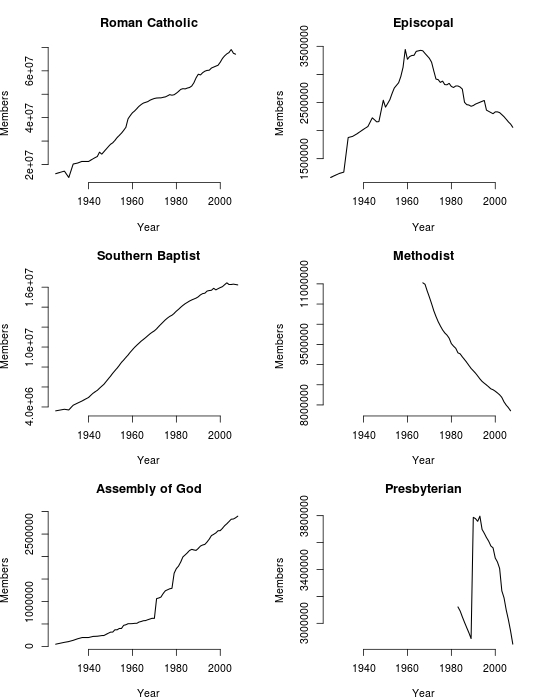
Case in point, if "accommodating the culture" explains why Episcopal numbers declined from the '70s onward, why did "accommodating the culture" apparently have no negative consequences from the gilded age to '66?

Or, if "holding true to orthodoxy" and "maintaining traditional, conservative faith" explains Southern Baptist success from the mid '30s to 2000, what happened then?

Another way to think about this is that explanations all have implications, and if you query some of those implications, making them more explicit, you can get a better sense of whether or not the argument is something more than an ad hoc guess.

So, for example, William M. Briggs, the Cornell University statistician who put the above graphs together follows Douthat's commentary on "liberal Christianity," which is changing and changing and dying for that reason. Worked into a rule, the thesis proposes: when a religion becomes indistinguishable from the surrounding culture, in an environment where religions compete for adherents, said religion will lose adherents.

It's actually a really interesting thesis. What "the surrounding culture" consists of needs clarification, of course, and it would be helpful if the corollary thesis were also considered, that when religious stand out from or oppose the surrounding culture, in an environment where religions compete for adherents, said religions will gain adherents. I can think of a number of religions that seem more oppositional to American culture than, say, Southern Baptists, which have not done so well in gaining adherents. Especially in places where the "surrounding culture" actually is most accurately described as "Southern Baptists."

The point being, if this explanation is going to account for why there are so many Southern Baptists in the American South, it is also going to need to explain why Hare Krishna and Zoroastrianism are not so popular in that same region.

If the explanation can't explain anything except the one particular point, it's not a particularly good explanation. It's likely just hackery, an ad hoc, not-really-serious argument that supports a pre-conclusion, i.e., that one side is right, "winning" because they should be winning, etc., etc.

2. There are internal changes and external changes. Changes in thought and ideas and changes in conditions and contexts. Remember to also consider the later. Many interpretations of graphs like the above emphasize or focus on only changes (or purported changes) in theology. But that's not all that's going on.

While many have, e.g., said things like Briggs says about the above graphs, that,
"those denominations which are roughly 'conservative' are strengthening, while those which are roughly 'liberal' or 'progressive' are weakening. And it doesn’t take a keen eye to see when the trouble started. With your finger, draw a vertical line at 1960 or so on each of these plots, and then allow yourself a slight 'Ah,'"
that only takes changes of ideas into consideration. What other external factors changed in the mid '60s?  It's true that the 1960s saw a leftward lean for many churches, but it was also a time when America's immigration policies changed, which meant that the racial make-up of the country changed. One could plausibly "draw a vertical line at 1960 or so on each of these plots" and then think about the 1965 Immigration and Nationality Act and how that has dramatically reshaped the demographics of the US. In the cases of Catholicism and Pentecostalism, here represented by the Assemblies of God, it's quite possible to argue that growth has everything to do with that immigrant influx. Methodists and Episcopalians, on the other hand, are nearly 90 percent white.

I don't know why it's so hard to imagine that culture is not just mental and psychological, but also material, but it is. Changes that happen -- in religion or anything -- are often better explained by charting changes in context and conditions than by accounts of how people have suddenly transformed.

3. Correlation and causation are not the same thing.

Anyone who interprets contemporary religious numbers should have to have this tattooed on the insides of their eyelids.
Read More
Posted in American religion, Episcopal Church, Religion and the marketplace, religious data, religious journalism, secularization, statistics | No comments

Tuesday, 17 July 2012

The fictitious history of the Episcopal Church

Posted on 11:56 by Unknown
Conservative critiques of the Episcopal Church seem to have come up with a fictitious history of the church. It makes sense -- or enough sense -- on the level of critique, except that it's also always historical, and it's about how Episcopalians used to be but now have changed. And on that level it's very strange nonsense.

Ross Douthat, doing this:
Today, by contrast, the leaders of the Episcopal Church and similar bodies often don’t seem to be offering anything you can’t already get from a purely secular liberalism.
Russel Mead says the church's extreme irrelevance comes from the fact that it followed "the theological path of least resistance as it makes the transition from a church that once spoke to a nation to a sect in communion only with itself."

Philip Jenkins makes the same argument, essentially correlating the decline in church attendance to a change in the Episcopal Church's relationship to American culture. The church began, the implication goes, to just accommodate culture at some point, and then there wasn't any real difference between being in church or not, so what was the point? Thus the decline. Jenkins says what especially worries him, as an Episcopalian, is that the church leaders won't reverse this trend, but instead will be more accommodationist, adapting even more to "secular" "liberal" culture, instead of staking out an oppositional position that would legitimize the church's continued existence.

Except the Episcopal Church's "golden age" was actually more like the "gilded age."

The church's high-water mark came when it was most staunchly on the side of the status quo. Not when it was prophetically standing against the culture, but when it was, in large part, a club for powerful people and an endorser of proper opinion

The Episcopal Church was at it's height in 1966. According to the Historical Statistics of the United States, which is put out by the US Chamber of Commerce, in 1966 the Episcopal Church had 3.6 million members in the US. More than ever before; more than ever since.

The church's reputation at that moment was as the church of the J.P. Morgans and Vanderbilts and Roosevelts and Astors, who dominated America and the Episcopal Church from the 1900s to the 1920s, and made the Episcopal Church into a quasi-national church. In the '50s, according to one report, about three-quarters of New York Times wedding announcements were for weddings in Episcopal churches. It was the church of Wall Street. Church as country club. The "Republican Party at Prayer." One prominent member in the late '60s was Gerald Ford, then the House minority leader. Another was George H.W. Bush, then a congressman from Texas. John Lindsay, the leading liberal Republican from New York, was Episcopalian. As was William Randolph Hearst, as was William Davis Taylor, then the publisher of the Boston Globe, and as were one third of the Supreme Court, Thurgood Marshall, Potter Stewart and Byron White. When Dwight D. Eisenhower died in '69, he laid it repose at the Washington National Cathedral.

This was not a counter cultural church. This was not a church offering an alternative to the dominant status quo.

And yet it was really, really popular. So if something changed between the height of the 1960s and the bottom dropping out of attendance today, it wasn't that Episcopalians suddenly started "accommodating" to popular opinion and polite society.

In fact, the decline that conservative critiques are pointing to began about a decade before the changes they'll specifically point to as causes. The Episcopal Church began to make the changes that upset conservatives in the mid 1970s: changing the prayer book in '76, declaring homosexuals to be "children of God" deserving of equal rights in '76, ordaining women in '77, ordaining an open homosexual in '77, and so on.

By that time, though, the church was already in decline, having lost about 800,000 members between '66 and '75.

It's perfectly legitimate to critique the changes in theology in the Episcopal Church over the last four decades. It's legitimate, too, to point out how the power, prestige and numbers of the church have more or less evaporated in recent years. Successfully correlating the two things, though, and claiming, even, that there's a causal relationship between the two things, is going to take more work.

But imagining a fictitious history where the Episcopal Church stood against the trends of its day, taking stands for orthodoxy and the Bible against the elite of the era is just nonsense. The Episcopal Church never occupied the culture space of, say, today's Jehovah's Witnesses. There are definitely some things that have changed with this church and with American culture since the 1960s, but this story about this sudden cultural accommodation to fashionable liberalism is fantasy.
Read More
Posted in American religion, Episcopal Church, liberal, politics, religious data, religious journalism, secularization | No comments

Tuesday, 10 July 2012

Andrew Sullivan's anti-Mormon biogtry, ctd

Posted on 01:12 by Unknown
Andrew Sullivan has -- kind of amazingly -- now discovered that Mormon theology of America is -- OH MY GOD! -- complicated.

A Sunday afternoon post, citing an actual news piece with actual scholars actually quoted: "it turns out Mormon patriotism has a more complex past than you might think."

Unless, of course, "you" thought about it.

Or, like, googled.

These scholars quoted in the piece, Kathleen Flake and Quin Monson, aren't exactly difficult to find. They're not hiding from the press. Flake has been on PBS. Monson on NPR. Both have been quoted in the Washington Post.

A few minutes of due diligence would have answered some of Sullivan's questions about the policy implications of Mormon beliefs about America's part in the divine plan, if those questions hadn't been just rhetorical cloaks for anti-Mormonism.

Besides, even the most rudimentary knowledge of Mormon history -- e.g., what happened to Joseph Smith, and why the Mormons ended up in Utah anyway -- would, if reflected on a little, show that Mormon patriotism is of course tempered by critiques of America.

This is how it is with "refined" and "classy" bigotry. The "scrim of rhetorical finesse" covers up sloppy, sloppy thinking, and stupid, stupid research.

And just as a general point, a good rule of thumb: theology is always complicated.
Read More
Posted in American religion, Andrew Sullivan, Anti-Mormonism, Mitt Romney, religious journalism, thinking | No comments
Older Posts Home
Subscribe to: Posts (Atom)

Popular Posts

  • The Derrida point
    "I was wondering myself where I am going. So I would answer you by saying, first, that I am trying, precisely, to put myself at a point...
  • How New Atheists are like Victorian-era bishops
    The secularization thesis -- the most traditional version, rather crude, which predicted religion would disappear from the modern world -- i...
  • On exorcism
  • Happy birthday Billy Graham
    Billy Graham turns 94 today. One of the odder moments of Graham's very public career -- though there are many, and many more than one ...
  • The courts' disagreement over corporations having religion
    Can corporations practice religion? The courts disagree. In two different federal courts, in two different cases where for-profit companies ...
  • The religious shape of capitalism
    A new study published in Management Science is making a very Max Weber-like claim about the essential differences of religions affecting eng...
  • 'Christianity is not a religion'
    Watch the latest video at video.foxnews.com I don't know whether it's really possible to have a meaningful, reasonable debate about ...
  • Teaching: History of American Atheism
    I'm in the process of preparing a class on the history of American Atheism, which, as far as I can tell, is more or less uncharted terri...
  • Reza Aslan's outrage
    Among scholars of religion, there's no consensus on the relevance of scholar's personal religious beliefs and practices to their sch...
  • Snake handlers embrace media attention
    The National Geographic channel is planning a show on two Tennessee men and their communities struggling to keep the snake-handling faith. T...

Categories

  • "sacred steel" (1)
  • #PrayforBoston (1)
  • 1848 (1)
  • 1916 (1)
  • 2012 (4)
  • 2013 (1)
  • 4th of July (1)
  • 9/11 (1)
  • A Christian Manifesto (1)
  • AAR (1)
  • Aaron Schock (1)
  • abolitionists (1)
  • abortion (6)
  • Abraham Kuyper (2)
  • Abraham Lincoln (1)
  • abuse (4)
  • academia (22)
  • academica (1)
  • Acton Institute (1)
  • aesthetics (2)
  • African-American religion (3)
  • Al Mohler (1)
  • Albert J. Raboteau (1)
  • Alex Grenier (1)
  • aliens (1)
  • Alton Lemon (1)
  • Amazon (1)
  • ambition (1)
  • ambivalence (1)
  • America (21)
  • America’s Blessings: How Religion Benefits Everyone (1)
  • American (1)
  • American religion (128)
  • American Revolution (1)
  • Amish (1)
  • anabaptists (1)
  • Andrew Hamblin (1)
  • Andrew Sullivan (1)
  • Angela Zimmann (1)
  • animation (1)
  • Ann Taves (1)
  • Anti-Catholicism (1)
  • Anti-Mormonism (1)
  • apocalyptic (3)
  • apocalypticsm (2)
  • apologetics (1)
  • Appalachian (1)
  • Archdiocese of Philadelphia (1)
  • arguments (5)
  • Arizona Republic (1)
  • ark (1)
  • art (12)
  • Art Gish (1)
  • Art Young (1)
  • astrophysics (1)
  • asylum (4)
  • Aten Reign (1)
  • atheism (28)
  • audience (1)
  • authors (1)
  • Baby Doe (1)
  • bad faith (2)
  • baptism (1)
  • Baptists (2)
  • Baron d'Holbach (1)
  • Barry Hankins (1)
  • bars (1)
  • baseball (1)
  • bear market in God (2)
  • beer (1)
  • belief (13)
  • Ben-Hur (1)
  • Benedict XVI (4)
  • bible (4)
  • Big Mountain Jesus (1)
  • big Other (1)
  • Bill O'Reilly (1)
  • Billy Graham (4)
  • Billy Sunday (1)
  • birds (1)
  • birth control (10)
  • bishops (1)
  • Black Mountain Poets (1)
  • blasphemy (2)
  • blues (1)
  • Bob Dylan (2)
  • Bob Grenier (1)
  • book (4)
  • book culture (6)
  • book review (1)
  • bookshelf (1)
  • bookstore (3)
  • Boston (2)
  • Boz Tchividjian (1)
  • Brennan Manning (2)
  • Brethern (1)
  • Broderick Rice (1)
  • buddhism (1)
  • Bulldogs (1)
  • Calvary Chapel (2)
  • calvinism (12)
  • Canada (1)
  • capitalism (9)
  • cardinals (1)
  • Cardus (1)
  • Carl F. H. Henry (1)
  • Catholic hierarchy (1)
  • Catholicism (19)
  • Chance The Rapper (1)
  • charity (2)
  • Charlemagne (1)
  • Charles Chaput (1)
  • Charles Darwin (1)
  • Charles Fox Parham (1)
  • Charles Olson (2)
  • Charles Taylor (3)
  • Chicago (2)
  • child molestation (1)
  • children (2)
  • Children's literature (1)
  • Chris Rock (1)
  • Chris Stedman (1)
  • Chris Sullivan (1)
  • christian fiction (14)
  • Christian Hedonism (1)
  • Christian music (5)
  • Christian publishing (7)
  • Christian Reconstructionism (2)
  • Christianity (15)
  • Christianity Today (1)
  • Christmas (7)
  • Chuck Colson (2)
  • Chuck Smith (1)
  • church (7)
  • church suppers (1)
  • churches (6)
  • churches in bars (1)
  • citations (1)
  • civil religion (7)
  • Civil War (4)
  • Clarence Darrow (1)
  • clergy (2)
  • Cloud Ten (2)
  • cognitive minorities (1)
  • Col. Sanders (1)
  • comedians (1)
  • comedy (1)
  • commodification (1)
  • Conestoga Wood Specialties vs. Sebelius (1)
  • congress (1)
  • Constantin Volney (1)
  • Consuming Spirits (1)
  • conversation (3)
  • conversion (4)
  • Cotton Mather (1)
  • Courageous (1)
  • cover-up (2)
  • creationism (2)
  • creativity (1)
  • creeds and confessions (1)
  • crime fiction (2)
  • crime writing (1)
  • criticism (5)
  • crucifixion (2)
  • cubicle (1)
  • culpability (1)
  • cultural relevance (3)
  • cultural studies (10)
  • culture war (8)
  • D.G. Hart (1)
  • D.T. Max (3)
  • Dale McGowan (1)
  • Dan Fincke (1)
  • Daniel Dennett (2)
  • Darwin (1)
  • David Foster Wallace (3)
  • David Lipsky (1)
  • David Silverman (3)
  • David Tamayo (1)
  • de (1)
  • death (5)
  • Declaration of Independence (1)
  • definition of religion (3)
  • demons (6)
  • denominations (2)
  • depression (1)
  • Derrida (2)
  • Descartes (1)
  • Detroit (1)
  • digital humanities (1)
  • discourse analysis (1)
  • documentary (3)
  • dominionism (1)
  • Doomsday Preppers (1)
  • Dorothy Day (1)
  • doubt (2)
  • Dutch Calvinist (3)
  • e-books (2)
  • e-readers (1)
  • Eastern Orthodox (3)
  • economics (6)
  • ecstatic prayer (4)
  • Ed Gass-Donnelly (1)
  • Edith Schaeffer (1)
  • election (4)
  • Elmbrook v. Doe (1)
  • end times (4)
  • Episcopal Church (3)
  • epistemology (1)
  • Erasmus (1)
  • Eric Hobsbawm (1)
  • Errorl Morris (1)
  • ethics (5)
  • ethics of writing (1)
  • evangelicalism (38)
  • Every Love Story is a Ghost Story (2)
  • evil (2)
  • evolution (5)
  • exorcism (1)
  • experimental fiction (2)
  • faith (4)
  • Family Life Faith and Freedom v. Lynda Serrano (1)
  • Family Research Council (1)
  • fasnet (1)
  • Faulkner (1)
  • Fenway (1)
  • fiction (6)
  • film (8)
  • financial crisis (1)
  • fireworks (1)
  • First Amendment (26)
  • First Things (4)
  • folk art (1)
  • forgiveness (1)
  • fortune telling (1)
  • FOX news (1)
  • France (1)
  • Francis Schaeffer (4)
  • Frank Peretti (1)
  • Freedom From Religion Foundation (1)
  • freedom of religion (14)
  • French Revolution (1)
  • Front Porch Republic (1)
  • Fundamentalist-Modernist (4)
  • funerals (2)
  • gender (1)
  • George Beverly Shea (1)
  • George McGovern (1)
  • German (1)
  • German Reformed Church (1)
  • Germany (9)
  • giving (2)
  • Good Friday (1)
  • gospel (4)
  • gothic (1)
  • government (1)
  • grace (1)
  • Grammys (1)
  • Gravity (1)
  • Greece v. Galloway (1)
  • Greg Abbott (1)
  • Greg Brown (1)
  • Gruppe 91 (1)
  • Habermas (2)
  • Hagee (1)
  • Halakha (1)
  • Halloween (1)
  • Harry Crews (1)
  • HCA (4)
  • health care (3)
  • Heidelberg (2)
  • Heidelberg Catechism (1)
  • hell (3)
  • Henry Luce (1)
  • Herbert Rösler (1)
  • Herman Miller (1)
  • hermeneutics (1)
  • Hinduism (1)
  • Hispanic (1)
  • history (24)
  • Hitchcock (1)
  • Hobby Lobby Inc. vs. Sebelius (7)
  • Hobby Lobby Inc. vs. Sebillius (1)
  • holiness (1)
  • Hollingsworth v. Perry (1)
  • holy roller (1)
  • homemaking (1)
  • homeschooling (4)
  • homosexuality (2)
  • horseshoe (1)
  • Hosanna-Tabor (2)
  • hospitality (1)
  • Houndmouth (1)
  • houses of worship (2)
  • How's that working out for you -- being clever? (1)
  • Howard Phillips (1)
  • HR 1627 (1)
  • HSLDA (4)
  • humanism (2)
  • Hume (1)
  • icon (1)
  • icons (3)
  • ideology (1)
  • immigration (4)
  • In God We Trust (1)
  • In the Year of Dreaming Dangerously (1)
  • incarnation (1)
  • Including Atheists (1)
  • infanticide (1)
  • Intelligent Design (3)
  • Ira Glass (1)
  • Iraq (1)
  • Islam (3)
  • J. Gresham Machen (1)
  • Jack Chick (1)
  • James D. Bratt (1)
  • James Turner (2)
  • James Turrell (1)
  • James W.C. Pennington (1)
  • Jamie Coots (1)
  • Jason Molina (1)
  • Jehovah's Witnesses (1)
  • Jerry Jenkins (2)
  • Jesus (3)
  • Jesus People (1)
  • Jim Bakker (1)
  • Jodi Arias (1)
  • Joe Biden (1)
  • Joel Barlow (1)
  • Joel Osteen (1)
  • John Bunyan (1)
  • John Jay Institute (1)
  • John Piper (1)
  • John Reist (1)
  • John Roberts (2)
  • John Weiners (1)
  • John Wesley (1)
  • John XXIII (1)
  • Jonathan Cahn (1)
  • Jonathan Edwards (3)
  • Jonathan Smith (1)
  • Joseph M. Bauman (1)
  • journalism (4)
  • Juan Mendez (1)
  • Judaism (1)
  • Judge Carol E. Jackson (1)
  • Judge Sarah Evans Barker (1)
  • Justin Taylor (2)
  • Justin Townes Earle (1)
  • Kathryn Jean Lopez (1)
  • Kathryn Lofton (1)
  • Kenneth D. Royal (1)
  • kerfuffle (1)
  • language theory (1)
  • Lauren Green (1)
  • law (12)
  • Lawrence Krauss (3)
  • Lecrae (2)
  • Lee Braver (1)
  • Left Behind (2)
  • Lemon Test (1)
  • let's be serious (1)
  • Lew Wallace (1)
  • liberal (5)
  • liberalism (1)
  • life in Germany (2)
  • Linda Rios Brooks (1)
  • links (1)
  • literary studies (2)
  • living in Germany (15)
  • Local Religious Beliefs and Mutual Fund Risk-Taking Behaviors (1)
  • logic (1)
  • Logical Positivism (1)
  • luck (1)
  • M.S. Simkin (1)
  • maps (1)
  • Marc Ouellet (1)
  • marijuana (1)
  • Mark Driscoll (1)
  • Mark Hatfield (1)
  • marriage (2)
  • married life (1)
  • Martin Luther King Jr. (1)
  • Marx (4)
  • Marxism (3)
  • material conditions (3)
  • Matthew S. Hedstrom (1)
  • Matthew Sutton (1)
  • Max Weber (1)
  • Mayan calendar (1)
  • megachurch (3)
  • Megan Phelps-Roper (1)
  • Mennonites (1)
  • metafiction (2)
  • metaphysics (3)
  • Methodists (1)
  • Metropolitan Jonah (2)
  • Michael Farris (4)
  • Michael W. Cuneo (1)
  • Michele Bachmann (1)
  • Michio Kaku (1)
  • Mike Huckabee (2)
  • minimalism (1)
  • misreading (1)
  • Mitt Romney (6)
  • modern conservatism (13)
  • monasticism (1)
  • Mormonism (2)
  • mural (1)
  • music (1)
  • my life (28)
  • names (1)
  • narratives (5)
  • Nate Silver (1)
  • Nathan Hitchen (1)
  • Natural Law (1)
  • natural theology (1)
  • Nazis (3)
  • Neil Carter (1)
  • Neil DeGrasse Tyson (1)
  • Neo-Calvinism (1)
  • networks (1)
  • New Atheists (4)
  • New New Atheists (1)
  • new religious movements (1)
  • ngrams (1)
  • Nibiru (1)
  • Nicolas Cage (1)
  • Nikolaevsk (1)
  • Nils Frahm (1)
  • Noah (1)
  • non-denominational (1)
  • non-profit (1)
  • nones (11)
  • not fiction (18)
  • notes on reading (4)
  • novel (2)
  • Obama (13)
  • obit (8)
  • obits (1)
  • OCA (2)
  • Old Believers (1)
  • Old North Church (1)
  • ontology (1)
  • P.T. Anderson (1)
  • pacifism (1)
  • patriots (1)
  • Paul Ryan (1)
  • peace activists (1)
  • Peggy Gish (1)
  • pentecostal (14)
  • pet funerals (1)
  • Peter Lalonde (1)
  • Peter Stormare (1)
  • phenomenology (1)
  • philosophy (11)
  • photographs (41)
  • photography (1)
  • Pilgrim's Progress (1)
  • platform (1)
  • pluralism (4)
  • poetry (4)
  • political debate (11)
  • politics (37)
  • politics of distraction (3)
  • poll (1)
  • Pope (6)
  • poverty (1)
  • practice (2)
  • prayer (8)
  • preaching (3)
  • priests (1)
  • printing (2)
  • pro-life movement (1)
  • processing (1)
  • proselytization (1)
  • Protestantism (3)
  • Psalm (1)
  • public service announcement (1)
  • public square (4)
  • publishing (3)
  • pulpit freedom (1)
  • Puritans (4)
  • Quakers (1)
  • quote (2)
  • quotes (1)
  • race (2)
  • racing (1)
  • Ragamuffin Gospel (2)
  • Ralph Reed (1)
  • rap (3)
  • Raymond Burke (1)
  • Reformed theology (3)
  • religion (11)
  • religion and politics (20)
  • religion and science (8)
  • Religion and the marketplace (27)
  • Religion for Atheists (1)
  • Religions in America survey (1)
  • religious data (19)
  • religious experience (1)
  • religious journalism (12)
  • religious marketplace (5)
  • religious practice (27)
  • religious right (6)
  • Religious Studies Project (1)
  • repost (1)
  • Republican Party (2)
  • Rev. Peyton's Big Damn Band (1)
  • revolutions (1)
  • Reza Aslan (1)
  • Rich Mullins (1)
  • Richard Buel Jr. (1)
  • Richard Dawkins (2)
  • Rick Warren (1)
  • rites (2)
  • ritual (4)
  • Rob Bell (2)
  • Robert Bellah (3)
  • Robert D. Putnam (1)
  • Robert Ingersoll (4)
  • Robert Randolph (1)
  • Rodney Stark (2)
  • Roe vs. Wade (2)
  • Romeike (4)
  • Ron Hansen (1)
  • Rosa Parks (1)
  • Ryan Hunter (1)
  • Saddleback (1)
  • saints (3)
  • Salmon Chase (1)
  • same-sex marriage (2)
  • Sandy Hook Elementary (1)
  • satanic panic (1)
  • scandal (4)
  • scholarship (3)
  • scientisim (2)
  • Scientology (1)
  • Scopes trial (2)
  • Searching for the Wrong-Eyed Jesus (1)
  • secularism (19)
  • secularity (15)
  • secularization (8)
  • self-publishing (1)
  • separatism (1)
  • Shane Claiborne (1)
  • sharia (1)
  • sketch (1)
  • Skewby (1)
  • slavery (1)
  • Slovoj Zizek (3)
  • Small Town Murder Songs (1)
  • snake handling (2)
  • Social Gospel (1)
  • social imaginaries (1)
  • social justice (1)
  • socialism (1)
  • sociology (1)
  • solidarity with the oppressed (1)
  • Sovereign Grace Ministries (3)
  • Spirit of Capitalism (1)
  • spirit phography (1)
  • spiritual warfare (2)
  • spirituality (2)
  • sports (1)
  • St. Francis (1)
  • statistics (6)
  • Stephen C. Meyer (1)
  • Stephen King (1)
  • student life (1)
  • Suess (1)
  • supernatural (1)
  • Supreme Court (5)
  • Susan Jacoby (2)
  • suspension of disbelief (4)
  • T.D. Jakes (1)
  • taxes (2)
  • teaching (8)
  • Ted Cruz (2)
  • televangelists (3)
  • Ten Commandments (1)
  • Terry Gross (1)
  • testimony (1)
  • Texas (1)
  • Thanksgiving (1)
  • The Birds (1)
  • The Color of Christ (1)
  • The Columbiad (1)
  • The Conjuring (1)
  • The Exorcist (1)
  • The Harbinger (1)
  • The Pale King (1)
  • the secular (5)
  • the South (2)
  • the work we do (3)
  • theodicy (1)
  • theology (3)
  • theory (1)
  • thinking (16)
  • This American Life (2)
  • Thomas Kincade (1)
  • Thomas Nagel (1)
  • Tim LaHaye (1)
  • Timothy Dolan (2)
  • Tony Perkins (1)
  • Tosca Lee (2)
  • tracts (1)
  • transatlantic (1)
  • travel (1)
  • Travis Alexander (1)
  • Treaty of Tripoli (1)
  • Tübingen (3)
  • Tulsi Gabbard (1)
  • TV (3)
  • Tyndale House (1)
  • Tyndale House vs. Sebelius (2)
  • UFOs (1)
  • UK (1)
  • unbelief (3)
  • Unitarians (1)
  • United Church of Christ (2)
  • United States v. Windsor (1)
  • USA Today (1)
  • utopia (1)
  • V.P. Roychowdhury (1)
  • Valerie Weaver-Zercher (1)
  • Van Orden v. Perry (1)
  • Vatican II (1)
  • violence (3)
  • Virgin of Guadalupe (1)
  • voting guides (1)
  • Walter Owens (1)
  • war (2)
  • weekend music (7)
  • welfare (1)
  • Westboro Baptist (1)
  • why philosophy? (4)
  • William F. Buckley (1)
  • William J. Lynn (1)
  • William James (1)
  • William Jennings Bryan (1)
  • Willow Creek (1)
  • women (1)
  • worldview (1)
  • worship (4)
  • WPA (1)
  • writing (4)
  • Zealot (1)
  • Zurich (1)

Blog Archive

  • ▼  2013 (147)
    • ▼  August (5)
      • Snake handlers embrace media attention
      • Robert Bellah and the 'religious turn'
      • Religious art's religious (?) evocations
      • No title
      • Robert Bellah, 1927 - 2013
    • ►  July (21)
    • ►  June (15)
    • ►  May (21)
    • ►  April (18)
    • ►  March (23)
    • ►  February (20)
    • ►  January (24)
  • ►  2012 (153)
    • ►  December (33)
    • ►  November (17)
    • ►  October (21)
    • ►  September (29)
    • ►  August (29)
    • ►  July (22)
    • ►  June (2)
Powered by Blogger.

About Me

Unknown
View my complete profile