RezaAslansoutrage

  • Subscribe to our RSS feed.
  • Twitter
  • StumbleUpon
  • Reddit
  • Facebook
  • Digg
Showing posts with label teaching. Show all posts

Sunday, 2 June 2013

Wanted: a history of America's irreligious

Posted on 06:28 by Unknown
Lincoln Mullen, who's writing a doctoral dissertation at Brandeis on "The Varieties of Religious Conversion," has an excellent post on Religion in American History on the possibility of a history of the not-religious, the irreligious. As Mullen notes, this is ground I'm exploring with the class I'm teaching on the history of American Atheism. This is a case, though, where the harvest is plentiful, the workers a pitiful few.

Mullen suggests attention should especially be paid to the non-eliete irreligious, if possible. He writes:
Irreligion was far more widespread than just among elites. If we trust work on the historical demography of American religion ... then there is reason to think that American religious history has neglected a lot of people. Simply put, if religion and specifically groups like Methodists, Baptists, and Catholics were growing constantly, and not just from immigration, then they had to grow from somewhere. Who were these secularists or 'nones'? The nineteenth century has bequeathed us competing explanations. The secularist explanation was that the more education one possessed, the further back one had pushed the superstitions of religion. Perhaps -- but only post-Darwin, and then only for elites. Much more persuasive is the shared assumption of Protestants, Catholics, and Jews that ignorance produced irreligion. Many of the vast nineteenth-century evangelistic enterprises, such as the Sunday school (Jewish as well as Christian), the Confraternity of Christian Doctrine, the evangelical tract and textbook, and for that matter the public schools, were fundamentally educational. To hear Peter Cartwright tell it, he was constantly encountering (and wrasslin’ with) “rowdies” and skeptics. When colporteurs of the American Tract Society sold Bibles in the Pine Barrens of New Jersey in the 1840s, they found many people who, they claimed, “had never heard of Jesus Christ.” What would a religious history of those people look like?
The post also offers and excellent overview of the historical works currently available on American atheist, agnostic, freethinking, humanist, and ethical culture movements, and highlights a few things that are in the works.
Read More
Posted in academia, American religion, atheism, history, secularism, secularity, teaching | No comments

Monday, 22 April 2013

Teaching the history of American atheism

Posted on 04:15 by Unknown
There are more than a few resources available to those who would teach on atheism, so long as they conceive of atheism in philosophical terms. There are anthologies, and college course syllabi available online, and a more-or-less established sense of what would be included in such a course.

For those interested in teaching on the history of atheism, this isn't the case.

Personally, I became interested in atheism as a historical phenomena when thinking about how to explain the relationship between the New Atheists and the cultural changes at the turn of the century -- the terrorist attacks of 2001, the election of George W. Bush, and the rise of blogging in particular. While the arguments being advanced by New Atheists were, from the most part, not directly speaking to their political and cultural context, those things seemed relevant nonetheless. They're relevant not necessarily in terms of evaluating the arguments being made, but in terms of understanding why the arguments were what they were, and why they were being made in the ways they were. It seemed, further, that in the atheism debates that sprang up in the first part of the 21st century, atheism was consistently being treated as one thing, a timeless and unchanging philosophy. But when one looks at actually existing atheism, there are always multiple movements and counter-movements and many contested claims about coextensive commitments that come along with atheism.

Atheism, that is to say, is always, in history, atheisms. In the plural, they are, I find, more complex, more fraught, and more alive than they're generally made to seem in popular, public conversations.

Thinking about atheism ahistorically means leaving out a lot of interesting and arguably important aspects of the atheisms that people hold to and live their lives with.

Approaching the subject as history, on the other hand, allows one to focus on at least two important issues. One, what cultural conditions contributed to and determined the shape and tenor of various atheist movements, and two, what effect those movements had and have on the culture. Approaching atheism historically can mean (for example) allowing for the space necessary to think about how different political environments and philosophies were hospitable to different movements of atheists at different times -- why, for example, Republicans in the Gilded Age gladly counted Robert Ingersoll as one of their own, while in the first decades of the 20th century atheists were associated and affiliated with the more radical strains of the politics of the left.

As far as I can tell, the only readily available historical works on atheism tend towards hagiography, or are designed to be dismissive, so that "history" means either "model for moral instruction" or "refutation." Such approaches aren't great, academically. While they may be useful for arguing for atheism or against atheism, they're not helpful in teaching about atheism, which is what I want to do.

I am trying to teach the history of American atheism(s) this semester. I've had to create my own canon, to do that, with a bit of very helpful advice. With the thought that there may be others interested in teaching such a course, or anyway, general interest in approaching atheism as aspect of American history, I offer my course schedule reading list here, along with some explanatory notes.

In selecting the assigned readings, I kept two principals in mind: One, representitiveness; Two, accessibility.

It quickly became evident that it would not be possible to be comprehensive, given limitations of a semester. But I wanted readings that would adequately represent the various movements of atheism in American history, give students a vairly complete overview, and I wanted to have selections that would sufficiently present the particular thinkers and their arguments. Also I wanted readings that would not give my students -- mostly in their first years of university, coming from a wide variety of educational backgrounds, from a number of different disciplines -- too much trouble. Plus I had to be able to get ahold of the given readings and make them available to the students. With those limitations and goals, here's what I came up with:

15 April
Introduction; syllabus; definitions; review of classic arguments for the existence of God

22 April
Thomas Paine (1737-1809)
Selections from Age of Reason
Joel Barlow (1754-1812)
Selections from Joel Barlow: American Citizen in a Revolutionary World, by Richard Buel, Jr.

29 April
Robert Ingersoll (1833-1899)
"Centennial Oration"; "Why I am an Agnostic"; selections from The Great Agnostic, by Susan Jacoby
Elizabeth Candy Stanton (1815-1902)
Selections from A Woman's Bible

6 May
Charles Chilton Moore (1837-1906)
Selections from Kentucky's Most Hated Man, by John Sparks
Blue Grass Blade
Selections from Letter from an Atheist Nation, ed. Thomas Lawson

13 May
William Graham Sumner (1840-1910)
"Religion and the Mores"; "That it is Not Wicked to be Rich; Nay, Even That it is Not Wicked to be Richer Than One's Neighbor"; "The Shifting of Responsiblity"; "Sketch of William Graham Sumner," by Albert Galloway Keller; "God and Man at Yale (in 1880)" by George Marsden

20 May
Max Eastman (1883-1969)
"The Religion of Patriotism"
Mike Gold (1894-1967)
"The Jesus-Thinkers"

27 May
H.L. Menken (1880-1956)
Selections from Damn! A Book of Calumny; Scopes trial reporting

3 June: NO CLASS 

10 June 
Humanist Manifestoes (1933; 1973)

17 June
Richard Wright (1908-1960)
Selections from Black Boy
James Baldwin (1924-1987)
Selections from Go Tell it on a Mountain

24 June
Ayn Rand (1905-1982)
Selections from Atlas Shrugged; Playboy Interview 1964

1 July
Madalyn Murray O’Hair (1919-1995)
Playboy Interview 1965, "The Murder of the Madalyn Murray O'Hair: America's Most Hated Woman," by Lona Manning

8 July
William Hamilton (1924-2012)
"The New Essence of Christianity"
Thomas J.J. Altizer (1927- )
"A Wager"

Make-up class:
Richard Feynman (1918-1988)
"The Relation of Science and Religion"; "Cargo Cult Science"
Carl Sagan (1934-1996)
"Pale Blue Dot"; selections from "The Varieties of Scientific Experience"

15 July
Daniel Dennett (1942- )
"The Bright Stuff"; "Atheism and Evolution"; "The Evolution of Misbelief"

22 July
Chris Stedman (1987- )
Selections from Faitheist
Conclusion; wrap-up 

A few thoughts:
1. It would be very easy to double the number of readings. There are lots and lots of people who are not here and could be here, though hopefully the above gives a good overview even though it's not comprehensive.
2. There were a number of people who I ended up leaving out because their work is limited mainly to criticizing instantiations of Chrisitanity, and they don't generally go beyond that. Examples range from 19th century abolitionists to 21st century media figures. I gave preference to works where epistemological and metaphysical claims are made.
3. If this could be expanded, it would be worth looking at those who were not atheists per se but attempted to establish secular alternatives to traditional religions, such as Felix Addler and John Muir. Such movements will be referenced in discussions of readings that are included, but there are limits on time that forced me to make some tough decisions.
4. With a few noted exceptions, fictional works on atheism were not included. While there would ideally be space for Mark Twain, Ambrose Bierce, Robert Heinlein, Isaac Asimov, Kurt Vonnegut, etc., etc., there was a problem of accessibility. In some cases, non fiction versions of the author's arguments are easier to teach. In others, the issue of excerpting a short enough portion of text for a single undergrad class was very problematic. Additionally, teaching fiction is different than teaching argumentative essays, and switching back and forth too much presents a number of challenges.
5. There are only a few secondary texts, here, mostly in the first month of class. The secondary texts I've found tend to be very uneven. The hope, though, is that these texts will demonstrate to the students how one can take a primary text and situate it historically and read it in historical context, which the class will then do with the later texts.
6. Class time will be given to a combination of history lectures and group discussions explicating the assigned readings.

This is obviously a work in progress, but, I hope, a promising one.
Read More
Posted in academia, atheism, cultural studies, HCA, history, my life, New Atheists, teaching | No comments

Monday, 25 February 2013

Posted on 07:05 by Unknown
she said
Read More
Posted in HCA, living in Germany, student life, teaching | No comments

Monday, 21 January 2013

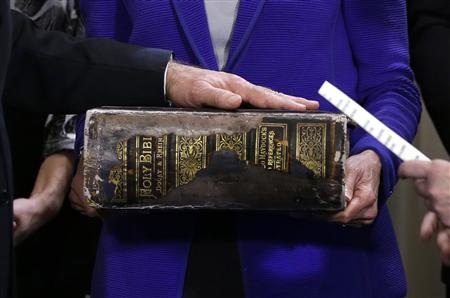
Religion at the inauguration

Posted on 01:48 by Unknown
God is all over inauguration
Obama family goes to church
Sermon uses Obama campaign theme, 'Forward'
Commentary: Obama's inauguration Bibles
Historic Bibles used in ceremonies 
The tradition of inaugural prayer
Presidential oaths, from Washington to Obama
Adding "So help me God" to the Constitution:
... there was a myth that the tradition of adding God to the oath began with George Washington. It didn’t, say experts at the Library of Congress, the U.S. Senate Historical Office and the first president’s home, Mount Vernon. Although the phrase was used in federal courtrooms since 1789, the first proof it was used in a presidential oath of office came with Chester Arthur’s inauguration in September 1881.
Newdow v. Roberts, the 2008 lawsuit over "So help me God"
Court declines to hear case over "So help me God"
Why doesn't every president use the Lincoln Bible? (And what did John Adams swear on instead of a Bible?)
Biden takes the oath:
Biden used his family Bible for today's ceremony, a 5-inch-thick tome featuring a Celtic cross on the cover. It has been in the Biden family since 1893. He used it each time he was sworn in as a senator and when he was sworn in as vice president in 2009. His son Beau used it when he was sworn in as Delaware's attorney general.
The Biden family Bible, in use
Special piece of art Biden had hung for inauguration
Official & unofficial inauguration prayers
Evangelical pastor's 90s sermon stirs controversy after inauguration invitation
Unpacking the Giglio imbroglio
Commentary: Stop politicizing inaugural prayers
Commentary: Pastor's dis-invitation to inauguration is new moral McCarthyism
Commentary: A wry congratulations to the LGBT community
Commentary: I don't care who prays at the inauguration
Discussing the Giglio controversy & its wider implications
Political/religious tensions in prayer invitations
Farewell, Louie Giglio?
Does Giglio controversy mean the end of publican role for evangelicals?
Obama may have disagreed with how Giglio controversy was handled
Benedictions not offered
When was the last time a rabbi prayed at a presidential inauguration?
1,500 to pray for president, government, military, media & business. Also: Great Awakening.
Methodist pastor Adam Hamilton to preach at inauguration
Widow of civil right's icon to deliver invocation
Episcopal priest to close inauguration
Commentary: Obama should invoke Puritan vision of 'City on a Hill'
Commentary: Civil religion holds country to higher moral standard
Inauguration is 'worship of the nation'
Inaugurations & America's 'civil religion':
President Obama’s [2009] inaugural address contains a muted expression of the American civil religion that Robert Bellah first recognized in Kennedy’s speech of 1961. The reference to God as the transcendent source of values, the activist faith, the trust in God’s providence and grace, notions of sacrifice and rebirth, the appeal to sacred events and heroes of the past (recall, too, Obama’s use of Lincoln’s Bible during the swearing-in ceremony), are all enduring aspects of this tradition, and Obama placed special emphasis on the civil republican dimension 
Yet, the God that Obama appeals to feels more remote, less directly involved in history than in earlier inaugural addresses. Remarkable, too, is Obama’s stress on the nation’s shortcomings, his mention of religious traditions beyond the so-called “Judeo-Christian” faiths, his outreach to Muslims and inclusion of non-believers. The latter represents a real and significant innovation ....
Update: 
Myrlie Evers-Williams delivers inaugural invocation 
The text of Obama's inaugural address
Cornel West's critique of Obama's use of Martin Luther King Jr.'s Bible
Pastor Mark Driscoll's critique of Obama's use of the Bible
Richard Blanco's poem, "One Day"
Richard Blanco reading
Kelly Clarkson performs "My Country Tis of Thee"
Rev. Luis Leon delivers benediction
The text of Leon's benediction

Update 2:
Obama swears on two Bibles
Read More
Posted in American religion, civil religion, links, politics, religion and politics, teaching | No comments

Tuesday, 27 November 2012

Teaching: History of American Atheism

Posted on 06:52 by Unknown
I'm in the process of preparing a class on the history of American Atheism, which, as far as I can tell, is more or less uncharted territory. Existing studies and curricula seem to either be philosophical examinations of atheism (e.g.), or much too narrow for my interests (e.g.), or really more hagiographical canonization efforts than I am comfortable with (e.g.). Not to mention the very common whig histories of atheism.

Given the new(ish?) direction of the class I'm designing, it seems some readers might be interested in the shape of the class as it develops. Also, as there's no standard text outlining major figures or movements in American Atheism, I would appreciate readers' help in identifying critical people and/or texts to teach.

Below, I've listed those I have in mind who are important in this history and who I think can be taught fairly well to first and second year students with an interest in religious history and American cultural studies. I've construed "atheist" fairly broadly, to include some agnostics and skeptics (especially if they expand the possibility of disbelief); as well as some who's opposition to specific faith traditions is clear while their own position is more ambiguous; those of the political right as well as the more well-represented left; some who are hostile towards religion and some who attempt to make use of religious rhetoric. I've also tried to work in a fair representation of non-whites, women, and, as far as possible, some from backgrounds other than Protestant.

Are there any significant figures or movements I'm missing?

Anyone who would likely teach particularly well that I haven't thought of?

Course description:

From Cotton Mather’s denunciations to Daniel Dennett’s proposal atheists rebrand themselves as “brights,” atheists have been a much-discussed but little understood feature of the religious landscape of America. This class will take a historical approach to the subject, analytically examining the many varieties of atheism in America. Students will learn about atheisms, plural, in the past and present, and will study their cultural contexts, as well as arguments for and against the existence of God, and vying conceptions of meaning and morality. Students will also be introduced to the methodological issues in the study of the history of religion, gaining a working understanding of the approaches entailed by cultural history.

Tentative syllabus:
1. Thomas Paine
2. Joel Barlow
3. Joseph Weydemeyer
4. Robert Ingersoll
5. Charles Chilton Moore and the Blue Grass Blade
6. Emma Goldman
7. Eugene V. Debs
8. Emanuel and Marcet Haldeman-Julius
9. Richard Wright
10. James Baldwin
11. Ayn Rand
12. Madeline Murray O'Hare
13. Kurt Vonnegut
14. Thomas Altizer
15. Sam Harris
16. David Silverman
17. YouTub videos: "Why I am an Atheist"/"How I became an Atheist."
18. "Preachers who are not believers"
19. Chris Stedman

Update:
Additions suggested via twitter:
Felix Adler
Paul Kutz
Carl Sagan

Update:
Additions suggested via Facebook:
Penn Jilette
Seth MacFarlane
George Carlin
Linus Pauling
Richard Feynman
James Rani
Michael Hardt
H.L. Menken

Update:
Other additions suggested:
Charles Lee Smith
Ambrose Bierce
H.P. Lovecraft
Read More
Posted in academica, American religion, atheism, history, teaching | No comments

Thursday, 1 November 2012

Dr. Reist

Posted on 16:18 by Unknown
Dr. John Reist once drew me a map to his house when I was a student in one of his classes at Hillsdale College. It started with a circle, which he said was God and he said "There is a God and she's black." "Hey whoa," he said. About 10 minutes of map drawing and jokes later, I realized it was actually a straight line from the college to his house. No turns or anything. But still that map, like all the lessons Reist taught, turned out, kinda mysteriously, to be profoundly useful.

Rest in peace, Dr. Reist. Quack to you too, and rest in peace.
Read More
Posted in academia, death, John Reist, obit, teaching | No comments

Tuesday, 16 October 2012

Sitting for spirits

Posted on 00:52 by Unknown
Man with a spirit face appearing


More spirit photography at the National Media Museum, which has made many of these photos available online.
Read More
Posted in American religion, photography, religion and science, spirit phography, spirituality, teaching | No comments

Wednesday, 3 October 2012

A teaching career

Posted on 05:53 by Unknown
 

The professor, as imagined in children's lit: a tumblr.

Read More
Posted in academia, cultural studies, Suess, teaching, the work we do | No comments
Older Posts Home
Subscribe to: Posts (Atom)

Popular Posts

  • The Derrida point
    "I was wondering myself where I am going. So I would answer you by saying, first, that I am trying, precisely, to put myself at a point...
  • How New Atheists are like Victorian-era bishops
    The secularization thesis -- the most traditional version, rather crude, which predicted religion would disappear from the modern world -- i...
  • On exorcism
  • Happy birthday Billy Graham
    Billy Graham turns 94 today. One of the odder moments of Graham's very public career -- though there are many, and many more than one ...
  • The courts' disagreement over corporations having religion
    Can corporations practice religion? The courts disagree. In two different federal courts, in two different cases where for-profit companies ...
  • The religious shape of capitalism
    A new study published in Management Science is making a very Max Weber-like claim about the essential differences of religions affecting eng...
  • 'Christianity is not a religion'
    Watch the latest video at video.foxnews.com I don't know whether it's really possible to have a meaningful, reasonable debate about ...
  • Reza Aslan's outrage
    Among scholars of religion, there's no consensus on the relevance of scholar's personal religious beliefs and practices to their sch...
  • Teaching: History of American Atheism
    I'm in the process of preparing a class on the history of American Atheism, which, as far as I can tell, is more or less uncharted terri...
  • Snake handlers embrace media attention
    The National Geographic channel is planning a show on two Tennessee men and their communities struggling to keep the snake-handling faith. T...

Categories

  • "sacred steel" (1)
  • #PrayforBoston (1)
  • 1848 (1)
  • 1916 (1)
  • 2012 (4)
  • 2013 (1)
  • 4th of July (1)
  • 9/11 (1)
  • A Christian Manifesto (1)
  • AAR (1)
  • Aaron Schock (1)
  • abolitionists (1)
  • abortion (6)
  • Abraham Kuyper (2)
  • Abraham Lincoln (1)
  • abuse (4)
  • academia (22)
  • academica (1)
  • Acton Institute (1)
  • aesthetics (2)
  • African-American religion (3)
  • Al Mohler (1)
  • Albert J. Raboteau (1)
  • Alex Grenier (1)
  • aliens (1)
  • Alton Lemon (1)
  • Amazon (1)
  • ambition (1)
  • ambivalence (1)
  • America (21)
  • America’s Blessings: How Religion Benefits Everyone (1)
  • American (1)
  • American religion (128)
  • American Revolution (1)
  • Amish (1)
  • anabaptists (1)
  • Andrew Hamblin (1)
  • Andrew Sullivan (1)
  • Angela Zimmann (1)
  • animation (1)
  • Ann Taves (1)
  • Anti-Catholicism (1)
  • Anti-Mormonism (1)
  • apocalyptic (3)
  • apocalypticsm (2)
  • apologetics (1)
  • Appalachian (1)
  • Archdiocese of Philadelphia (1)
  • arguments (5)
  • Arizona Republic (1)
  • ark (1)
  • art (12)
  • Art Gish (1)
  • Art Young (1)
  • astrophysics (1)
  • asylum (4)
  • Aten Reign (1)
  • atheism (28)
  • audience (1)
  • authors (1)
  • Baby Doe (1)
  • bad faith (2)
  • baptism (1)
  • Baptists (2)
  • Baron d'Holbach (1)
  • Barry Hankins (1)
  • bars (1)
  • baseball (1)
  • bear market in God (2)
  • beer (1)
  • belief (13)
  • Ben-Hur (1)
  • Benedict XVI (4)
  • bible (4)
  • Big Mountain Jesus (1)
  • big Other (1)
  • Bill O'Reilly (1)
  • Billy Graham (4)
  • Billy Sunday (1)
  • birds (1)
  • birth control (10)
  • bishops (1)
  • Black Mountain Poets (1)
  • blasphemy (2)
  • blues (1)
  • Bob Dylan (2)
  • Bob Grenier (1)
  • book (4)
  • book culture (6)
  • book review (1)
  • bookshelf (1)
  • bookstore (3)
  • Boston (2)
  • Boz Tchividjian (1)
  • Brennan Manning (2)
  • Brethern (1)
  • Broderick Rice (1)
  • buddhism (1)
  • Bulldogs (1)
  • Calvary Chapel (2)
  • calvinism (12)
  • Canada (1)
  • capitalism (9)
  • cardinals (1)
  • Cardus (1)
  • Carl F. H. Henry (1)
  • Catholic hierarchy (1)
  • Catholicism (19)
  • Chance The Rapper (1)
  • charity (2)
  • Charlemagne (1)
  • Charles Chaput (1)
  • Charles Darwin (1)
  • Charles Fox Parham (1)
  • Charles Olson (2)
  • Charles Taylor (3)
  • Chicago (2)
  • child molestation (1)
  • children (2)
  • Children's literature (1)
  • Chris Rock (1)
  • Chris Stedman (1)
  • Chris Sullivan (1)
  • christian fiction (14)
  • Christian Hedonism (1)
  • Christian music (5)
  • Christian publishing (7)
  • Christian Reconstructionism (2)
  • Christianity (15)
  • Christianity Today (1)
  • Christmas (7)
  • Chuck Colson (2)
  • Chuck Smith (1)
  • church (7)
  • church suppers (1)
  • churches (6)
  • churches in bars (1)
  • citations (1)
  • civil religion (7)
  • Civil War (4)
  • Clarence Darrow (1)
  • clergy (2)
  • Cloud Ten (2)
  • cognitive minorities (1)
  • Col. Sanders (1)
  • comedians (1)
  • comedy (1)
  • commodification (1)
  • Conestoga Wood Specialties vs. Sebelius (1)
  • congress (1)
  • Constantin Volney (1)
  • Consuming Spirits (1)
  • conversation (3)
  • conversion (4)
  • Cotton Mather (1)
  • Courageous (1)
  • cover-up (2)
  • creationism (2)
  • creativity (1)
  • creeds and confessions (1)
  • crime fiction (2)
  • crime writing (1)
  • criticism (5)
  • crucifixion (2)
  • cubicle (1)
  • culpability (1)
  • cultural relevance (3)
  • cultural studies (10)
  • culture war (8)
  • D.G. Hart (1)
  • D.T. Max (3)
  • Dale McGowan (1)
  • Dan Fincke (1)
  • Daniel Dennett (2)
  • Darwin (1)
  • David Foster Wallace (3)
  • David Lipsky (1)
  • David Silverman (3)
  • David Tamayo (1)
  • de (1)
  • death (5)
  • Declaration of Independence (1)
  • definition of religion (3)
  • demons (6)
  • denominations (2)
  • depression (1)
  • Derrida (2)
  • Descartes (1)
  • Detroit (1)
  • digital humanities (1)
  • discourse analysis (1)
  • documentary (3)
  • dominionism (1)
  • Doomsday Preppers (1)
  • Dorothy Day (1)
  • doubt (2)
  • Dutch Calvinist (3)
  • e-books (2)
  • e-readers (1)
  • Eastern Orthodox (3)
  • economics (6)
  • ecstatic prayer (4)
  • Ed Gass-Donnelly (1)
  • Edith Schaeffer (1)
  • election (4)
  • Elmbrook v. Doe (1)
  • end times (4)
  • Episcopal Church (3)
  • epistemology (1)
  • Erasmus (1)
  • Eric Hobsbawm (1)
  • Errorl Morris (1)
  • ethics (5)
  • ethics of writing (1)
  • evangelicalism (38)
  • Every Love Story is a Ghost Story (2)
  • evil (2)
  • evolution (5)
  • exorcism (1)
  • experimental fiction (2)
  • faith (4)
  • Family Life Faith and Freedom v. Lynda Serrano (1)
  • Family Research Council (1)
  • fasnet (1)
  • Faulkner (1)
  • Fenway (1)
  • fiction (6)
  • film (8)
  • financial crisis (1)
  • fireworks (1)
  • First Amendment (26)
  • First Things (4)
  • folk art (1)
  • forgiveness (1)
  • fortune telling (1)
  • FOX news (1)
  • France (1)
  • Francis Schaeffer (4)
  • Frank Peretti (1)
  • Freedom From Religion Foundation (1)
  • freedom of religion (14)
  • French Revolution (1)
  • Front Porch Republic (1)
  • Fundamentalist-Modernist (4)
  • funerals (2)
  • gender (1)
  • George Beverly Shea (1)
  • George McGovern (1)
  • German (1)
  • German Reformed Church (1)
  • Germany (9)
  • giving (2)
  • Good Friday (1)
  • gospel (4)
  • gothic (1)
  • government (1)
  • grace (1)
  • Grammys (1)
  • Gravity (1)
  • Greece v. Galloway (1)
  • Greg Abbott (1)
  • Greg Brown (1)
  • Gruppe 91 (1)
  • Habermas (2)
  • Hagee (1)
  • Halakha (1)
  • Halloween (1)
  • Harry Crews (1)
  • HCA (4)
  • health care (3)
  • Heidelberg (2)
  • Heidelberg Catechism (1)
  • hell (3)
  • Henry Luce (1)
  • Herbert Rösler (1)
  • Herman Miller (1)
  • hermeneutics (1)
  • Hinduism (1)
  • Hispanic (1)
  • history (24)
  • Hitchcock (1)
  • Hobby Lobby Inc. vs. Sebelius (7)
  • Hobby Lobby Inc. vs. Sebillius (1)
  • holiness (1)
  • Hollingsworth v. Perry (1)
  • holy roller (1)
  • homemaking (1)
  • homeschooling (4)
  • homosexuality (2)
  • horseshoe (1)
  • Hosanna-Tabor (2)
  • hospitality (1)
  • Houndmouth (1)
  • houses of worship (2)
  • How's that working out for you -- being clever? (1)
  • Howard Phillips (1)
  • HR 1627 (1)
  • HSLDA (4)
  • humanism (2)
  • Hume (1)
  • icon (1)
  • icons (3)
  • ideology (1)
  • immigration (4)
  • In God We Trust (1)
  • In the Year of Dreaming Dangerously (1)
  • incarnation (1)
  • Including Atheists (1)
  • infanticide (1)
  • Intelligent Design (3)
  • Ira Glass (1)
  • Iraq (1)
  • Islam (3)
  • J. Gresham Machen (1)
  • Jack Chick (1)
  • James D. Bratt (1)
  • James Turner (2)
  • James Turrell (1)
  • James W.C. Pennington (1)
  • Jamie Coots (1)
  • Jason Molina (1)
  • Jehovah's Witnesses (1)
  • Jerry Jenkins (2)
  • Jesus (3)
  • Jesus People (1)
  • Jim Bakker (1)
  • Jodi Arias (1)
  • Joe Biden (1)
  • Joel Barlow (1)
  • Joel Osteen (1)
  • John Bunyan (1)
  • John Jay Institute (1)
  • John Piper (1)
  • John Reist (1)
  • John Roberts (2)
  • John Weiners (1)
  • John Wesley (1)
  • John XXIII (1)
  • Jonathan Cahn (1)
  • Jonathan Edwards (3)
  • Jonathan Smith (1)
  • Joseph M. Bauman (1)
  • journalism (4)
  • Juan Mendez (1)
  • Judaism (1)
  • Judge Carol E. Jackson (1)
  • Judge Sarah Evans Barker (1)
  • Justin Taylor (2)
  • Justin Townes Earle (1)
  • Kathryn Jean Lopez (1)
  • Kathryn Lofton (1)
  • Kenneth D. Royal (1)
  • kerfuffle (1)
  • language theory (1)
  • Lauren Green (1)
  • law (12)
  • Lawrence Krauss (3)
  • Lecrae (2)
  • Lee Braver (1)
  • Left Behind (2)
  • Lemon Test (1)
  • let's be serious (1)
  • Lew Wallace (1)
  • liberal (5)
  • liberalism (1)
  • life in Germany (2)
  • Linda Rios Brooks (1)
  • links (1)
  • literary studies (2)
  • living in Germany (15)
  • Local Religious Beliefs and Mutual Fund Risk-Taking Behaviors (1)
  • logic (1)
  • Logical Positivism (1)
  • luck (1)
  • M.S. Simkin (1)
  • maps (1)
  • Marc Ouellet (1)
  • marijuana (1)
  • Mark Driscoll (1)
  • Mark Hatfield (1)
  • marriage (2)
  • married life (1)
  • Martin Luther King Jr. (1)
  • Marx (4)
  • Marxism (3)
  • material conditions (3)
  • Matthew S. Hedstrom (1)
  • Matthew Sutton (1)
  • Max Weber (1)
  • Mayan calendar (1)
  • megachurch (3)
  • Megan Phelps-Roper (1)
  • Mennonites (1)
  • metafiction (2)
  • metaphysics (3)
  • Methodists (1)
  • Metropolitan Jonah (2)
  • Michael Farris (4)
  • Michael W. Cuneo (1)
  • Michele Bachmann (1)
  • Michio Kaku (1)
  • Mike Huckabee (2)
  • minimalism (1)
  • misreading (1)
  • Mitt Romney (6)
  • modern conservatism (13)
  • monasticism (1)
  • Mormonism (2)
  • mural (1)
  • music (1)
  • my life (28)
  • names (1)
  • narratives (5)
  • Nate Silver (1)
  • Nathan Hitchen (1)
  • Natural Law (1)
  • natural theology (1)
  • Nazis (3)
  • Neil Carter (1)
  • Neil DeGrasse Tyson (1)
  • Neo-Calvinism (1)
  • networks (1)
  • New Atheists (4)
  • New New Atheists (1)
  • new religious movements (1)
  • ngrams (1)
  • Nibiru (1)
  • Nicolas Cage (1)
  • Nikolaevsk (1)
  • Nils Frahm (1)
  • Noah (1)
  • non-denominational (1)
  • non-profit (1)
  • nones (11)
  • not fiction (18)
  • notes on reading (4)
  • novel (2)
  • Obama (13)
  • obit (8)
  • obits (1)
  • OCA (2)
  • Old Believers (1)
  • Old North Church (1)
  • ontology (1)
  • P.T. Anderson (1)
  • pacifism (1)
  • patriots (1)
  • Paul Ryan (1)
  • peace activists (1)
  • Peggy Gish (1)
  • pentecostal (14)
  • pet funerals (1)
  • Peter Lalonde (1)
  • Peter Stormare (1)
  • phenomenology (1)
  • philosophy (11)
  • photographs (41)
  • photography (1)
  • Pilgrim's Progress (1)
  • platform (1)
  • pluralism (4)
  • poetry (4)
  • political debate (11)
  • politics (37)
  • politics of distraction (3)
  • poll (1)
  • Pope (6)
  • poverty (1)
  • practice (2)
  • prayer (8)
  • preaching (3)
  • priests (1)
  • printing (2)
  • pro-life movement (1)
  • processing (1)
  • proselytization (1)
  • Protestantism (3)
  • Psalm (1)
  • public service announcement (1)
  • public square (4)
  • publishing (3)
  • pulpit freedom (1)
  • Puritans (4)
  • Quakers (1)
  • quote (2)
  • quotes (1)
  • race (2)
  • racing (1)
  • Ragamuffin Gospel (2)
  • Ralph Reed (1)
  • rap (3)
  • Raymond Burke (1)
  • Reformed theology (3)
  • religion (11)
  • religion and politics (20)
  • religion and science (8)
  • Religion and the marketplace (27)
  • Religion for Atheists (1)
  • Religions in America survey (1)
  • religious data (19)
  • religious experience (1)
  • religious journalism (12)
  • religious marketplace (5)
  • religious practice (27)
  • religious right (6)
  • Religious Studies Project (1)
  • repost (1)
  • Republican Party (2)
  • Rev. Peyton's Big Damn Band (1)
  • revolutions (1)
  • Reza Aslan (1)
  • Rich Mullins (1)
  • Richard Buel Jr. (1)
  • Richard Dawkins (2)
  • Rick Warren (1)
  • rites (2)
  • ritual (4)
  • Rob Bell (2)
  • Robert Bellah (3)
  • Robert D. Putnam (1)
  • Robert Ingersoll (4)
  • Robert Randolph (1)
  • Rodney Stark (2)
  • Roe vs. Wade (2)
  • Romeike (4)
  • Ron Hansen (1)
  • Rosa Parks (1)
  • Ryan Hunter (1)
  • Saddleback (1)
  • saints (3)
  • Salmon Chase (1)
  • same-sex marriage (2)
  • Sandy Hook Elementary (1)
  • satanic panic (1)
  • scandal (4)
  • scholarship (3)
  • scientisim (2)
  • Scientology (1)
  • Scopes trial (2)
  • Searching for the Wrong-Eyed Jesus (1)
  • secularism (19)
  • secularity (15)
  • secularization (8)
  • self-publishing (1)
  • separatism (1)
  • Shane Claiborne (1)
  • sharia (1)
  • sketch (1)
  • Skewby (1)
  • slavery (1)
  • Slovoj Zizek (3)
  • Small Town Murder Songs (1)
  • snake handling (2)
  • Social Gospel (1)
  • social imaginaries (1)
  • social justice (1)
  • socialism (1)
  • sociology (1)
  • solidarity with the oppressed (1)
  • Sovereign Grace Ministries (3)
  • Spirit of Capitalism (1)
  • spirit phography (1)
  • spiritual warfare (2)
  • spirituality (2)
  • sports (1)
  • St. Francis (1)
  • statistics (6)
  • Stephen C. Meyer (1)
  • Stephen King (1)
  • student life (1)
  • Suess (1)
  • supernatural (1)
  • Supreme Court (5)
  • Susan Jacoby (2)
  • suspension of disbelief (4)
  • T.D. Jakes (1)
  • taxes (2)
  • teaching (8)
  • Ted Cruz (2)
  • televangelists (3)
  • Ten Commandments (1)
  • Terry Gross (1)
  • testimony (1)
  • Texas (1)
  • Thanksgiving (1)
  • The Birds (1)
  • The Color of Christ (1)
  • The Columbiad (1)
  • The Conjuring (1)
  • The Exorcist (1)
  • The Harbinger (1)
  • The Pale King (1)
  • the secular (5)
  • the South (2)
  • the work we do (3)
  • theodicy (1)
  • theology (3)
  • theory (1)
  • thinking (16)
  • This American Life (2)
  • Thomas Kincade (1)
  • Thomas Nagel (1)
  • Tim LaHaye (1)
  • Timothy Dolan (2)
  • Tony Perkins (1)
  • Tosca Lee (2)
  • tracts (1)
  • transatlantic (1)
  • travel (1)
  • Travis Alexander (1)
  • Treaty of Tripoli (1)
  • Tübingen (3)
  • Tulsi Gabbard (1)
  • TV (3)
  • Tyndale House (1)
  • Tyndale House vs. Sebelius (2)
  • UFOs (1)
  • UK (1)
  • unbelief (3)
  • Unitarians (1)
  • United Church of Christ (2)
  • United States v. Windsor (1)
  • USA Today (1)
  • utopia (1)
  • V.P. Roychowdhury (1)
  • Valerie Weaver-Zercher (1)
  • Van Orden v. Perry (1)
  • Vatican II (1)
  • violence (3)
  • Virgin of Guadalupe (1)
  • voting guides (1)
  • Walter Owens (1)
  • war (2)
  • weekend music (7)
  • welfare (1)
  • Westboro Baptist (1)
  • why philosophy? (4)
  • William F. Buckley (1)
  • William J. Lynn (1)
  • William James (1)
  • William Jennings Bryan (1)
  • Willow Creek (1)
  • women (1)
  • worldview (1)
  • worship (4)
  • WPA (1)
  • writing (4)
  • Zealot (1)
  • Zurich (1)

Blog Archive

  • ▼  2013 (147)
    • ▼  August (5)
      • Snake handlers embrace media attention
      • Robert Bellah and the 'religious turn'
      • Religious art's religious (?) evocations
      • No title
      • Robert Bellah, 1927 - 2013
    • ►  July (21)
    • ►  June (15)
    • ►  May (21)
    • ►  April (18)
    • ►  March (23)
    • ►  February (20)
    • ►  January (24)
  • ►  2012 (153)
    • ►  December (33)
    • ►  November (17)
    • ►  October (21)
    • ►  September (29)
    • ►  August (29)
    • ►  July (22)
    • ►  June (2)
Powered by Blogger.

About Me

Unknown
View my complete profile