RezaAslansoutrage

  • Subscribe to our RSS feed.
  • Twitter
  • StumbleUpon
  • Reddit
  • Facebook
  • Digg
Showing posts with label religion and politics. Show all posts

Tuesday, 2 July 2013

Atheists make peace with public monuments

Posted on 10:25 by Unknown
There was some reticence.

Among the atheists who organized to erect an atheist monument at a Florida courthouse, there was some ambivalence about the idea of having a monument. It was a compromise. They had wanted a 10 Commandments monument removed from the courthouse grounds, and had argued against such displays on government property in principle. Such a monument, they said, signaled the exclusion of some citizens. Such a monument meant an implicit government endorsement of religion.

They settled for denying the 10 Commandments its exclusive position in Starke, Florida.

David Silverman with America's first atheist monument.
Credit: American Atheists
According to the Associated Press, "It's a case of if you can't beat 'em, join 'em."

Maybe that's a win for pluralism, and equal access, but it's also at least a little bit of a de facto endorsement of the idea of monuments on government land. It would seem to be accepting the idea that a monument in can exist on public property, at least in certain contexts without signaling government endorsement or making some feel like second-class citizens.

The internal conflict can be seen in the public statements about the monument made by the American Atheists. The man who designed the monument expressed this reticence. Ken Loukinen, a regional director of the American Atheists, said "We'd rather there be no monuments at all, but if they are allowed to have the 10 Commandments, we will have our own."

The president of the American Atheists made similar statements. David Silverman told Time Magazine "We don't want to establish this monument; we feel we need to establish it."

The American Atheists have apparently made peace with that position, though, because Silverman announced on Saturday at the monuments' unveiling that there's now a plan to build 50 more monuments on government property in the United States. Silverman said an anonymous donor has provided funds for more atheist monuments, and the group is working to make that happen.

He told reporters he would also support other groups' legal rights to put up their own monuments.

Atheist blogger Hemat Mehta writes that this strategic, though not ideal. He says,
In an ideal world, atheist monuments like this one wouldn’t have to be here. It’s not like American Atheists was pushing to have it installed. It was only when the Courthouse granted special access to a Christian group that AA knew they couldn’t let them get away with it. Same with the rest of the nation.  
If the Christians take down their monuments, the atheists will, too.  
But until then, might as well make Christians feel *really* uncomfortable about the fact that their actions are paving the way for pro-atheist monuments to go up across the country.
There were a few protestors at the unveiling who perhaps could be taken as evidence of more general discomfort with the idea. Some flew Confederate battle flags and had signs with slogans about Yankees. Another, creationist Eric Hovind, reportedly jumped up on the monument and thanked those gathered for giving him a platform from which to preach Jesus. The private group that put up the 10 Commandment monuments has said several times publicly that they're not concerned by this development. They also weren't present at the Atheists' ceremony on Saturday.

Whether there are others who "feel *really* uncomfortable" with the monument and the idea of other such monuments remains to be seen.

The American Atheists, though, seem to have overcome their own discomfort with idea of public monuments, so long as they can have theirs too.
Read More
Posted in American religion, atheism, civil religion, David Silverman, First Amendment, public square, religion and politics, secularity | No comments

Saturday, 1 June 2013

Atheists get granite monument in Fla.

Posted on 01:37 by Unknown

A $6,000 monument to atheism -- the first public monument of its kind in the US -- will be unveiled at a courthouse in Starke, Florida, this month. The monument will stand opposite a 10 Commandments monument.

The largest quote on the monument is from Madalyn Murray O'Hair, the founder of the American Atheists. In the quote, she defines atheism and offers a sort of secularist creed:
An atheist believes that a hospital should be built instead of a church. An atheist believes a deed must be done instead of a prayer said. An atheist strives for involvement in life instead of escape into death. He wants disease conquered, poverty banished, war eliminated.
Read More
Posted in American religion, atheism, civil religion, David Silverman, public square, religion and politics, secularity | No comments

Monday, 13 May 2013

Churches and taxes

Posted on 01:08 by Unknown
A Congressional committee working on ways to reform and simplify the US tax code has considered recommendations to change the tax exempt status of churches.

The working group hears and summarizes recommendations from interested parties and passes that information on to the elected representatives on the House Ways and Means Committee. There's no straight line from the working group's report to eventual legislation. It doesn't make recommendations, but considers them, digests them, and passes them on. In the more than 500-page report, however, this is the only reform considered that is specific to churches' tax status.

The committee heard three recommendations for change:
  • Require churches to apply for tax-exempt status, rather than receiving it automatically
  • Require churches to file an annual tax return, even though no taxes are being paid, as do other non-profits
  • Ease restrictions on IRS, allowing for more tax inquiries and audits of church finances
The recommendations seem to come from the Secular Coalition for America.

In a letter to the House Ways and Means Committee, the group writes, 
A fair tax system should require accountability from all organizations that are entrusted with the privileges of tax exemption. However, the limitations imposed on the IRS by these three provisions ensure that churches are virtually insulated from public or government oversight. Reporting requirements for tax-exempt organizations are in place to ensure the benefits received are serving the benevolent purpose for which they were intended. Charitable contributions by individuals, foundations, bequests, and corporations reached $298.42 billion in 2011, with religious organizations receiving the largest share -- 32 percent -- of total estimated contributions. Holding religious organizations to the same filing standards as other charitable and educational institutions ensures that the almost $100 billion being donated to these organizations is actually going to help those who need it.
The group is not recommending churches lose their tax-exempt status, but that they be held to the same standards as other non-profits, such as para-church organizations.

The Secular Coalition argues that some specific religious groups, notably the Catholic Church and the Church of Jesus Christ of Latter-day Saints, have used their money in questionable ways and cannot be held accountable because the government has provided them with a "veil of secrecy." The Secular Coalition also objects to the way charitable donations are being used for political purposes in violation of the Johnson Amendment, sometimes flagrantly, as in the Pulpit Freedom movement

The Secular Coalition estimates that "Enabling the IRS to revoke the tax-exempt status of violating religious organizations by requiring application, reporting, and removing [Church Audit Procedures Act] from the tax code could generate up to $16.75 billion per year, almost enough to cover the entire 2012 budget for NASA.

The politics of such a reform make it pretty unlikely. Changing the tax code in these ways would probably be cast as an attack on churches, and it's pretty impolitic to be seen as attacking churches.

There is, though, at least one interesting possibility for a compromise apparent in the clash between the reforms suggested by the Secular Coalition and those sought by those Pulpit Freedom movement. Perhaps the restriction on political activity could be withdrawn in exchange for new requirements that churches apply for tax exempt status, report their taxes and submit to audits in the same way as other non-profits. 
Read More
Posted in American religion, churches, First Amendment, non-profit, politics, religion and politics, secularism, taxes | No comments

Saturday, 27 April 2013

Howard Phillips, 1941-2013

Posted on 01:13 by Unknown
Howard Phillips, a leader of the religious right who spent more than 30 years pushing conservatives to be more true to their anti-government principals, has died at the age of 72.

He worked for Richard Nixon in the 1970s, dismantling welfare programs, but resigned when Nixon failed to stop funding programs he had promised to slash. Phillips was a key player in the founding of the Moral Majority and the politicization of evangelicals in the 1980s, and then founded a religious right party as an alternative to the Republicans in 1991. Phillips ran for president three times on the U.S. Taxpayers' Party ticket, in 1992, 1996, and 2000.

He embraced Christian Reconstructionism and libertarian economics, and was particularly interesting as a radical figure who refused to compromise. At his most politically successful, in 1996, Howard got .19 percent of the vote.

In 2000, during his last presidential run, he devoted some of his campaigning to attacking George W. Bush, a politically conservative evangelical Christian embraced by much of the religious right. Phillips, however, called Bush "a pretty new face to mask the ugly old policies" of "America's permanent power structure."

On the stump that year, Phillips said,
In this century, three Presidents in particular, Woodrow Wilson, Franklin D. Roosevelt, and Lyndon B. Johnson have successfully launched fundamental assaults on America's heritage of Constitutional liberty. None of their successors altered the course on which these Presidents directed us.

Neither Harding, Coolidge nor Hoover undid the damage done during the Wilson presidency. Eisenhower consolidated and extended the systems put in place under FDR's New Deal and carried forward the institutional policies of the Truman presidency.

When Richard Nixon became President, instead of challenging the neo-Marxist revolutionary agenda of LBJ's Great Society, he consolidated it and extended it, while providing increased funding for its activities.

Ford, Carter, Reagan, Bush, and Clinton all operated in the context of LBJ's Gramsci-esque political reality which was, in essence, a Federally funded war on the Constitution, on the culture, on the military, on traditional educational policy, and on the family.

Instead of e pluribus unum, America has become 'a house divided,' with its citizens defined on the basis of gender, ethnicity, race, and sexual orientation.

A runaway Supreme Court has, without serious challenge, asserted legislative claims never intended or granted by the Framers. Religious liberty has been assaulted, respect for the sanctity of human life has been abandoned, local control of crime has been undermined, and private property rights have been jeopardized. 
[....] 
But the real reason for the pro-Bush dynamic of the Year 2000 election is the overriding disgust with Bill Clinton and the desire to end the Clinton era.

Moreover, America's permanent power structure needs a pretty new face to mask ugly old policies.

That is the reason 'Dubya' is the clear favorite.

Once disgust with Clinton is, a few years hence, superseded by a new political reality, with Dubya having been in office for one, two, or three years, sensible conservatives and Christians will discern that, in GWB, they have installed Clintonism without Clinton.
Phillips got more than 98,000 votes cast for him that year, about .09 percent of the total vote. He finished in sixth place, behind the Green Party, Reform Party and Libertarian Party candidates. Despite his electoral failures, though Phillips was a real force for radicalization on the Christian right.
Read More
Posted in Christian Reconstructionism, evangelicalism, Howard Phillips, modern conservatism, obit, religion and politics, religious right | No comments

Monday, 4 March 2013

An emerging alliance in defense of sharia

Posted on 03:41 by Unknown
The attacks on sharia law in American have been vociferous and completely out of proportion with actual instances of sharia law in America. A coalition of conservatives with various concerns have sought to enact legislation prohibiting sharia -- prohibiting state judges from considering religious codes that Muslims believe to be binding and might, e.g., have cited in private contracts, or even going so far as to enact legislation that equates adherence to the Islamic rules for worship with terrorism, so that "sharia organizations," including mosques, would be illegal.

Defenders of sharia against these state prohibitions are now arising from a perhaps unexpected quarter. Sharia has an ally with some Jewish legal thinkers and some Jewish groups concerned about the way these laws infringe on religious liberty.

From Florida:
A Florida state bill targeting a supposed threat from Islamic law may instead end up preventing Orthodox couples from using Jewish religious courts, or batei din, to arbitrate their divorces, according to legal specialists and some Jewish groups. 
[....] 
The Council on American-Islamic Relations has vowed to fight the bill. So too has the strictly Orthodox umbrella organization Agudath Israel of America.
There are other problems with the proposed Florida law, including the fact it is worded so ambiguously that it's not at all clear how the courts might apply the legislation. One Jewish state representative is arguing that the law is designed to have no legal effect at all, actually, and is merely meant to "generate fear of Muslims," reinforcing some of the political rhetoric of recent days.

What's interesting, though, is this alliance between a religious Jewish groups and Islamic groups. An important feature of fights over religious liberty in the United States is the way that different groups end up politically allied, with common cause. This was true in 1802, when Deists and Baptists came together in opposition to the establishment of religion, and in 1989, when the Native American Church's religious use of peyote was defended by the Traditional Values Coalition, the Christian Legal Society, the National Association of Evangelicals and the American Jewish Congress in their push to enact the Religious Freedom Restoration Act.

As the political landscape shifts, groups that might otherwise have little in common come together. Change, in these sorts of affairs, seems to happen by this process of alliances.

Others have noted the possible common cause of Muslims' wanting to defend their right to use sharia in some limited legal contracts and so forth and other religious groups in America. Eric N. Kniffen, of the Beckett Fund for Religious Liberty, has argued that the case against Muslims' religious practice in America is historically similar to the cases made against Jews, Mormons and Catholics, implying that those groups ought to sympathize with and even support American Muslims in these political struggles. Matthew Schmitz, of First Things, made the argument that there's no reason to be more suspicious of Muslims' claims to religious freedom than of Protestants' or Catholics', and that there is, rather, a common cause the three groups could share: protecting the US Constitution against illiberal excesses. Eliyahu Stern, a religious studies and history professor at Yale, also made a case in the New York Times for the specific alliance of Jews and Muslims in opposition to a ban on sharia.

It has seemed to me, though, that those alliances was mostly theoretical. Jewish groups' sympathies for Muslims' rights to religious exercise have been mixed. For example, in the controversy over Perk51 -- the so-called "Ground Zero Mosque" -- there seemed to a lot of conflict between Jewish groups, and even within Jewish groups.

It's too early to tell for sure, but perhaps that's changing. There are at least some efforts being made at the moment to flesh out the connections between Jewish religious practice in American and Muslim religious practice in America, and how their relationship to America law is identical. In Chicago, next month, for example, there's a conference of religious scholars and legal scholars considering the topic of "Shari'a and Halakha in America." There are experts on Judaism and on Islam scheduled to attend, as well as one scholar from a evangelical Christian school. At the conference, they plan to consider:
how liberal democracies can and should accommodate legal systems that are not themselves originally grounded on liberal or democratic principles [and] to what degree can systems of this sort adapt themselves to a liberal democratic environment? This conference will explore these questions, as they pertain to both shari'a and Jewish law (halacha).
The questions are good, but what's more important is the combination of Jewish and Muslim religious laws as the subjects of the question. Whether or not such efforts change the political landscape remains to be seen, but this is the sort of shift that does change things.
Read More
Posted in American religion, First Amendment, freedom of religion, Halakha, Islam, Judaism, law, politics, religion and politics, religious practice, sharia | No comments

Sunday, 10 February 2013

Habermas' secular sources

Posted on 00:02 by Unknown

I maintain that we have good reasons to insist on secular sources for justifying the principles of the constitutions our forms of societies fortunately have for constituting the polity. 
I don't think -- it is not necessary to take resource to religious sources for justifying the principles.
-- Jürgen Habermas
Read More
Posted in Habermas, political debate, politics, religion and politics, secularity, the secular | No comments

Monday, 21 January 2013

Religion at the inauguration

Posted on 01:48 by Unknown
God is all over inauguration
Obama family goes to church
Sermon uses Obama campaign theme, 'Forward'
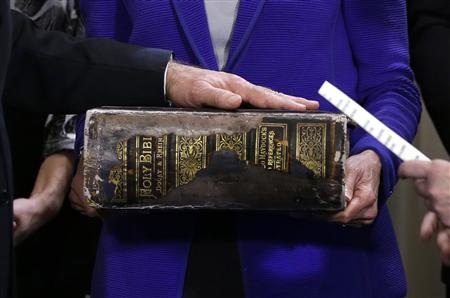
Commentary: Obama's inauguration Bibles
Historic Bibles used in ceremonies 
The tradition of inaugural prayer
Presidential oaths, from Washington to Obama
Adding "So help me God" to the Constitution:
... there was a myth that the tradition of adding God to the oath began with George Washington. It didn’t, say experts at the Library of Congress, the U.S. Senate Historical Office and the first president’s home, Mount Vernon. Although the phrase was used in federal courtrooms since 1789, the first proof it was used in a presidential oath of office came with Chester Arthur’s inauguration in September 1881.
Newdow v. Roberts, the 2008 lawsuit over "So help me God"
Court declines to hear case over "So help me God"
Why doesn't every president use the Lincoln Bible? (And what did John Adams swear on instead of a Bible?)
Biden takes the oath:
Biden used his family Bible for today's ceremony, a 5-inch-thick tome featuring a Celtic cross on the cover. It has been in the Biden family since 1893. He used it each time he was sworn in as a senator and when he was sworn in as vice president in 2009. His son Beau used it when he was sworn in as Delaware's attorney general.
The Biden family Bible, in use
Special piece of art Biden had hung for inauguration
Official & unofficial inauguration prayers
Evangelical pastor's 90s sermon stirs controversy after inauguration invitation
Unpacking the Giglio imbroglio
Commentary: Stop politicizing inaugural prayers
Commentary: Pastor's dis-invitation to inauguration is new moral McCarthyism
Commentary: A wry congratulations to the LGBT community
Commentary: I don't care who prays at the inauguration
Discussing the Giglio controversy & its wider implications
Political/religious tensions in prayer invitations
Farewell, Louie Giglio?
Does Giglio controversy mean the end of publican role for evangelicals?
Obama may have disagreed with how Giglio controversy was handled
Benedictions not offered
When was the last time a rabbi prayed at a presidential inauguration?
1,500 to pray for president, government, military, media & business. Also: Great Awakening.
Methodist pastor Adam Hamilton to preach at inauguration
Widow of civil right's icon to deliver invocation
Episcopal priest to close inauguration
Commentary: Obama should invoke Puritan vision of 'City on a Hill'
Commentary: Civil religion holds country to higher moral standard
Inauguration is 'worship of the nation'
Inaugurations & America's 'civil religion':
President Obama’s [2009] inaugural address contains a muted expression of the American civil religion that Robert Bellah first recognized in Kennedy’s speech of 1961. The reference to God as the transcendent source of values, the activist faith, the trust in God’s providence and grace, notions of sacrifice and rebirth, the appeal to sacred events and heroes of the past (recall, too, Obama’s use of Lincoln’s Bible during the swearing-in ceremony), are all enduring aspects of this tradition, and Obama placed special emphasis on the civil republican dimension 
Yet, the God that Obama appeals to feels more remote, less directly involved in history than in earlier inaugural addresses. Remarkable, too, is Obama’s stress on the nation’s shortcomings, his mention of religious traditions beyond the so-called “Judeo-Christian” faiths, his outreach to Muslims and inclusion of non-believers. The latter represents a real and significant innovation ....
Update: 
Myrlie Evers-Williams delivers inaugural invocation 
The text of Obama's inaugural address
Cornel West's critique of Obama's use of Martin Luther King Jr.'s Bible
Pastor Mark Driscoll's critique of Obama's use of the Bible
Richard Blanco's poem, "One Day"
Richard Blanco reading
Kelly Clarkson performs "My Country Tis of Thee"
Rev. Luis Leon delivers benediction
The text of Leon's benediction

Update 2:
Obama swears on two Bibles
Read More
Posted in American religion, civil religion, links, politics, religion and politics, teaching | No comments

Wednesday, 16 January 2013

Michele Bachmann's post-eleciton disasters

Posted on 02:23 by Unknown
Michele Bachmann's ill-fated campaign for the GOP presidential nomination ended over a year ago, after a brutal loss in the Iowa Caucuses. Bachmann, who is now returning to Congress for her another term, had serious religious right bona fides, having been politicized by Francis Schaeffer in 1977, but couldn't rally the Republican faithful and couldn't manage the necessary transformation into a plausible national candidate.

Her campaign went from disaster to disaster.

Her campaign is still going from disaster to disaster, long after it's over.

A year after the campaign, Peter Waldron, the Bachmann staffer in charge of evangelical outreach is now saying the congresswoman is refusing to pay staffers for work they did. It's a relatively small amount of money. Bachmann ended her presidential campaign with more than $2 million in her war chest and reportedly raised more money in her congressional campaign than any other candidate, but is, according to the disgruntled ex-staffer, refusing to pay out on less than $5,000 of outstanding bills. Which seems like strange behavior.

Or, as Bachmann's one-time head of Christian outreach put it: "It is sobering to think that a Christian member of Congress would betray her testimony to the Lord and the public by withholding earned wages from deserving staff."

The official response has been accusations that Waldron is lying. Which he may be, though that only calls into question the Bachmann campaigns competency in another way. This man, after all, has a historythat would have given another political team pause before making him a key part of its strategy.

There's been some speculation that this conflict stems from a separate post-campaign disaster, the ongoing investigation into the alleged theft of a list of homeschooler's e-mails. According to the Star Tribune, the Bachmann campaign eventually paid the homeschool group $2,000 for using or misusing the list, but the campaign is also being sued by the individual they got the list from and the criminal investigation into how that happened is still open.

Whether that's the source of the conflict or not, the public fight between Waldron and the Bachmann loyalists has now escalated, with the ex-staffer now making colorful accusations about unusual things going on in the campaign and the extreme extent to which Bachmann let her staff control her. Things were so bad, according to Waldron, that avid supporters didn't recognize the Bachmann they thought they knew, and "More than one staffer was grateful to God that she didn't win the nomination."

This isn't reliable information, of course, but there is a clear pattern of very bad judgment from this Republican leader of the religious right. Whether one believes the ex-staffer or thinks he's crazy or both, the conclusion would be the same: Bachmann lacks the ability to surround herself with reasonable, reliable people. A good number of her history of crises can be attributed directly to this fact, and she'll likely continue, despite her success at fundraising and winning the vote of her Minnesota district, careening from disaster to disaster.

Her fiercest supporters and critics hold that this is because of her strong ideological positions. It seems possible, though, that it's just incompetance.

Read More
Posted in America, Francis Schaeffer, Michele Bachmann, politics, religion and politics, religious right | No comments

Thursday, 10 January 2013

J. Gresham Machen's signs of the times

Posted on 01:27 by Unknown
What will be the end of that European civilization, of which I had a survey from my mountain vantage ground—of that European civilization and its daughter in America? What does the future hold in store? Will Luther prove to have lived in vain? Will all the dreams of liberty issue into some vast industrial machine? Will even nature be reduced to standard, as in our country the sweetness of the woods and hills is being destroyed, as I have seen them destroyed in Maine, by the uniformities and artificialities and officialdom of our national parks? Will the so-called 'Child Labor Amendment' and other similar measures be adopted, to the destruction of all the decencies and privacies of the home? Will some dreadful second law of thermodynamics apply in the spiritual as in the material realm? Will all things in church and state be reduced to one dead level, coming at last to an equilibrium in which all liberty and all high aspirations will be gone? Will that be the end of all humanity's hopes? I can see no escape from that conclusion in the signs of the times; too inexorable seems to me to be the march of events. No, I can see only one alternative. The alternative is that there is a God -- a God who in His own good time will bring forward great men again to do His will, great men to resist the tyranny of experts and lead humanity out again into the realms of light and freedom, great men, above all, who will be messengers of His grace. There is, far above any earthly mountain peak of vision, a God high and lifted up who, though He is infinitely exalted, yet cares for His children among men.
-- J. Gresham Machen, Mountains and Why We Love Them, 1933.

The "signs of the times" really do dramatically change. Even though what the signs say is always the same, regardless of whether the specific sign is a new national park or gays openly serving in the military, regulation of child labor or employee health care.

Machen -- a Reformed theologian at the forefront of opposition to Modernism and Christian liberalism -- climbed the Swiss Alps in 1913 and 1932, in both cases ascending a peak on the eve of a world war. He believed Modernism, especially in the form of the "higher criticism" taught by German theologians, had significantly weakened Christianity, undermined it, and was threatening the faith and also civilization, leading directly to the destruction and devestation of World War I and World War II.

He was a significant influence on Francis Schaeffer, and can be thought of as the grandfather of today's religious right, though many reformed Christians, such as Machen biographer and religious-right-critic D.G. Hart, would argue that politically-oriented American Christians have strayed too far from Machen's ideals. I.e., that they are not conservative enough to be Machen's true heirs.

Those who are direct spiritual and intellectual descendants of this leader of Christian fundamentalism have famously been called "Machen's warrior children," emphasizing a Machenian attitude that's praised by some as a willingness -- a boldness in being willing -- to defend truth.

Machen, it's important to say, accepted the name "fundamentalist." He thought there was a better word for it, though: orthodox.

What's perhaps most notable about this quote, if one is looking for historical precedent for contemporary conservative Christians, is the sense that it's "experts" who are the problem. "Experts" who, through an exercise in "tyranny," have lead humanity away from both light and freedom. There's a deep strain of anti-intellectualism in American history, of course, and that's been of significant aspect of religious experience throughout the history. Machen states it so succinctly, here, and puts experts up as the most basic problem.

Notable, also, are the two politically issues Machen highlights. These are the "signs" he sees in America in the 1930s. In the piece, he mentions the international situation, decrying Mussolini by name and Hitler by reference. Domestically, however, Machen sees the end of civilization and betrayal of Reformed Christian truths in a) national parks, and b) federal child labor laws.

Two peculiar issues, if ever there were.


This was, after all, the beginning of Franklin D. Roosevelt's first term, the depth of the Great Depression and the beginning of the New Deal.


Overall, Machen wasn't particularly interested in politics. Certain less than his "warrior children." Here, though, in 1933, he does for a moment speak politically, and chooses out of all the issues of the day to take a stand against national parks and child labor laws. There's probably an explanation for why these could have seemed so pressing from a particular cultural position. To first sight, though, the choice of issues highlights certain characteristics of this worldview, and goes to show how strange many political fights seem from a distance.

The only National Park in Maine in 1933, as far as I can tell, was Arcadia National Park, the first National Park east of the Mississippi. A system of carriage trails through the park were then being built by John D. Rockefeller Jr., and that seems to have particularly offended Machen. In one of his books he wrote,
When I first went there it was about the sweetest and most beautiful lake and mountain region that could possibly be imagined. It really seemed as though no human being would have the heart to destroy the delicate charm of those woods. But then came Mr. John D. Rockefeller, Jr., and the Lafayette (later Acadia) National Park, and all was changed. Huge roads now scar practically every mountainside and skirt the shores of practically every lake. The woods near the roads have been ruthlessly ‘cleaned up.’ The natural beauty of the region has been systematically destroyed. When I go into that National Park, with its dreary regularity and its officialdom, I almost feel as though I were in some kind of penal institution .... Certain it is at any rate that the best way to destroy true recreation is for government to go into the business of promoting it.
I don't know how it looked in '33, but today, to be sure, Machen's assessment that "the sweetness of the woods and hills is being destroyed" seems strange.

I can imagine other reasons he might have had for opposing the park -- libertarian principle, perhaps, or just privileged annoyance that what one enjoys is now widely available -- but the argument he makes is somewhat bizarre.

The constitutional amendment that Machen references as the other "sign of the times" was ratified by 13 states in 1933, but never acheived the necessary 2/3 majority. The Child Labor Amendment is technically still pending approval. The amendment reads: "The Congress shall have power to limit, regulate, and prohibit the labor of persons under eighteen years of age." The Fair Labor Standards Act of 1938 -- a key piece of New Deal lesgislation -- succeeded where the ammendment failed.

Machen seems to have opposed the amendment specifically for being too general, and not specifying what sort of child labor congress might be interested in prohibiting or limiting. He said, in another piece on the topic, that the amendment was "the most sinister attack upon American institutions and the sanctity of the American home that has been made for half a century."

Further, he made the sort of limited government, anti-government argument that's standard on the right:
[The amendement] would take by far the most important part of human life out of the hands of state legislatures in touch with local conditions, and put it into the hands of the army of government agents, which any exercise of the powers to be conferred by the amendment would require. There could scarcely be a more disastrous blow at the very foundations of American freedom.
Though few conservative Christians in America would, today, make an argument against child labor laws, the logic Machen employs about the privacy and the sanctity of families, that "the family" constitutes a seperate sphere that ought to be autonomous, the federal government represents a kind of hideous, alien aberration of the normal order of things, is quite common.

That's the way it seems to work: the signs of the times change; the interpretations of said signs are consistent, though, across time.
Read More
Posted in American religion, calvinism, Fundamentalist-Modernist, J. Gresham Machen, modern conservatism, Reformed theology, religion and politics | No comments

Sunday, 6 January 2013

The faiths of Congress

Posted on 22:20 by Unknown

From the Pew Forum on Religion and Public Life:
The new, 113th Congress includes the first Buddhist to serve in the Senate, the first Hindu to serve in either chamber and the first member of Congress to describe her religion as “none,” continuing a gradual increase in religious diversity that mirrors trends in the country as a whole. While Congress remains majority Protestant, the institution is far less so today than it was 50 years ago, when nearly three-quarters of the members belonged to Protestant denominations.
Read More
Posted in American religion, pluralism, religion and politics, religious data | No comments

Tuesday, 13 November 2012

Religion in politics, election data

Posted on 01:46 by Unknown
Photo by dennizo
Pew: How the faithful voted
CNN: exit polls
FOX: exit polls


Also of interest:
First Hindu elected to congress, Tulsi Gabbard:


Black Mormon woman elected to congress (first black Republican congresswoman), Mia Love:


The Catholic hierarchy's opposition to Obama:


Staunch evangelical opposition to Obama:

Read More
Posted in American religion, election, religion and politics | No comments

Friday, 9 November 2012

Science wins small symbolic victory in Georgia vote

Posted on 04:28 by Unknown
A bit of a political protest is becoming apparent as the ballots are tallied in one North Georgia congressional district: a protest on behalf of science.

According to the Athens Banner-Herald, Charles Darwin received nearly 4,000 write-in votes in one of the 24 counties that make up the state's 10th Congressional District, where the unopposed Republican incumbent had declared the theory of evolution to be the work of Satan. How many write-in votes went to Darwin in the 23 other counties of the district is not clear, as not all of the counties report write-ins, yet the symbolic protest was sizable enough to attract the attention of national news outlets and, Darwin supporters hope, attract a real challenger to the race in 2014. 

Broun's broad dismissal of science -- from evolution to the Big Band to embryology -- at a political rally in a Baptist church was especially inflammatory because he sits on the House Science, Space and Technology Committee. In the viedo released by the church, Broun stood in front of a wall of mounted deer heads, and said that science was opposed to the Bible, which is the "manufacturer's handbook."

Echoing the ideas of Christian Theonomists such as R.J. Rushdooney, who taught that the world is divided into four spheres and that God is king of all four, Broun explained that science is a blasphemous attempt to displace God. He told the audience he doesn't accept the authority of science, but of the Bible, which "teaches us how to run our lives, individually, how to run our families, how to run our churches. But it teaches us how to run all of public policy and everything in society. And that's the reason as your congressman, I hold the Holy Bible as being the major directions for how I vote in Washington D.C."

The brouhaha that followed the congressman's version of theocratic government was turned into a symbolic protest at the polls, last week, in part due to the work of a UGA professor. 


Jim Thompson of the Athens Banner-Herald reports:
"A campaign asking voters to write-in Darwin’s name in the 10th Congressional District, which includes half of Athens-Clarke County, began after Broun, speaking at a sportsmen’s banquet at a Hartwell church, called evolution and other areas of science 'lies straight from the pit of hell.'

"Jim Leebens-Mack, the University of Georgia plant biologist who started a 'Darwin for Congress' Facebook page in the wake of Broun’s remarks, said the number of Darwin votes cast in the race were 'in the ballpark, a little bit more' than he had expected.

"The Darwin votes, Leebens-Mack added, made it 'clear to me, and I hope everybody, that Paul Broun is vulnerable' in terms of continued re-election to Congress. Broun was first elected in a special 2007 election, and won re-election in 2008, 2010 and again on Tuesday in a newly drawn 10th District, reconfigured as part of congressional reapportionment." 
Broun won re-election fairly easily, though, garnering more than 200,000 votes in his district, more than he won in 2006, 2008 or 2010. 

Even in 2008, in the context of the massive turn-out for Democrats inspired by Barack Obama's first election, Broun managed a decisive win. The Democratic challenger Bobby Saxon won only about 39 percent of the vote.

Nevertheless, the write-in votes can be read as a core of opposition to Broun, or to conservative evangelical candidates more generally, even in the deeply Republican districts of deeply Republican states like Georgia.

The Flagpole, the University of Georgia Athens paper, reports that in addition to the votes for Darwin, there were about 2,000 other write-in votes in the congressional race in Athens-Clarke County. Another 23,000 voters reportedly ignored that part of the ballot entirely.

Other write-in votes from those dissatisfied with Broun included votes for: "Carl" Marx, Burning Bag of Dog Shit, Doritos, Michael Stipe, Ron Paul, Satan, Stephen Colbert, and Taylor Swift. A fictitious candidate from a previous protest against Broun, "Pete McCommunist," also won more than 100 write-in votes. An actual person who also ran a write-in campaign, Brian Russell Brown, won 238 votes.

Bill Nye the Science Guy, who has come out in opposition of teaching creationism to children and slammed Broun for his anti-science statements, also won some of the one county's write-in votes.

Not all of the opposition to Broun, notably, was from the left. Georgia's libertarian-leaning talk show host Neil Bortz, who's most significant political foray to date was probably promoting fellow Georgian Herman Cain, came out strongly in opposition to Broun. Bortz said Republicans like Broun were "hurting the brand," making the party look like it consisted of un-evolved Neanderthals and redneck hicks.

The radio show host encouraged listeners to write-in Darwin.

The coalition of libertarians, UGA faculty and students and others who want their government officials to accept science didn't carry the day, in North Georgia, but the small symbolic protest was nonetheless noted when they went to the polls in Athens-Clarke County.
Read More
Posted in American religion, bible, Charles Darwin, Christian Reconstructionism, election, evangelicalism, evolution, modern conservatism, religion and politics, religion and science | No comments

Wednesday, 7 November 2012

Catholics to bishops: never mind our souls

Posted on 13:29 by Unknown
American Catholic bishops attempted to exert their influence on the electorate, but to little effect.

Looking at the Catholic vote the day after the election doesn't reveal any significant shifts or surprises, but the results do indicate the political impotency of a Catholic hierarchy that has become very strongly identified with politics.

The American bishops didn't appear to hesitate in picking political sides in this last election. That has not always been the case, but this time the church's hierarchy leaned heavily on Catholic parishioners, making strong pronouncements about the morality of voting one way or another, clearly indication how good Catholics should cast their ballots if they cared about their souls. Picking up issues such as abortion and mandated coverage of contraception, the church's leaders issued strongly worded statements that, ostensibly, left little room for differences of opinion among the faithful.

And yet they were ignored by significant portions of the church.

One poll in the final days of the campaign put Catholic support of Barack Obama's reelection at 52 percent. An exit poll widely cited had half of self-identified Catholics saying they'd voted for Obama, and only 48 percent saying they'd supported Mitt Romney.

The bishops were spurned by sizable portions of Catholic voters, nationally and locally.

In Illinois, for example, Bishop Thomas John Paprocki wrote that voting for candidates who supported the Democratic Party platform -- which, in contrast to the Republican platform, has planks that "explicitly endorse intrinsic evils" -- puts one's soul in danger. But many, many Illinois Catholics voters just didn't seem to care.

Paprocki's message:
"I am not telling you which party or which candidates to vote for or against, but I am saying that you need to think and pray very carefully about your vote, because a vote for a candidate who promotes actions or behaviors that are intrinsically evil and gravely sinful makes you morally complicit and places the eternal salvation of your own soul in serious jeopardy."
Nearly half of the Catholic voters in Illinois disagreed with or disregarded the bishop's warning. The CNN exit poll shows that 48 percent of the state's Catholic voters cast their ballot for Obama on Tuesday.

This is true other places as well: The bishops simply do not have significant influence over their supposed flocks.

In Colorado, some lay Catholics paid for a full-page newspaper ad carrying the political message of Denver's Archbishop Samuel J. Aquila. Aquila urged Catholics to do their "moral duty" in opposing Obama's health care plan, and the Heath and Human Services mandate that insurance coverage, including that offered by Catholic charities, include coverage of contraceptives.

Colorado opted to re-elect the president by about 110,000 votes, though, and many of those were the state's more than 700,000 Catholics.

There is some minor variation from state to state in the break-down of the Catholic vote, but it doesn't seem to have anything in particular to do with the efforts of statements or activism of the region's respective bishops.

In the five states with the largest percentage of Catholics, Obama actually won, and CNN's exit polls show that the Catholic voters were split between the parties:
  • In Rhode Island, 59 percent of the population is Catholic, and Obama won by 29 percentage points.
  • In Massachusetts, where 43 percent of the population is Catholic, only 21 percent of voters identify as conservative, and more than a quarter of those calling themselves conservative reported they voted for Obama.
  • In New Jersey, 41 percent of the population is Catholic, and 45 percent of Catholics voters said they voted for Obama. The number of Catholics in New Jersey is about six times the number of votes that made up Obama's margin of victory.
  • In Connecticut, 36.6 percent of the population is Catholic, and 49 percent of Catholic voters cast their ballots for Obama. The state went for the Democrats by 17 percent.
  • In New York, where 37 percent of the population is Catholic, 47 percent of Catholic voters went for Obama. 
The 47 percent of New York Catholics who voted for Obama presumably did not include Cardinal Timothy Dolan, who went on television in the Spring to describe Obama's policies as "dramatic, radical intrusion of a government bureaucracy into the internal life of the church," and an attempt to silence people of faith, saying: "I think the public square is impoverished when people might be coerced to put a piece of duct tape over their mouth keeping them from bringing their deepest held convictions to the conversation."

And, presumably, the 47 percent of New York Catholics who voted for the president don't feel that they've been violently gagged by the policies of the man they voted for.

There will likely be arguments that those Catholics who didn't vote in accordance with the wishes of the hierarchy are, in some way, not really Catholic. It is true that Catholics who attend weekly mass -- the one measure of religiosity in election polls -- were more likely to vote for Romney. FOX's exit poll shows 57 percent of weekly mass-goers voted Republican, nationally. Of those who attend less than once per week, 57 percent voted for Obama.

The much more sharp division, though, seems to be between white Catholics and non-white Catholics, not the devout and the irregular church-goers.

According to a Pew poll done in October, 71 percent of Latino Catholics identified as Democrats, and 73 percent were planning on voting for Obama. They were nearly 20 percent more likely to support Obama than non-Latino Catholics. That overwhelming support didn't disappear when one measured for religiosity, either: among Latinos who attended mass weekly, more than 60 percent said they would vote for Obama. Where the so-called "God gap" is in effect with whites, it seems minimal at best with Latinos.

This support came despite what they heard in church when they were there every week, too, further demonstrating the church's lack of authority on these matters. Nearly one third of the church-going Latinos told pollsters they had heard sermons on candidates and elections, and more than half said they'd heard priests speak from the pulpit about abortion. It's not that they're not paying attention when, for example, a church includes a weekly prayer that "the federal government will be restored to its founding principles and allow religious liberty," it's just that they disagree.

Latino Catholics express a clear political preference, a preference which is not represented in their church's leadership.

As Eduardo Peñalver wrote in Common Weal today,
"the hierarchy finds itself identified more closely than ever with a single party in the United States, a party that is on the wrong side of inexorable demographic change. The result will be diminished influence for the Church in American politics and greater hostility towards requests for accommodation from the Democrats in power."
This divide isn't new, actually, as the numbers in this election more or less match those of the last few presidential races. Increasingly, though, the clash within the Catholic church is aggravated, as "Catholic leaders and Catholic voters can’t agree on what they think these Catholic teachings actually mean. Nor can they agree on how, or whether, those teachings might apply to the public square," as exemplified, quite publicly, in the vice presidential debate.

The election results raise very real questions about what it even means to talk about a "Catholic vote," given these divisions, and it undercuts the claims of conservatives who want to speak unilaterally about what "the church" supports or doesn't. It also especially demonstrates the hierarchy of the American Catholic church, try as they might, don't carry that much weight when it comes to the country's voting Catholics. 
Read More
Posted in American religion, Catholicism, election, Mitt Romney, Obama, religion and politics | No comments

Monday, 5 November 2012

The diversity of religion in American politics

Posted on 08:12 by Unknown
Two congressional candidates in two very different districts demonstrate something of the religious diversity in American politics today.

In Hawaii, in a district that previously elected one of congress' few Buddhists, Tulsi Gabbard is currently leading in the polls by 52 points. If elected, Gabbard would be the country's first Hindu representative.

As the Religious News Service reports:
"Gabbard, 31, was born in American Samoa to a Catholic father and a Hindu mother, and moved to Hawaii when she was 2. In 2002, at age 21, she was elected to the Hawaii state legislature.

"[...] Gabbard, whose first name refers to a tree sacred to Hindus, fully embraced Hinduism as a teenager, and follows the Vaishnava branch that believes in the Supreme Lord Vishnu, and his 10 primary incarnations. Her primary scripture is the centuries-old Bhagavad Gita, whose themes include selfless action, spirituality, war, and serving God and humanity.

"'The Bhagavad Gita is often considered a guide as to how to make decisions in difficult situations, when the decision is often not clear cut,'  [co-founder of the Washington-based Hindu American Foundation, Mihir] Meghani said. 'Hinduism’s innate pluralism recognizes that there are various ways to look at things, and its focus on dharma, or duty, guides those holding positions of power or authority.'"
Gabbard's political rise has been described as "out of nowhere," though her district is strongly Democratic, and her opponent is homeless. She has, interestingly, talked about how her faith has important in her life, both during the time she spent in the military in the Iraq war, and in this campaign for congress.

As Michael J. Altman notes, there's a history of opposition to Hinduism in America, and that "the earliest American ideas about Hinduism, both for good and ill, endure" in discussions of Gabbard's faith. There's been especially vigorous opposition to Hindus involved in politics. That opposition has notably come from those who've argued that there shouldn't be a separation of church and state, and that a persons faith is necessary and an integral part of their public service.

Gabbard's faith doesn't appear to have been a critical part of her campaign, though. In one interview, she suggested her Hinduism would be an advantage when working with some foreign nations, such as India, but has otherwise made central such as issues banks foreclosing on deployed soldiers' houses, regulating banks, and changing America's nuclear policy, without making reference to Hinduism.

In Northwest Ohio, meanwhile, the Democratic challenger appears to be the country's only congressional candidate who is also a female ordained minister. Angela Zimmann is the pastor of Trinity Evangelical Lutheran Church.

Zimmann's chances at election are slim: the district hasn't gone Democratic since 1939, and Ohio's districts were recently re-drawn by Republicans. The incumbent is seeking his fourth term, has raised more than $1 million, more than twice the amount Zimmann has raised, and he won his last race with 64 percent of the vote.

The Toledo Blade reports that Zimmann's faith has been a question in the campaign specifically as it relates to social issues. Her church allows for the ordination of homosexuals, for example, and has a moderate position on abortion. As the Blade reports:
"Challenger Angela Zimmann (D., Springfield Township), has likely the most pro-choice position of any of the major congressional candidates in the area. She says she personally opposes abortion, but doesn't feel the government has the right to make that decision for others, even late in a pregnancy.

"'As a mother and foster mother who personally opposes abortion, I find the late-term procedure to be particularly horrific,' she said in a statement, 'however, these difficult and deeply personal medical issues are best decided between a woman and her doctor.'

"Ms. Zimmann is a pastor for the Southeast Michigan Synod of the Evangelical Lutheran Church in America. The Evangelical Lutheran Church in America has approved the ordination of homosexual clergy members and the blessings of same-sex unions.

"She frames her position on gay marriage around keeping government small, considering the Defense of Marriage Act an overreach of the federal government, and said the U.S. Supreme Court should rule it unconstitutional."
According to the Religious News Service, Zimmann has also attempted to cautiously delineate the relationship, in her own life, between religion and politics. She plans to keep ministering at her church, if she wins, but is adamant that politics not be a topic at church. She spoke with two bishops before announcing her run, but said it was a conversation, "non-hierarchical."

Her articulation of the role her faith plays in her public life is likewise cautious:
"'A person without a religious faith can still be a person of integrity,' Zimmann said in an interview, 'so I wouldn’t say that if you don’t have faith you don’t have values. But I know for myself my faith influences my values.'

"'Being from the Christian faith, our values are to care for the needy. The Bible talks about helping the elderly and the widows, and I see that as an analogy for helping anyone who doesn’t have their needs met.'"
As always, the conversation about "religion in politics" this election seems to be mostly about a certain kind of religion and a certain kind of politics. As these two congressional candidates, show, though, there's actually a good bit of variety when it comes to the religious faiths involved in politics, and when it comes to how politicians understand the relationship between their faith and their public works.

Read More
Posted in American religion, Angela Zimmann, congress, Hinduism, politics, religion and politics, the secular, Tulsi Gabbard | No comments

Monday, 29 October 2012

A political 'evolution' on social conservative issues

Posted on 08:33 by Unknown
Has Mitt Romney evolved?

According to the conservative Christian group Family Research Council, Romney has changed positions on five key issues between the Republican primaries and the general election. Contrary to the conventional wisdom that says candidates tack to the center during general elections, and become more moderate to appeal to independents and swing voters, Romney has apparently strengthened his case with social conservatives since winning the Republican party nomination.

Where once he was squishy, apparently, on the issues the FRC cared about, now he's firm. Where once the FRC judged the Mass. governor to be only 50 percent in line with the positions of "values voters," he now has a perfect score.

Of course it's possible it's not Romney who has changed.

As noted by Christianity Today in a piece on Christian voter guides last week, the FRC guide released during the primaries highlighted significant areas of disagreement with Romney: stem cell research, cloning, the estate tax, employee non-discrimination, and "strict constitutionalist" judges. On half the issues held to be important by the conservative group started by evangelical child-rearing guru James Dobson, Romney was represented as being on the wrong side.

That voting guide showed him to be a less desirable candidate than Michele Bachmann, Rick Santorum, or Rick Perry. Newt Gingrich and Ron Paul didn't have perfect scores -- both differing from the FRC on the question of a federal ban on human cloning -- but they still were more in line with the group's position than Romney.

Correction: than Romney was.

According to the FRC voting guide being distributed right now as church bulletin inserts, Romney has changed his position on all five of these issues, and is now in complete agreement with the conservative Christian positions on everything that's politically important.

In at least one case, though, Romney has managed this remarkable transformation without actually changing his position. The FRC footnotes their sources for the statements about candidates' positions, and though the earlier guide and the later guide represent Romney as having different positions on stem cell research, the sources cited say the same thing in both cases. He's for stem cell research, but opposed to embryos created specifically for such studies, and opposed to federal funding of these studies.

As Romney himself explained the position in 2007, "There are different levels of stem cell research."

That nuanced position was presented by the FRC as having a "mixed" record on the issue. It is now being presented as opposing the federal funding of stem cell research, which is true, but has actually always been Romney's position. His statements on the issue, cited by the FRC, are consistent from 2005 to today. It's the FRC's representation of that position has changed.

So perhaps it's the Family Research Council that has evolved?

In another case, the records cited by the FRC show Romney has in fact changed his position, but that change happened long before either voting guide was published. Romney's current position on federal protection of gays and lesbians against employer discrimination has been represented in two diametrically opposite ways.

It's true that in 1994 Romney pledged his support for EDNA, the "Employment Non-Discrimination Act" that the FRC calls "SPECIAL EMPLOYMENT RIGHTS BASED ON SEXUAL BEHAVIOR." Romney instituted a non-discrimination policy that included sexual orientation as one of the protected classes when he was organizing the hosting of the 2002 Olympics. In 2007, though, Romney announced that he'd adjusted his position, and now felt that protecting people from discrimination was the states' job, not the federal government's. He told Tim Russert, "I think it makes sense at the state level for states to put in provision of this .... I would not support at the federal level, and I changed in that regard because I think that policy makes more sense to be evaluated or to be implemented at the state level."

During the primaries, that 2007 position was characterized by the FRC as support for the Employment Non-Discrimination Act." That same position is now characterized by the FRC as opposition.

The word for this is duplicitous.

Much has been made of Romney's inconsistencies and how his only guiding principle seems to be his own desire for power. Especially when it comes to the social issues that concern conservative Christians. That, it turns out, may not be a problem for those who claim to represent these Christians, but rather a key a point of commonality.

The FRC voting guides show that Romney has strengthened his position with at least some conservative Christian groups -- but only because they too are more committed to political victories than anything else.
Read More
Posted in abortion, ambition, American religion, bad faith, evangelicalism, Family Research Council, Mitt Romney, modern conservatism, political debate, politics, religion and politics, Tony Perkins, voting guides | No comments
Older Posts Home
Subscribe to: Posts (Atom)

Popular Posts

  • The Derrida point
    "I was wondering myself where I am going. So I would answer you by saying, first, that I am trying, precisely, to put myself at a point...
  • How New Atheists are like Victorian-era bishops
    The secularization thesis -- the most traditional version, rather crude, which predicted religion would disappear from the modern world -- i...
  • On exorcism
  • Happy birthday Billy Graham
    Billy Graham turns 94 today. One of the odder moments of Graham's very public career -- though there are many, and many more than one ...
  • The courts' disagreement over corporations having religion
    Can corporations practice religion? The courts disagree. In two different federal courts, in two different cases where for-profit companies ...
  • The religious shape of capitalism
    A new study published in Management Science is making a very Max Weber-like claim about the essential differences of religions affecting eng...
  • 'Christianity is not a religion'
    Watch the latest video at video.foxnews.com I don't know whether it's really possible to have a meaningful, reasonable debate about ...
  • Teaching: History of American Atheism
    I'm in the process of preparing a class on the history of American Atheism, which, as far as I can tell, is more or less uncharted terri...
  • Reza Aslan's outrage
    Among scholars of religion, there's no consensus on the relevance of scholar's personal religious beliefs and practices to their sch...
  • Snake handlers embrace media attention
    The National Geographic channel is planning a show on two Tennessee men and their communities struggling to keep the snake-handling faith. T...

Categories

  • "sacred steel" (1)
  • #PrayforBoston (1)
  • 1848 (1)
  • 1916 (1)
  • 2012 (4)
  • 2013 (1)
  • 4th of July (1)
  • 9/11 (1)
  • A Christian Manifesto (1)
  • AAR (1)
  • Aaron Schock (1)
  • abolitionists (1)
  • abortion (6)
  • Abraham Kuyper (2)
  • Abraham Lincoln (1)
  • abuse (4)
  • academia (22)
  • academica (1)
  • Acton Institute (1)
  • aesthetics (2)
  • African-American religion (3)
  • Al Mohler (1)
  • Albert J. Raboteau (1)
  • Alex Grenier (1)
  • aliens (1)
  • Alton Lemon (1)
  • Amazon (1)
  • ambition (1)
  • ambivalence (1)
  • America (21)
  • America’s Blessings: How Religion Benefits Everyone (1)
  • American (1)
  • American religion (128)
  • American Revolution (1)
  • Amish (1)
  • anabaptists (1)
  • Andrew Hamblin (1)
  • Andrew Sullivan (1)
  • Angela Zimmann (1)
  • animation (1)
  • Ann Taves (1)
  • Anti-Catholicism (1)
  • Anti-Mormonism (1)
  • apocalyptic (3)
  • apocalypticsm (2)
  • apologetics (1)
  • Appalachian (1)
  • Archdiocese of Philadelphia (1)
  • arguments (5)
  • Arizona Republic (1)
  • ark (1)
  • art (12)
  • Art Gish (1)
  • Art Young (1)
  • astrophysics (1)
  • asylum (4)
  • Aten Reign (1)
  • atheism (28)
  • audience (1)
  • authors (1)
  • Baby Doe (1)
  • bad faith (2)
  • baptism (1)
  • Baptists (2)
  • Baron d'Holbach (1)
  • Barry Hankins (1)
  • bars (1)
  • baseball (1)
  • bear market in God (2)
  • beer (1)
  • belief (13)
  • Ben-Hur (1)
  • Benedict XVI (4)
  • bible (4)
  • Big Mountain Jesus (1)
  • big Other (1)
  • Bill O'Reilly (1)
  • Billy Graham (4)
  • Billy Sunday (1)
  • birds (1)
  • birth control (10)
  • bishops (1)
  • Black Mountain Poets (1)
  • blasphemy (2)
  • blues (1)
  • Bob Dylan (2)
  • Bob Grenier (1)
  • book (4)
  • book culture (6)
  • book review (1)
  • bookshelf (1)
  • bookstore (3)
  • Boston (2)
  • Boz Tchividjian (1)
  • Brennan Manning (2)
  • Brethern (1)
  • Broderick Rice (1)
  • buddhism (1)
  • Bulldogs (1)
  • Calvary Chapel (2)
  • calvinism (12)
  • Canada (1)
  • capitalism (9)
  • cardinals (1)
  • Cardus (1)
  • Carl F. H. Henry (1)
  • Catholic hierarchy (1)
  • Catholicism (19)
  • Chance The Rapper (1)
  • charity (2)
  • Charlemagne (1)
  • Charles Chaput (1)
  • Charles Darwin (1)
  • Charles Fox Parham (1)
  • Charles Olson (2)
  • Charles Taylor (3)
  • Chicago (2)
  • child molestation (1)
  • children (2)
  • Children's literature (1)
  • Chris Rock (1)
  • Chris Stedman (1)
  • Chris Sullivan (1)
  • christian fiction (14)
  • Christian Hedonism (1)
  • Christian music (5)
  • Christian publishing (7)
  • Christian Reconstructionism (2)
  • Christianity (15)
  • Christianity Today (1)
  • Christmas (7)
  • Chuck Colson (2)
  • Chuck Smith (1)
  • church (7)
  • church suppers (1)
  • churches (6)
  • churches in bars (1)
  • citations (1)
  • civil religion (7)
  • Civil War (4)
  • Clarence Darrow (1)
  • clergy (2)
  • Cloud Ten (2)
  • cognitive minorities (1)
  • Col. Sanders (1)
  • comedians (1)
  • comedy (1)
  • commodification (1)
  • Conestoga Wood Specialties vs. Sebelius (1)
  • congress (1)
  • Constantin Volney (1)
  • Consuming Spirits (1)
  • conversation (3)
  • conversion (4)
  • Cotton Mather (1)
  • Courageous (1)
  • cover-up (2)
  • creationism (2)
  • creativity (1)
  • creeds and confessions (1)
  • crime fiction (2)
  • crime writing (1)
  • criticism (5)
  • crucifixion (2)
  • cubicle (1)
  • culpability (1)
  • cultural relevance (3)
  • cultural studies (10)
  • culture war (8)
  • D.G. Hart (1)
  • D.T. Max (3)
  • Dale McGowan (1)
  • Dan Fincke (1)
  • Daniel Dennett (2)
  • Darwin (1)
  • David Foster Wallace (3)
  • David Lipsky (1)
  • David Silverman (3)
  • David Tamayo (1)
  • de (1)
  • death (5)
  • Declaration of Independence (1)
  • definition of religion (3)
  • demons (6)
  • denominations (2)
  • depression (1)
  • Derrida (2)
  • Descartes (1)
  • Detroit (1)
  • digital humanities (1)
  • discourse analysis (1)
  • documentary (3)
  • dominionism (1)
  • Doomsday Preppers (1)
  • Dorothy Day (1)
  • doubt (2)
  • Dutch Calvinist (3)
  • e-books (2)
  • e-readers (1)
  • Eastern Orthodox (3)
  • economics (6)
  • ecstatic prayer (4)
  • Ed Gass-Donnelly (1)
  • Edith Schaeffer (1)
  • election (4)
  • Elmbrook v. Doe (1)
  • end times (4)
  • Episcopal Church (3)
  • epistemology (1)
  • Erasmus (1)
  • Eric Hobsbawm (1)
  • Errorl Morris (1)
  • ethics (5)
  • ethics of writing (1)
  • evangelicalism (38)
  • Every Love Story is a Ghost Story (2)
  • evil (2)
  • evolution (5)
  • exorcism (1)
  • experimental fiction (2)
  • faith (4)
  • Family Life Faith and Freedom v. Lynda Serrano (1)
  • Family Research Council (1)
  • fasnet (1)
  • Faulkner (1)
  • Fenway (1)
  • fiction (6)
  • film (8)
  • financial crisis (1)
  • fireworks (1)
  • First Amendment (26)
  • First Things (4)
  • folk art (1)
  • forgiveness (1)
  • fortune telling (1)
  • FOX news (1)
  • France (1)
  • Francis Schaeffer (4)
  • Frank Peretti (1)
  • Freedom From Religion Foundation (1)
  • freedom of religion (14)
  • French Revolution (1)
  • Front Porch Republic (1)
  • Fundamentalist-Modernist (4)
  • funerals (2)
  • gender (1)
  • George Beverly Shea (1)
  • George McGovern (1)
  • German (1)
  • German Reformed Church (1)
  • Germany (9)
  • giving (2)
  • Good Friday (1)
  • gospel (4)
  • gothic (1)
  • government (1)
  • grace (1)
  • Grammys (1)
  • Gravity (1)
  • Greece v. Galloway (1)
  • Greg Abbott (1)
  • Greg Brown (1)
  • Gruppe 91 (1)
  • Habermas (2)
  • Hagee (1)
  • Halakha (1)
  • Halloween (1)
  • Harry Crews (1)
  • HCA (4)
  • health care (3)
  • Heidelberg (2)
  • Heidelberg Catechism (1)
  • hell (3)
  • Henry Luce (1)
  • Herbert Rösler (1)
  • Herman Miller (1)
  • hermeneutics (1)
  • Hinduism (1)
  • Hispanic (1)
  • history (24)
  • Hitchcock (1)
  • Hobby Lobby Inc. vs. Sebelius (7)
  • Hobby Lobby Inc. vs. Sebillius (1)
  • holiness (1)
  • Hollingsworth v. Perry (1)
  • holy roller (1)
  • homemaking (1)
  • homeschooling (4)
  • homosexuality (2)
  • horseshoe (1)
  • Hosanna-Tabor (2)
  • hospitality (1)
  • Houndmouth (1)
  • houses of worship (2)
  • How's that working out for you -- being clever? (1)
  • Howard Phillips (1)
  • HR 1627 (1)
  • HSLDA (4)
  • humanism (2)
  • Hume (1)
  • icon (1)
  • icons (3)
  • ideology (1)
  • immigration (4)
  • In God We Trust (1)
  • In the Year of Dreaming Dangerously (1)
  • incarnation (1)
  • Including Atheists (1)
  • infanticide (1)
  • Intelligent Design (3)
  • Ira Glass (1)
  • Iraq (1)
  • Islam (3)
  • J. Gresham Machen (1)
  • Jack Chick (1)
  • James D. Bratt (1)
  • James Turner (2)
  • James Turrell (1)
  • James W.C. Pennington (1)
  • Jamie Coots (1)
  • Jason Molina (1)
  • Jehovah's Witnesses (1)
  • Jerry Jenkins (2)
  • Jesus (3)
  • Jesus People (1)
  • Jim Bakker (1)
  • Jodi Arias (1)
  • Joe Biden (1)
  • Joel Barlow (1)
  • Joel Osteen (1)
  • John Bunyan (1)
  • John Jay Institute (1)
  • John Piper (1)
  • John Reist (1)
  • John Roberts (2)
  • John Weiners (1)
  • John Wesley (1)
  • John XXIII (1)
  • Jonathan Cahn (1)
  • Jonathan Edwards (3)
  • Jonathan Smith (1)
  • Joseph M. Bauman (1)
  • journalism (4)
  • Juan Mendez (1)
  • Judaism (1)
  • Judge Carol E. Jackson (1)
  • Judge Sarah Evans Barker (1)
  • Justin Taylor (2)
  • Justin Townes Earle (1)
  • Kathryn Jean Lopez (1)
  • Kathryn Lofton (1)
  • Kenneth D. Royal (1)
  • kerfuffle (1)
  • language theory (1)
  • Lauren Green (1)
  • law (12)
  • Lawrence Krauss (3)
  • Lecrae (2)
  • Lee Braver (1)
  • Left Behind (2)
  • Lemon Test (1)
  • let's be serious (1)
  • Lew Wallace (1)
  • liberal (5)
  • liberalism (1)
  • life in Germany (2)
  • Linda Rios Brooks (1)
  • links (1)
  • literary studies (2)
  • living in Germany (15)
  • Local Religious Beliefs and Mutual Fund Risk-Taking Behaviors (1)
  • logic (1)
  • Logical Positivism (1)
  • luck (1)
  • M.S. Simkin (1)
  • maps (1)
  • Marc Ouellet (1)
  • marijuana (1)
  • Mark Driscoll (1)
  • Mark Hatfield (1)
  • marriage (2)
  • married life (1)
  • Martin Luther King Jr. (1)
  • Marx (4)
  • Marxism (3)
  • material conditions (3)
  • Matthew S. Hedstrom (1)
  • Matthew Sutton (1)
  • Max Weber (1)
  • Mayan calendar (1)
  • megachurch (3)
  • Megan Phelps-Roper (1)
  • Mennonites (1)
  • metafiction (2)
  • metaphysics (3)
  • Methodists (1)
  • Metropolitan Jonah (2)
  • Michael Farris (4)
  • Michael W. Cuneo (1)
  • Michele Bachmann (1)
  • Michio Kaku (1)
  • Mike Huckabee (2)
  • minimalism (1)
  • misreading (1)
  • Mitt Romney (6)
  • modern conservatism (13)
  • monasticism (1)
  • Mormonism (2)
  • mural (1)
  • music (1)
  • my life (28)
  • names (1)
  • narratives (5)
  • Nate Silver (1)
  • Nathan Hitchen (1)
  • Natural Law (1)
  • natural theology (1)
  • Nazis (3)
  • Neil Carter (1)
  • Neil DeGrasse Tyson (1)
  • Neo-Calvinism (1)
  • networks (1)
  • New Atheists (4)
  • New New Atheists (1)
  • new religious movements (1)
  • ngrams (1)
  • Nibiru (1)
  • Nicolas Cage (1)
  • Nikolaevsk (1)
  • Nils Frahm (1)
  • Noah (1)
  • non-denominational (1)
  • non-profit (1)
  • nones (11)
  • not fiction (18)
  • notes on reading (4)
  • novel (2)
  • Obama (13)
  • obit (8)
  • obits (1)
  • OCA (2)
  • Old Believers (1)
  • Old North Church (1)
  • ontology (1)
  • P.T. Anderson (1)
  • pacifism (1)
  • patriots (1)
  • Paul Ryan (1)
  • peace activists (1)
  • Peggy Gish (1)
  • pentecostal (14)
  • pet funerals (1)
  • Peter Lalonde (1)
  • Peter Stormare (1)
  • phenomenology (1)
  • philosophy (11)
  • photographs (41)
  • photography (1)
  • Pilgrim's Progress (1)
  • platform (1)
  • pluralism (4)
  • poetry (4)
  • political debate (11)
  • politics (37)
  • politics of distraction (3)
  • poll (1)
  • Pope (6)
  • poverty (1)
  • practice (2)
  • prayer (8)
  • preaching (3)
  • priests (1)
  • printing (2)
  • pro-life movement (1)
  • processing (1)
  • proselytization (1)
  • Protestantism (3)
  • Psalm (1)
  • public service announcement (1)
  • public square (4)
  • publishing (3)
  • pulpit freedom (1)
  • Puritans (4)
  • Quakers (1)
  • quote (2)
  • quotes (1)
  • race (2)
  • racing (1)
  • Ragamuffin Gospel (2)
  • Ralph Reed (1)
  • rap (3)
  • Raymond Burke (1)
  • Reformed theology (3)
  • religion (11)
  • religion and politics (20)
  • religion and science (8)
  • Religion and the marketplace (27)
  • Religion for Atheists (1)
  • Religions in America survey (1)
  • religious data (19)
  • religious experience (1)
  • religious journalism (12)
  • religious marketplace (5)
  • religious practice (27)
  • religious right (6)
  • Religious Studies Project (1)
  • repost (1)
  • Republican Party (2)
  • Rev. Peyton's Big Damn Band (1)
  • revolutions (1)
  • Reza Aslan (1)
  • Rich Mullins (1)
  • Richard Buel Jr. (1)
  • Richard Dawkins (2)
  • Rick Warren (1)
  • rites (2)
  • ritual (4)
  • Rob Bell (2)
  • Robert Bellah (3)
  • Robert D. Putnam (1)
  • Robert Ingersoll (4)
  • Robert Randolph (1)
  • Rodney Stark (2)
  • Roe vs. Wade (2)
  • Romeike (4)
  • Ron Hansen (1)
  • Rosa Parks (1)
  • Ryan Hunter (1)
  • Saddleback (1)
  • saints (3)
  • Salmon Chase (1)
  • same-sex marriage (2)
  • Sandy Hook Elementary (1)
  • satanic panic (1)
  • scandal (4)
  • scholarship (3)
  • scientisim (2)
  • Scientology (1)
  • Scopes trial (2)
  • Searching for the Wrong-Eyed Jesus (1)
  • secularism (19)
  • secularity (15)
  • secularization (8)
  • self-publishing (1)
  • separatism (1)
  • Shane Claiborne (1)
  • sharia (1)
  • sketch (1)
  • Skewby (1)
  • slavery (1)
  • Slovoj Zizek (3)
  • Small Town Murder Songs (1)
  • snake handling (2)
  • Social Gospel (1)
  • social imaginaries (1)
  • social justice (1)
  • socialism (1)
  • sociology (1)
  • solidarity with the oppressed (1)
  • Sovereign Grace Ministries (3)
  • Spirit of Capitalism (1)
  • spirit phography (1)
  • spiritual warfare (2)
  • spirituality (2)
  • sports (1)
  • St. Francis (1)
  • statistics (6)
  • Stephen C. Meyer (1)
  • Stephen King (1)
  • student life (1)
  • Suess (1)
  • supernatural (1)
  • Supreme Court (5)
  • Susan Jacoby (2)
  • suspension of disbelief (4)
  • T.D. Jakes (1)
  • taxes (2)
  • teaching (8)
  • Ted Cruz (2)
  • televangelists (3)
  • Ten Commandments (1)
  • Terry Gross (1)
  • testimony (1)
  • Texas (1)
  • Thanksgiving (1)
  • The Birds (1)
  • The Color of Christ (1)
  • The Columbiad (1)
  • The Conjuring (1)
  • The Exorcist (1)
  • The Harbinger (1)
  • The Pale King (1)
  • the secular (5)
  • the South (2)
  • the work we do (3)
  • theodicy (1)
  • theology (3)
  • theory (1)
  • thinking (16)
  • This American Life (2)
  • Thomas Kincade (1)
  • Thomas Nagel (1)
  • Tim LaHaye (1)
  • Timothy Dolan (2)
  • Tony Perkins (1)
  • Tosca Lee (2)
  • tracts (1)
  • transatlantic (1)
  • travel (1)
  • Travis Alexander (1)
  • Treaty of Tripoli (1)
  • Tübingen (3)
  • Tulsi Gabbard (1)
  • TV (3)
  • Tyndale House (1)
  • Tyndale House vs. Sebelius (2)
  • UFOs (1)
  • UK (1)
  • unbelief (3)
  • Unitarians (1)
  • United Church of Christ (2)
  • United States v. Windsor (1)
  • USA Today (1)
  • utopia (1)
  • V.P. Roychowdhury (1)
  • Valerie Weaver-Zercher (1)
  • Van Orden v. Perry (1)
  • Vatican II (1)
  • violence (3)
  • Virgin of Guadalupe (1)
  • voting guides (1)
  • Walter Owens (1)
  • war (2)
  • weekend music (7)
  • welfare (1)
  • Westboro Baptist (1)
  • why philosophy? (4)
  • William F. Buckley (1)
  • William J. Lynn (1)
  • William James (1)
  • William Jennings Bryan (1)
  • Willow Creek (1)
  • women (1)
  • worldview (1)
  • worship (4)
  • WPA (1)
  • writing (4)
  • Zealot (1)
  • Zurich (1)

Blog Archive

  • ▼  2013 (147)
    • ▼  August (5)
      • Snake handlers embrace media attention
      • Robert Bellah and the 'religious turn'
      • Religious art's religious (?) evocations
      • No title
      • Robert Bellah, 1927 - 2013
    • ►  July (21)
    • ►  June (15)
    • ►  May (21)
    • ►  April (18)
    • ►  March (23)
    • ►  February (20)
    • ►  January (24)
  • ►  2012 (153)
    • ►  December (33)
    • ►  November (17)
    • ►  October (21)
    • ►  September (29)
    • ►  August (29)
    • ►  July (22)
    • ►  June (2)
Powered by Blogger.

About Me

Unknown
View my complete profile