RezaAslansoutrage

  • Subscribe to our RSS feed.
  • Twitter
  • StumbleUpon
  • Reddit
  • Facebook
  • Digg
Showing posts with label politics. Show all posts

Tuesday, 16 July 2013

The First Amendment legal battle in Texas politics

Posted on 03:09 by Unknown
The politics of the legal battles over the public religious displays and the vagaries of what it means for a government to respect an establishment of religion are playing out in Texas, now, in the governors' race that's just getting started.

Gregg Abbott, Texas' attorney general, announced on Sunday he is running for governor. If he wins, he'll succeed Rick Perry and George W. Bush, likely becoming a Republican Party leader and someone talked about, at least, as a possible presidential candidate. Political observers expect him to win: He has $20 million in his campaign war chest, the blessing of the Republican party establishment, and a reputation for being a fighter.

As attorney general, Abbott has sued the Barack Obama administration 27 times. He has said that's his job, suing Obama.

But perhaps the most important example of his fighting is one Supreme Court decision on the First Amendment question of a Ten Commandment monument. It's evidence that some Texans take quite seriously, evidence which may well be parlayed into lots of votes.

Part of that reputation for fighting comes from Abbott's personal biography. He was paralyzed by a falling tree 29 years ago, and has been confined to a wheelchair ever since. Despite that challenge, he's had a successful career as a lawyer, served as a judge on the Texas Supreme Court from 1995 to 2001, and has been the attorney general since 2002.

In his gubernatorial race announcement, Abbott said, "You know, too often you hear politicians get up and talk about having a spine of steel. I actually have one, and I will use my steel spine to fight for you and Texas families every single day."

The other part of his fighter's reputation comes from Abbott's successful legal defense of a public display of the Ten Commandments. In 2005, the Supreme Court decided the case of Van Orden v. Perry in Abbott's favor. That's not incidental to his campaign announcement. His political ambitions are underwritten by how Texas voters view that victory, and his role in that victory. The court ruled that, though on the grounds of the capitol, the monument of the decalogue -- which was erected by a fraternal order in connection with the promotion of Cecile B. DeMille's film, The Ten Commandments -- did not signify a government endorsement of religion.

From the opinion, written by then-Chief Justice William Rehnquist:
The Capitol Grounds, as a whole, form the proper context in which to determine the effect of the Ten Commandments monument upon a reasonable observer. And this overall, museum setting precludes any reasonable perception of official endorsement of the monument’s religious content .... In its museum-setting context, this monument would not convey to the reasonable observer any official en- dorsement of religion. This is simply not a context in which the State is reasonably understood to be taking sides. The many monuments commemorating veterans do not communicate disapproval of pacifists; the Tribute to Children does not reflect negatively on older Texans; the Hiker and horse-riding Cowboy monuments send no message concerning motorized transport; and the Volun- teer Firemen monument reflects no official disapproval of those who pursue firefighting as a paid profession. The monuments, memorials, and commemorative plaques on the Capitol Grounds are not reasonably perceived as creating 'insiders' and 'outsiders' in the Texas political community.
Rehnquist also wrote that the monument was not exclusively religious, as it has a civic meaning, says something about the history of the laws of the state, and can also be seen as a tribute to the fraternal order that put up the monument in the first place. Those who want Christianity honored in the public square have not seemed dismayed by the claim that the publicness depletes the religiousness.

In his campaign bio, Abbott's role in Van Orden v. Perry was highlighted as an example of the kind of person he is and the kind of governor he would be. The official statement says, "Attorney General Abbott believes there is no higher power than God, and in March 2005 he personally appeared before the United States Supreme Court, where he successfully defended the constitutionality of the Ten Commandments display that adorns the Texas Capitol grounds."

Another lawyer representing Texas in the case has already built a political career on the Van Orden v. Perry decision. Ted Cruz, now a U.S. senator, references the court case regularly in his speeches. He cites "Preserving Religious Freedom" as a major reason to support him. The Supreme Court decision that the Ten Commandment monument isn't an endorsement of religion is listed as the first bullet point evidencing that commitment. Cruz's campaign literature says "that U.S. Supreme Court victory set a vitally important precedent for the right to display similar monuments across the nation."

Legal scholars are not as persuaded of the significance of the court case. They have pointed to the case as an example of how confused the jurisprudence on the First Amendment's establishment clause is, at the moment. But if the precedent is not as clear as it might seem, politically, the political value of the victory is clear enough for Cruz's stump speeches and for Abbott's gubernatorial campaign.

It's a win. It's the victory of fighters. It's the basis of a reputation to run on.

Abbott faces a long-time Republican operative and venture capitalist in the GOP primary. Some expect the recently famous Wendy Davis to go up against the Republican candidate in the general election, though no Democrat has won the governorship since George W. Bush took it in 1994.


Read More
Posted in First Amendment, Greg Abbott, law, modern conservatism, politics, Supreme Court, Ted Cruz, Ten Commandments, Texas, Van Orden v. Perry | No comments

Monday, 15 July 2013

Even Christian conservatives are critiquing capitalism

Posted on 00:37 by Unknown
There's been a resurgence of critiques of capitalism since the financial crisis of 2008.

Or, to phrase it as a Guardian headline writer did, "Karl Marx is going mainstream." Last Summer, the British paper reported:
Sales of Das Kapital, Marx's masterpiece of political economy, have soared ever since 2008, as have those of The Communist Manifesto and the Grundrisse (or, to give it its English title, Outlines of the Critique of Political Economy). Their sales rose as British workers bailed out the banks to keep the degraded system going and the snouts of the rich firmly in their troughs while the rest of us struggle in debt, job insecurity or worse.
The resurrected interest isn't just British, either. It's here in Germany and can even be found in the US, where "socialist" is a popular political slur. The slur, though, isn't quite as much of a slur as it once was.  During the last midterm election cycle, a Pew poll found that the 29 percent of Americans said they had positive feelings about the word "socialism." That number was much higher when only younger Americans were considered. Nearly half of those under 30 respond positively to the idea of socialism, the poll found.

Bhaskar Sunkara -- who is one of those younger Americans, and is also the editor of one of the newest leading left-of-liberal journals, Jacobin -- thinks this new interest can be attributed to the financial crisis, the time that's passed since the collapse of the Soviet Union ("The cold war era conflation of socialism with Stalinism no longer holds sway," he writes), and with capitalism's failure to deliver the promised future.

The resurgent critiques of capitalism aren't just coming from the left, though, either.

There's also an apparent new willingness to raise questions about capitalism from the right. Even in quarters where there's little tolerance for Marx's thinking, little sympathy for socialism, one can find what appears to be a new openness to critical questions about capitalism. The resurgent, post-2008 critique of capitalism goes beyond the Marx revival.

First Things
At First Things, for example, a journal that can't credibly be construed as leftist, it has recently been argued that "out political challenges mostly flow from the triumph of capitalism. And American conservatism is in trouble because it can’t acknowledge much less respond to this fact."

The editor, Catholic theologian R.R. Reno, clarifies that such criticism is not an attack on capitalism, per se, any more than warnings about the dangers of sunburn on the beach are attacks on sunshine. Nevertheless, it is a critique, an argument for fetters on the "free" market.

Reno writes,
The triumph of economic freedom is a good thing. It’s made possible a global economy that has lifted and promises to continue lifting hundreds of millions of people out of poverty. But that’s only part of the story. If American conservatism is unwilling to face the fact that economic freedom creates social and therefore political problems -- political problems that will require in one way or another limiting economic freedom -- it will be irrelevant to our age.
There is, of course, a Catholic tradition here that Reno is continuing. To a certain extent this is not new, and doesn't date from the financial crisis. Catholic theologians have long argued and the church has regularly taught that the logic of markets leads to certain immoralities, injustices and oppressions, while at the same time reaffirming the rightness of many of the basic conditions and functions of capitalism. The argument is an argument against excesses. It's not a novel argument that Reno is re-raising.

It's my impression, though, that this argument hasn't been made in public very much, and Reno's article is a change in that regard. It's a critique that has been easy enough to find in theological circles, but it's been confined in those circles to some extent. In the US, Catholic concerns about capitalism have been marginalized, while concerns about abortion, the family, the death penalty, and even questions about the justice of a war like the 2003 invasion of Iraq have been much more prominent.

When Reno raises the issue of capitalism, then, and says capitalism is a problem, it's not a new argument, but may be considered a sign of new openness to critiques of capitalism on the right. It's a conservative instance of this cultural moment where the claims of a "free" market are being called into question.

It could also be just a quirk of the editorial policy of First Things. That magazine is not averse to trolling it's core audience. And yet, there are other conservative religious journals which one wouldn't associate with leftists or Marxists where there also seems to be a new openness to these sorts of questions.

Front Porch Republic
One relatively new journal -- Front Porch Republic -- is more or less dedicated to this kind of critique. It has been a platform for various arguments about right-of-center alternatives to capitalism, especially distributism, and also versions of localism. The journal hasn't invented these alternatives and the associated critiques, but it has done a good bit to promote them. The journal has worked to popularize anti-capitalist thinkers, such as Hilaire Belloc, who haven't been very popular in the past, as well as to call attention to traditional conservative arguments for restraints on the "free" market.

Front Porch Republic, notably, started in 2009, right after the financial crisis, at the very same moment Marx was "going mainstream." The editors note the historical moment's import in the journal's founding:
The economic crisis that emerged in late 2008 and the predictable responses it elicited from those in power has served to highlight the extent to which concepts such as human scale, the distribution of power, and our responsibility to the future have been eliminated from the public conversation .... We come from different backgrounds, live in different places, and have divergent interests, but we’re convinced that scale, place, self-government, sustainability, limits, and variety are key terms with which any fruitful debate about our corporate future must contend.
This isn't Marx, and it's a long way from Sunkara's Jacobins, but it is a critique of capitalism.

Cardus
This can also be seen in other religious conservative journals. The most recent online edition of Comment, for example, the journal of a  Neo-Calvinist think tank Cardus, which is "dedicated to the renewal of North American social architecture," includes an article arguing for a "biblical" alternative to capitalism. (Full disclosure: I wrote for Comment under a previous editor). In that article, Paul Williams writes:
In the biblical tradition, economic activity is depicted as something that is intended to bring together and sustain a relationship between God, humanity, and creation. In Genesis, for example, the work of humanity in cultivating the earth, making it fruitful, guarding, keeping, and caring for it is described in exactly the same language as that used later of the priestly tasks in the temple. Economic life is inherently religious because it is a form of worship taking place in the temple of God's creation. The fall of humanity into sin is a failure to guard, keep, and care for this place of intimate relationship safe from the evil of pride and autonomy -- sin fractures all the relationships that work and economic activity cultivate: those with God, with one another, and with creation itself. Redemption thus involves restoring these fractured relationships, and the primary biblical motif for redemption in the economic realm is 'Jubilee.'
The idea of "Jubilee," according to Williams, conflicts with what he calls "capitalism-as-ideology." He calls for a critique of capitalism -- or at least the ideology associated with it -- that challenges the idea that the mechanisms of the capitalist markets are morally neutral, and challenges the "sense that there is no alternative to our current system" (emphasis original).

Though the comparison would likely horrify both parties, Williams arguments are in some senses similar to those made by the French philosopher Alain Baidou. Baidou argues that "the existing world is not necessary," that it is only because "we accept the inevitability of the unbridled capitalist economy" that we "cannot see the other possibilities that are inherent in the situation in which we find ourselves" (emphases original). Baidou calls this claim, that things can be other than they are, that a politics of emancipation is possible, "the communist hypothesis." Williams clearly isn't talking about communism when he speaks of an alternative, yet he, like Baidou, starts his critique with an attack on the idea that capitalism is inevitable, alternatives impossible. The common starting point is that things could be different, and that those possibilities should be thought.

The alternative being entertained in the pages of Comment is not a Marxist one, and not something that could be described as "left of liberal." Williams holds a chair for Marketplace Theology and Leadership at a Christian graduate school in Vancouver, Canada, and he's previously worked as an economic advisor for major global corporations. The publisher of Comment, Ray Pennings, recently wrote that "growing sense of class identification" in Canada is a "reason for concern," and suggests economics shouldn't be a major, central political issue. No one would confusing Pennington for a mainstreamer of Marx. Nevertheless, there is a critique of capitalism happening at Comment.

There's a tradition here, too, that's being continued. This also is not exactly new. North American Neo-Calvinists have long critiqued capitalism, making arguments for the necessity of the values of stewardship and vocation. The market is good, according to Neo-Calvnists, not to the extent that it's totally unfettered, but to extent it is shaped and limited -- in a real sense, disciplined -- by Christian morality.

In many cases, though, this argument has not been articulated as a negative, a warning about capitalism, but as a statement about potential, and possibility. It has been a critique only in the softest, gentlest version of that term. Neo-Calvinists have generally made their arguments via statements about the good that Christians can do in business.

For example, the previous editor of Comment, Gideon Strauss, wrote,
The whole world of making products, providing services, buying and selling, building companies, establishing relationships of trade -- marketplaces filled with businesses and their customers -- can be a vibrant expression of what it means to be human in God's wonderful creation .... the original promise of business activity and market relationships is being redeemed, and we can work with courage, lead with love, and expect our efforts to bear fruit of very long-lasting value.
One can also find authors in Comment praising the important work of sales, calling for Christians to recognize the sacred in their office cubicles, calling for reconsideration of cubicles, and listing "50 things I love about business."

The critique, such as it was, was more like a call for a value supplement to capitalism. That's quite different than talk about jubilee.

The argument that Williams is making can be detected in each of these pieces, and one can connect what Williams says about the need for an alternative that arises from "jubilee" with these other articles. But the tenor is different. The negative point is much sharper. The shift may only be a shift in tone, a shift of emphasis, but such shifts are still important. What seems to be happening is a new willingness, a new need to critique capitalism.

That openness seems to date from 2008. Whether or not this is all a matter of passing grumblings or something more significant remains to be seen, but there is, right now, a broad and diverse range of sharp critiques on capitalism. It's broader, even, that has generally been noted. There's a lot of public interest from a lot of different quarters. Such arguments have seemed more palatable, more possible, and certainly more popular in the last few years than they have been for a long time.

It does seem that Sunkara's right about the historical causes of this, too. The financial crisis and the broad consensus among the political class about how to respond to the financial crisis ("too big to fail") opened up the possibility of serious critical questions. The counter argument for the necessity of capitalism, the boogie man of Stalinism, isn't as powerful as it once was. And, for a not insignificant number of people, the promises that capitalism makes about the future now kind of all sound like the same sort of fantastical sales job one heard from the hucksters of the housing bubble, the huskers of the dot com bubble, and from all the masters of the universe who stood to profit from the financial crises they helped create.

It's even more true, it seems, than Sunkara suspects. The resurgent critiques capitalism aren't just happening among the left-of-liberals: there are even a number of North American Christian conservatives of various stripes raising protests against the existing economic order.
Read More
Posted in American religion, capitalism, Cardus, economics, financial crisis, First Things, Front Porch Republic, Marx, Marxism, politics, Religion and the marketplace | No comments

Thursday, 23 May 2013

The Workingman of Nazareth

Posted on 06:06 by Unknown


Jesus as socialist radical, by Art Young, in The Masses, circa 1913 (top) and 1917 (bottom).

Young said of socialism: "I think we have the true religion. If only the crusade would take on more converts. But faith, like the faith they talk about in the churches, is ours and the goal is not unlike theirs, in that we want the same objectives but want it here on earth and not in the sky when we die."

More of his work can be seen here.
Read More
Posted in American religion, art, Art Young, Jesus, Marxism, politics, socialism | No comments

Thursday, 16 May 2013

Expanding the religious liberty argument against ObamaCare

Posted on 01:02 by Unknown
A bill being considered in Congress would allow individuals a religious exemption from ObamaCare. The bill, named the Equitable Access to Care and Health (EACH) Act, would make it so people could opt out of the mandate to buy health insurance by signing a sworn statement saying they have religious objections to some of what is covered by health insurance.

The way the Affordable Care Act currently stands, when it goes into effect in 2014, individuals will be required to buy health insurance or pay a tax. This amendment would create away for those whose "sincerely held religious beliefs would cause the individual to object to medical health care that would be covered under such coverage" to not buy health insurance and not pay the tax. The exemption could be used by Catholics and evangelicals who oppose some or all contraceptives, as well as others.

Creating a legal exemption that more than 50 percent of the country could ask for would, presumably, effectively kill health care.

The bill is currently being reviewed by the House Ways and Means Committee, but may not ever go to a vote.

Whether or not the EACH Act becomes law, though, it shows another angle of the conflict between those who want universal health care and those who believe that infringes on religious liberty. It's also another way that those opposed to ObamaCare are seeking to undermine it anyway they can before it becomes law.

The bill was sponsored by Republican Congressman Aaron Schock from Peoria, Illinois, who has voted to repeal ObamaCare, and is on record calling the law "deeply flawed."

Schock is considered to be a fiscal conservative, moderate on social issues. He is affiliated with a Conservative Baptist Association church and has positioned himself as someone generally supportive of social conservatives and of the sorts of groups who have have seen ObamaCare as an assault on their religious exercise, but with a stronger emphasis on economics. His main critique of the Democratic health care plan has been its "potential budget busting impact and negative economic consequences." He has said,
I believe that the Affordable Care Act has hurt job creation, burdened small businesses, put government bureaucrats between patients and their doctors, and taken the flexibility away from states like Illinois to make their own health care decisions.
The EACH Act comes at ObamaCare from an entirely different angle, though, having more in common with the scores of non-profit and business lawsuits over the contraception mandate than debates about financial costs and consequence. Those legal battles have, so far, only concerned non-profits and businesses required to provide health care for their employees, though. This bill takes that same argument and makes it on behalf of individuals.

Schock's bill suggests this front of that fight could be dramatically expanded, with millions of individuals claiming health care violates their Constitutionally guaranteed right to the free exercise of their religion.

The EACH act has been co-sponsored by 50 Republicans and 26 Democrats.
Read More
Posted in Aaron Schock, American religion, birth control, First Amendment, health care, Obama, politics, religious practice, Republican Party | No comments

Wednesday, 15 May 2013

US federal court: Homeschoolers aren't persecuted in Germany

Posted on 05:40 by Unknown
Homeschoolers are not a "particular social group" facing persecution in Germany, a federal appeals court has ruled, and homeschooling in a country where it's illegal is not grounds for asylum in the United States.

The ruling is a legal defeat for Uwe and Hannelore Romeike, a German homeschooling family, and the homeschooling activists who sought to use the case of Romeike v. Holder to get homeschoolers classified as a special, protected class.

The Romeikes have argued that they were being persecuted by the German government because they were homeschoolers; the Obama administration's Justice Department made the case that running afoul of the law does not amount to persecution, per se. In a ruling released yesterday, three federal judges unanimously agreed with the Obama administration.

Writing for the court, Judge Jeffrey S. Sutton wrote:
The question is not whether Germany’s policy violates the American Constitution, whether it violates the parameters of an international treaty or whether Germany’s law is a good idea. It is whether the Romeikes have established the prerequisites of an asylum claim -- a well-founded fear of persecution on account of a protected ground. [....]  
The Romeikes have not met this burden. The German law does not on its face single out any protected group, and the Romeikes have not provided sufficient evidence to show that the law’s application turns on prohibited classifications or animus based on any prohibited ground.
According to US law, five groups of people are eligible for asylum if they are being targeted by their home governments because they belong to one of those categories: race, religion, nationality, political opinion, or belonging to a "particular social" group. The last is not defined by the law, and has been only vaguely defined by the courts. The Romeike's lawyers were attempting to argue that homeschoolers should be considered such a "particular social group," negatively targeted in Germany.

The court rejected that argument, finding that the German law was not directed at homeschoolers, to suppress or oppress them, but is a law of general applicability.

According to Sutton (a George W. Bush appointee), the Romeikes needed to prove one of number of things. Either they had to prove that Germany's compulsory education law was designed specifically, "on its face," to persecute the particular social group, homeschoolers, or they had to prove that the law is selectively enforced to punish a particular social group (i.e., homeschoolers), or they had to prove that the law is, in practice, only applicable to that group.

Even assuming that homeschoolers are to be taken as a particular social group, and so in principle eligible for asylum, the Romeikes did not present evidence that "the compulsory school attendance law is selectively applied to homeschoolers" or that "homeschoolers are more severely punished than others whose children do not comply with the compulsory school attendance law."

In this ruling, the court affirmed that parents do have the Constitution-protected right to "to direct the upbringing and education of children under their control," an issue that had raised concerns among US homeschoolers. The court found, though, that that is not legal grounds for asylum:
The United States has not opened its doors to every victim of unfair treatment, even treatment that our laws do not allow. That the United States Constitution protects the rights of “parents and guardians to direct the upbringing and education of children under their control" does not mean that a contrary law in another country establishes persecution on religious or any other protected ground [legal citations removed].
The court cited Samuel Alito, now a conservative Supreme Court Justice, to support this argument. In the 1993 case of Fatin v. INS, where a woman wanted asylum from Iran on the grounds she was upperclass, educated, a feminist and a not a Muslim, Alito wrote,
the concept of persecution does not encompass all treatment that our society regards as unfair, unjust, or even unlawful or unconstitutional. If persecution were defined that expansively, a significant percentage of the world’s population would qualify for asylum in this country -- and it seems most unlikely that Congress intended such a result
Alito could get the chance to revisit that argument, as the Romeikes' lawyers hope to take this case to the Supreme Court. Michael Farris, chairman of the Home School Legal Defense Fund that recruited the Romeikes from Germany and is representing, said the group will file an appeal.

Whether or not the court is interested in hearing this case is another question.

For now, Germans who want to move to the US to homeschool their children will have to apply for immigrant visas, rather than apply for asylum.
Read More
Posted in American religion, asylum, Germany, homeschooling, HSLDA, law, Michael Farris, Obama, politics, Romeike | No comments

Monday, 13 May 2013

Churches and taxes

Posted on 01:08 by Unknown
A Congressional committee working on ways to reform and simplify the US tax code has considered recommendations to change the tax exempt status of churches.

The working group hears and summarizes recommendations from interested parties and passes that information on to the elected representatives on the House Ways and Means Committee. There's no straight line from the working group's report to eventual legislation. It doesn't make recommendations, but considers them, digests them, and passes them on. In the more than 500-page report, however, this is the only reform considered that is specific to churches' tax status.

The committee heard three recommendations for change:
  • Require churches to apply for tax-exempt status, rather than receiving it automatically
  • Require churches to file an annual tax return, even though no taxes are being paid, as do other non-profits
  • Ease restrictions on IRS, allowing for more tax inquiries and audits of church finances
The recommendations seem to come from the Secular Coalition for America.

In a letter to the House Ways and Means Committee, the group writes, 
A fair tax system should require accountability from all organizations that are entrusted with the privileges of tax exemption. However, the limitations imposed on the IRS by these three provisions ensure that churches are virtually insulated from public or government oversight. Reporting requirements for tax-exempt organizations are in place to ensure the benefits received are serving the benevolent purpose for which they were intended. Charitable contributions by individuals, foundations, bequests, and corporations reached $298.42 billion in 2011, with religious organizations receiving the largest share -- 32 percent -- of total estimated contributions. Holding religious organizations to the same filing standards as other charitable and educational institutions ensures that the almost $100 billion being donated to these organizations is actually going to help those who need it.
The group is not recommending churches lose their tax-exempt status, but that they be held to the same standards as other non-profits, such as para-church organizations.

The Secular Coalition argues that some specific religious groups, notably the Catholic Church and the Church of Jesus Christ of Latter-day Saints, have used their money in questionable ways and cannot be held accountable because the government has provided them with a "veil of secrecy." The Secular Coalition also objects to the way charitable donations are being used for political purposes in violation of the Johnson Amendment, sometimes flagrantly, as in the Pulpit Freedom movement

The Secular Coalition estimates that "Enabling the IRS to revoke the tax-exempt status of violating religious organizations by requiring application, reporting, and removing [Church Audit Procedures Act] from the tax code could generate up to $16.75 billion per year, almost enough to cover the entire 2012 budget for NASA.

The politics of such a reform make it pretty unlikely. Changing the tax code in these ways would probably be cast as an attack on churches, and it's pretty impolitic to be seen as attacking churches.

There is, though, at least one interesting possibility for a compromise apparent in the clash between the reforms suggested by the Secular Coalition and those sought by those Pulpit Freedom movement. Perhaps the restriction on political activity could be withdrawn in exchange for new requirements that churches apply for tax exempt status, report their taxes and submit to audits in the same way as other non-profits. 
Read More
Posted in American religion, churches, First Amendment, non-profit, politics, religion and politics, secularism, taxes | No comments

Tuesday, 23 April 2013

Hitler wins: the disjunction of law & politics in Romeike v. Holder

Posted on 11:16 by Unknown
The definition of a very vague legal term is at the center of oral arguments being heard today in a federal appeals court in Cincinnati, Ohio. That term is "particular social group."

In US law, that is one of five named groups of people eligible for asylum -- and the most ill-defined. The other categories are race, religion, nationality, and political opinions. If someone can demonstrate they are being persecuted or that they fear being persecuted on those grounds, they can be granted refugee status in America. People also have the right to asylum if they're being persecuted because they belong to a "particular social group," but what that means, who that applies to, is a matter of a legal dispute. In the case in court today, the question is whether or not homeschoolers count as a "particular social group" and should be granted asylum if they come to the US from a country where homeschooling isn't legal, such as Germany.

The political agitation coming out of this court case bears only the slightest relation to the legal issue, though.

The activists who care about this case, Romeike vs. Holder, don't appear to be at all interested in the legal issue at the heart of the case. They are, though, very interested in the way public perception of the case allows them to agitate against the Obama administration and for homeschooling.

The Romeike family has become a cause célèbre on the American right.

Uwe and Hannalore Romeike left southwest Germany in 2008, facing mounting fines for their refusal to send their children to either a public or private school. At the behest of the Home School Legal Defense Association, a non-profit committed to advocating for the rights of parents to homeschool, the Romeike's travelled to the US on tourist visas and then applied for asylum, claiming they were being persecuted in Germany for their religious belief that they should homeschool. The family does not belong to nor affiliate with any religious organization, but cited numerous Bible verses that they say instruct them to educate their own children, despite their lack of official credentials to do so.

The couple also claimed the German education system was teaching their children all sorts of things that they were opposed to, including witchcraft, though they didn't offer any evidence to support those claims.

Uwe Romeike told the authorities, "God requires me and my wife to educate our children at home ourselves."

In 2010, a federal judge ruled that the family was indeed a "particular social group" -- i.e., homeschoolers -- being persecuted in Germany, and thus could be considered to have the right to asylum in America.

The Romeike's lawyers also argued they were being discriminated against because of their political opinions and religious beliefs, but the court didn't accept those arguments. The family had no history of political activity. They certainly were religious, but the law they were accused of violating had no religious component to it, and didn't qualify, legally, as amounting to religious persecution. The judge wrote, however, that the family was being attacked by the German government because the German government, "for some unknown reason," wants to suppress the particular social group that is home schoolers. Their request for asylum was granted.

Then, a year ago, the immigration appeals board overturned the court's decision. The board ruled the Romeike's were not legally entitled to the status of refugees, as homeschoolers do not constitute a protected class, since they are a diverse group, amorphous. The main legal standards for establishing a group as a "particular social group," established by the precedent of court rulings, require the Romeike's lawyers prove that homeschoolers are a group with immutable characteristics. This means they have to make the case that being a homeschooler involves "a characteristic that either is beyond the power of an individual to change or is so fundamental to individual identity or conscience that it ought not be required to be changed." There are also other interpretations of what this term means that have been used by the courts, as is outlined in a Boston College International and Comparative Law Review article that strongly supports the Romeike's asylum case. The extensive legal issues involved in this case are further argued by one of the HSLDA lawyers in a long blog post here.

None of that shows up in the popular arguments being about this case, however.

Instead, the HSLDA is promoting arguments like this:


That comparison has been picked up and repeated by those who strongly support homeschooling and strongly oppose Obama and, generally, American liberalism. For example, a self-described "homeschooling guru" blogger writes,
the Obama Administration, while disregarding millions of illegal immigrants and Mexican drug lords sneaking over the Southern borders, dismissed the judge’s argument and immediately set their sights on an innocuous homeschooling family from Germany .... This case should be on the radar screen of every parent who values the freedom to raise and educate our children without government interference.
A FOX News story opened with the same comparison between "good" immigrants and the bad ones: "While the White House and many lawmakers push to grant legal status to immigrants who crossed the border illegally, the Romeike family thought they followed the rules -- but now face deportation."

None of this has anything to do with the case, in reality. The merits of the case -- on which the case will be debated and will be decided -- have not the slightest relationship to the question of immigration reform or general immigration policy. The politics of immigration aren't at issue in the federal appeals court.

The case has even less to do with Nazism, but the political agitators have been very aggressive in associating Germany's education law to that dark period of German history, making the hand-wavy argument that either this family should get asylum in America or the Nazis win. Though public education has existed in Germany since Luther, and was law long before Nazis took charge, people defending the Romeike's right to be seen as persecuted refugees repeat claims that German education policy is, at bottom, a Nazi policy.

As HSLDA head Michael Farris put it,
the German government wants to prohibit people who think differently from the government (on religious or philosophical grounds) from growing and developing into a force in society. It is thought control. 
It is belief control. It is totalitarianism dressed up in politically correct lingo. 
In the same vein, HSLDA has argued people should speak up in support of the Romeike's because:


While Dietrich Bonhoeffer's face may not symbolize principled opposition to growing government encroachment on the freedom of religion to everyone, that's what it communicates to Christian conservatives in America today.

Nor are the ad hitlerum arguments always so subtle.

A Neo-Calvinist homeschooler wrote that in this case, the US Attorney General is taking the side of Nazism in federal court. The homeschooling father writes:
This may be a glowing example of the argumentum ad hitlerium fallacy, but consider the facts. Adolf Hitler will be one of Eric Holder’s witnesses for the prosecution against the Romeikes. This is a human rights contest where the prosecution will posthumously call Adolf Hitler to testify on their behalf whenever German law is invoked, and the German Supreme Court’s upholding of these Nazi laws is the primary witness in Eric Holder’s case against the Romeikes.
No facts are actually involved in that paragraph. But details of how and why German education policy developed aren't relevant to rhetorical excess, nor to the political argument for homeschooling and against government generally. And anyway, no one who is making this argument-by-free-association seems to have bothered to investigate why Germans tolerate and even avidly support the ban on homeschooling.

It's enough, politically, to shout "Hilter!"

Or, as a columnist at the right-leaning Washington Times wrote, "small-minded and grasping totalitarianism .... It sounds like they aren’t really big on religious or philosophical diversity over there."

Even if it were what it seemed like or sounded like to those who think loose comparisons to Hitler serve as evidence of totalitarian intent, that wouldn't be relevant to this court case being heard in Ohio today. The decision won't be based on anything having to do with Hitler. Or immigration. Or any of the political conflicts being actively aggravated by homeschooling advocates in loose connection to the Romeike case.

The court case isn't about any of these things.

But then maybe that's the point, because HSLDA can lose this appeal and still advance its cause and rally its base with all this rhetoric and agitation that's only tangentially connected to the court case purportedly arousing it. Getting people up in arms can serve a purpose. And people are unlikely to strong emotional reactions to debates over the definition of "particular social group" in a US asylum law passed in 1980. The politics of this and the legal case in the courts are, when one looks at them, only barely related. The two discourses never quite intersect, even when they're presented as being (and necessarily, for the sake of the politics) entirely the same.

This is what's really crazy about the public debates about politically sensitive court cases -- knowing the facts of the case and legal issues being debated doesn't really turn out to be particularly relevant to the social groups who really, passionately care.
Read More
Posted in American religion, asylum, evangelicalism, Germany, homeschooling, HSLDA, law, Michael Farris, political debate, politics, Romeike | No comments

Sunday, 21 April 2013

A tax on sex outside of marriage

Posted on 08:44 by Unknown
Chuck Colson died a year ago today. The one-time Watergate criminal, who converted to evangelical Christianity after his indictment, played a pivotal role in the political mobilization of American evangelicals, particularly by popularizing and promoting the work of Francis Schaeffer and the idea of "worldviews," and also in convincing evangelicals to work with Catholics on common social causes.

In one of his very last daily radio commentaries, broadcast April 2, Colson argued tax policies necessarily reflects legislator's worldview, and that conceptions of "sin" are important to the shape that those tax policies take. He said,
... the number of sin taxes is increasing, perhaps because legislators simply want to be on record as opposing the 'sins' of alcohol, smoking, and even sugary drinks! 
It’s odd, though, that despite this feeding frenzy, nobody is proposing to tax an activity that nearly every previous generation saw as truly sinful and harmful to society: sexual promiscuity. 
In fact, the word 'promiscuity' is no longer uttered after the word 'sexual' in polite company, although the word 'freedom' certainly is. And we actually celebrate sexual promiscuity. 
... now the Sexual Left not only excuses sin, they want us to actually subsidize it.
It's a clever argument, partly playfully facetious, built not on argument for a policy position per se but the deftness of the reversal of the policy position being opposed, an argument via subversion, mutates mutandis.

That style was not incidental to his success, I don't think.

The late Colson's radio commentaries can be heard here. Colson's columns for Christianity Today, including those he co-wrote with the Catholic theologian Robert P. George, can be found here. The radio commentaries of those who have continued his work -- including those of popular Dietrich Bonhoeffer biographer Eric Metaxas -- can be heard here.

Read More
Posted in birth control, Chuck Colson, evangelicalism, modern conservatism, obit, political debate, politics | No comments

Monday, 4 March 2013

An emerging alliance in defense of sharia

Posted on 03:41 by Unknown
The attacks on sharia law in American have been vociferous and completely out of proportion with actual instances of sharia law in America. A coalition of conservatives with various concerns have sought to enact legislation prohibiting sharia -- prohibiting state judges from considering religious codes that Muslims believe to be binding and might, e.g., have cited in private contracts, or even going so far as to enact legislation that equates adherence to the Islamic rules for worship with terrorism, so that "sharia organizations," including mosques, would be illegal.

Defenders of sharia against these state prohibitions are now arising from a perhaps unexpected quarter. Sharia has an ally with some Jewish legal thinkers and some Jewish groups concerned about the way these laws infringe on religious liberty.

From Florida:
A Florida state bill targeting a supposed threat from Islamic law may instead end up preventing Orthodox couples from using Jewish religious courts, or batei din, to arbitrate their divorces, according to legal specialists and some Jewish groups. 
[....] 
The Council on American-Islamic Relations has vowed to fight the bill. So too has the strictly Orthodox umbrella organization Agudath Israel of America.
There are other problems with the proposed Florida law, including the fact it is worded so ambiguously that it's not at all clear how the courts might apply the legislation. One Jewish state representative is arguing that the law is designed to have no legal effect at all, actually, and is merely meant to "generate fear of Muslims," reinforcing some of the political rhetoric of recent days.

What's interesting, though, is this alliance between a religious Jewish groups and Islamic groups. An important feature of fights over religious liberty in the United States is the way that different groups end up politically allied, with common cause. This was true in 1802, when Deists and Baptists came together in opposition to the establishment of religion, and in 1989, when the Native American Church's religious use of peyote was defended by the Traditional Values Coalition, the Christian Legal Society, the National Association of Evangelicals and the American Jewish Congress in their push to enact the Religious Freedom Restoration Act.

As the political landscape shifts, groups that might otherwise have little in common come together. Change, in these sorts of affairs, seems to happen by this process of alliances.

Others have noted the possible common cause of Muslims' wanting to defend their right to use sharia in some limited legal contracts and so forth and other religious groups in America. Eric N. Kniffen, of the Beckett Fund for Religious Liberty, has argued that the case against Muslims' religious practice in America is historically similar to the cases made against Jews, Mormons and Catholics, implying that those groups ought to sympathize with and even support American Muslims in these political struggles. Matthew Schmitz, of First Things, made the argument that there's no reason to be more suspicious of Muslims' claims to religious freedom than of Protestants' or Catholics', and that there is, rather, a common cause the three groups could share: protecting the US Constitution against illiberal excesses. Eliyahu Stern, a religious studies and history professor at Yale, also made a case in the New York Times for the specific alliance of Jews and Muslims in opposition to a ban on sharia.

It has seemed to me, though, that those alliances was mostly theoretical. Jewish groups' sympathies for Muslims' rights to religious exercise have been mixed. For example, in the controversy over Perk51 -- the so-called "Ground Zero Mosque" -- there seemed to a lot of conflict between Jewish groups, and even within Jewish groups.

It's too early to tell for sure, but perhaps that's changing. There are at least some efforts being made at the moment to flesh out the connections between Jewish religious practice in American and Muslim religious practice in America, and how their relationship to America law is identical. In Chicago, next month, for example, there's a conference of religious scholars and legal scholars considering the topic of "Shari'a and Halakha in America." There are experts on Judaism and on Islam scheduled to attend, as well as one scholar from a evangelical Christian school. At the conference, they plan to consider:
how liberal democracies can and should accommodate legal systems that are not themselves originally grounded on liberal or democratic principles [and] to what degree can systems of this sort adapt themselves to a liberal democratic environment? This conference will explore these questions, as they pertain to both shari'a and Jewish law (halacha).
The questions are good, but what's more important is the combination of Jewish and Muslim religious laws as the subjects of the question. Whether or not such efforts change the political landscape remains to be seen, but this is the sort of shift that does change things.
Read More
Posted in American religion, First Amendment, freedom of religion, Halakha, Islam, Judaism, law, politics, religion and politics, religious practice, sharia | No comments

Sunday, 10 February 2013

Habermas' secular sources

Posted on 00:02 by Unknown

I maintain that we have good reasons to insist on secular sources for justifying the principles of the constitutions our forms of societies fortunately have for constituting the polity. 
I don't think -- it is not necessary to take resource to religious sources for justifying the principles.
-- Jürgen Habermas
Read More
Posted in Habermas, political debate, politics, religion and politics, secularity, the secular | No comments

Tuesday, 22 January 2013

'This right of privacy . . . is broad enough to encompass a woman's decision whether or not to terminate her pregnancy'

Posted on 01:00 by Unknown
Roe vs. Wade, the federal case that legalized abortion, thus determining one critical line of political battle and cultural division for generations to come, was handed down by the Supreme Court 40 years ago today.

The decision, writing by Justice Harry Blackmun, focused on the question of whether privacy was a right guaranteed by the constitution. That's not normally the core of the debate as it's debated day to day in American culture, but that was the central question of the legal issue.

A key excerpt of the decision, on the matter of a constitutional right to privacy:


The Constitution does not explicitly mention any right of privacy. In a line of decisions, however, going back perhaps as far as Union Pacific R. Co. v. Botsford, (1891), the Court has recognized that a right of personal privacy, or a guarantee of certain areas or zones of privacy, does exist under the Constitution. In varying contexts, the Court or individual Justices have, indeed, found at least the roots of that right in the First Amendment, Stanley v. Georgia, (1969); in the Fourth and Fifth Amendments, Terry v. Ohio, (1968), Katz v. United States, (1967), Boyd v. United States, (1886), see Olmstead v. United States, (1928) (Brandeis, J., dissenting); in the penumbras of the Bill of Rights, Griswold v. Connecticut, ; in the Ninth Amendment, (Goldberg, J., concurring); or in the concept of liberty guaranteed by the first section of the Fourteenth Amendment, see Meyer v. Nebraska, (1923). These decisions make it clear that only personal rights that can be deemed "fundamental" or "implicit in the concept of ordered liberty," Palko v. Connecticut, (1937), are included in this guarantee of personal privacy. They also make it clear that the right has some extension to activities relating to marriage, Loving v. Virginia, (1967); procreation, Skinner v. Oklahoma, (1942); contraception, Eisenstadt v. Baird, (WHITE, J., concurring in result); family relationships, Prince v. Massachusetts, (1944); and child rearing and education, Pierce v. Society of Sisters, (1925), Meyer v. Nebraska, supra.

This right of privacy, whether it be founded in the Fourteenth Amendment's concept of personal liberty and restrictions upon state action, as we feel it is, or, as the District Court determined, in the Ninth Amendment's reservation of rights to the people, is broad enough to encompass a woman's decision whether or not to terminate her pregnancy. The detriment that the State would impose upon the pregnant woman by denying this choice altogether is apparent. Specific and direct harm medically diagnosable even in early pregnancy may be involved. Maternity, or additional offspring, may force upon the woman a distressful life and future. Psychological harm may be imminent. Mental and physical health may be taxed by child care. There is also the distress, for all concerned, associated with the unwanted child, and there is the problem of bringing a child into a family already unable, psychologically and otherwise, to care for it. In other cases, as in this one, the additional difficulties and continuing stigma of unwed motherhood may be involved. All these are factors the woman and her responsible physician necessarily will consider in consultation.

On the basis of elements such as these, appellant and some amici argue that the woman's right is absolute and that she is entitled to terminate her pregnancy at whatever time, in whatever way, and for whatever reason she alone chooses. With this we do not agree. Appellant's arguments that Texas either has no valid interest at all in regulating the abortion decision, or no interest strong enough to support any limitation upon the woman's sole determination, are unpersuasive. The Court's decisions recognizing a right of privacy also acknowledge that some state regulation in areas protected by that right is appropriate. As noted above, a State may properly assert important interests in safeguarding health, in maintaining medical standards, and in protecting potential life. At some point in pregnancy, these respective interests become sufficiently compelling to sustain regulation of the factors that govern the abortion decision. The privacy right involved, therefore, cannot be said to be absolute. In fact, it is not clear to us that the claim asserted by some amici that one has an unlimited right to do with one's body as one pleases bears a close relationship to the right of privacy previously articulated in the Court's decisions. The Court has refused to recognize an unlimited right of this kind in the past. Jacobson v. Massachusetts, (1905) (vaccination); Buck v. Bell, (1927) (sterilization).

We, therefore, conclude that the right of personal privacy includes the abortion decision, but that this right is not unqualified and must be considered against important state interests in regulation.
Read More
Posted in abortion, culture war, politics, Roe vs. Wade, Supreme Court | No comments

Monday, 21 January 2013

Religion at the inauguration

Posted on 01:48 by Unknown
God is all over inauguration
Obama family goes to church
Sermon uses Obama campaign theme, 'Forward'
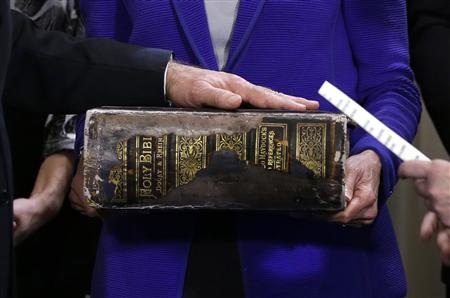
Commentary: Obama's inauguration Bibles
Historic Bibles used in ceremonies 
The tradition of inaugural prayer
Presidential oaths, from Washington to Obama
Adding "So help me God" to the Constitution:
... there was a myth that the tradition of adding God to the oath began with George Washington. It didn’t, say experts at the Library of Congress, the U.S. Senate Historical Office and the first president’s home, Mount Vernon. Although the phrase was used in federal courtrooms since 1789, the first proof it was used in a presidential oath of office came with Chester Arthur’s inauguration in September 1881.
Newdow v. Roberts, the 2008 lawsuit over "So help me God"
Court declines to hear case over "So help me God"
Why doesn't every president use the Lincoln Bible? (And what did John Adams swear on instead of a Bible?)
Biden takes the oath:
Biden used his family Bible for today's ceremony, a 5-inch-thick tome featuring a Celtic cross on the cover. It has been in the Biden family since 1893. He used it each time he was sworn in as a senator and when he was sworn in as vice president in 2009. His son Beau used it when he was sworn in as Delaware's attorney general.
The Biden family Bible, in use
Special piece of art Biden had hung for inauguration
Official & unofficial inauguration prayers
Evangelical pastor's 90s sermon stirs controversy after inauguration invitation
Unpacking the Giglio imbroglio
Commentary: Stop politicizing inaugural prayers
Commentary: Pastor's dis-invitation to inauguration is new moral McCarthyism
Commentary: A wry congratulations to the LGBT community
Commentary: I don't care who prays at the inauguration
Discussing the Giglio controversy & its wider implications
Political/religious tensions in prayer invitations
Farewell, Louie Giglio?
Does Giglio controversy mean the end of publican role for evangelicals?
Obama may have disagreed with how Giglio controversy was handled
Benedictions not offered
When was the last time a rabbi prayed at a presidential inauguration?
1,500 to pray for president, government, military, media & business. Also: Great Awakening.
Methodist pastor Adam Hamilton to preach at inauguration
Widow of civil right's icon to deliver invocation
Episcopal priest to close inauguration
Commentary: Obama should invoke Puritan vision of 'City on a Hill'
Commentary: Civil religion holds country to higher moral standard
Inauguration is 'worship of the nation'
Inaugurations & America's 'civil religion':
President Obama’s [2009] inaugural address contains a muted expression of the American civil religion that Robert Bellah first recognized in Kennedy’s speech of 1961. The reference to God as the transcendent source of values, the activist faith, the trust in God’s providence and grace, notions of sacrifice and rebirth, the appeal to sacred events and heroes of the past (recall, too, Obama’s use of Lincoln’s Bible during the swearing-in ceremony), are all enduring aspects of this tradition, and Obama placed special emphasis on the civil republican dimension 
Yet, the God that Obama appeals to feels more remote, less directly involved in history than in earlier inaugural addresses. Remarkable, too, is Obama’s stress on the nation’s shortcomings, his mention of religious traditions beyond the so-called “Judeo-Christian” faiths, his outreach to Muslims and inclusion of non-believers. The latter represents a real and significant innovation ....
Update: 
Myrlie Evers-Williams delivers inaugural invocation 
The text of Obama's inaugural address
Cornel West's critique of Obama's use of Martin Luther King Jr.'s Bible
Pastor Mark Driscoll's critique of Obama's use of the Bible
Richard Blanco's poem, "One Day"
Richard Blanco reading
Kelly Clarkson performs "My Country Tis of Thee"
Rev. Luis Leon delivers benediction
The text of Leon's benediction

Update 2:
Obama swears on two Bibles
Read More
Posted in American religion, civil religion, links, politics, religion and politics, teaching | No comments

Posted on 00:08 by Unknown

Some facts about women who have had abortions. Tomorrow marks the 40th anniversary of the supreme court decision that legalized abortion in the United States. 


Read More
Posted in abortion, America, culture war, politics, Roe vs. Wade, statistics | No comments

Wednesday, 16 January 2013

Michele Bachmann's post-eleciton disasters

Posted on 02:23 by Unknown
Michele Bachmann's ill-fated campaign for the GOP presidential nomination ended over a year ago, after a brutal loss in the Iowa Caucuses. Bachmann, who is now returning to Congress for her another term, had serious religious right bona fides, having been politicized by Francis Schaeffer in 1977, but couldn't rally the Republican faithful and couldn't manage the necessary transformation into a plausible national candidate.

Her campaign went from disaster to disaster.

Her campaign is still going from disaster to disaster, long after it's over.

A year after the campaign, Peter Waldron, the Bachmann staffer in charge of evangelical outreach is now saying the congresswoman is refusing to pay staffers for work they did. It's a relatively small amount of money. Bachmann ended her presidential campaign with more than $2 million in her war chest and reportedly raised more money in her congressional campaign than any other candidate, but is, according to the disgruntled ex-staffer, refusing to pay out on less than $5,000 of outstanding bills. Which seems like strange behavior.

Or, as Bachmann's one-time head of Christian outreach put it: "It is sobering to think that a Christian member of Congress would betray her testimony to the Lord and the public by withholding earned wages from deserving staff."

The official response has been accusations that Waldron is lying. Which he may be, though that only calls into question the Bachmann campaigns competency in another way. This man, after all, has a historythat would have given another political team pause before making him a key part of its strategy.

There's been some speculation that this conflict stems from a separate post-campaign disaster, the ongoing investigation into the alleged theft of a list of homeschooler's e-mails. According to the Star Tribune, the Bachmann campaign eventually paid the homeschool group $2,000 for using or misusing the list, but the campaign is also being sued by the individual they got the list from and the criminal investigation into how that happened is still open.

Whether that's the source of the conflict or not, the public fight between Waldron and the Bachmann loyalists has now escalated, with the ex-staffer now making colorful accusations about unusual things going on in the campaign and the extreme extent to which Bachmann let her staff control her. Things were so bad, according to Waldron, that avid supporters didn't recognize the Bachmann they thought they knew, and "More than one staffer was grateful to God that she didn't win the nomination."

This isn't reliable information, of course, but there is a clear pattern of very bad judgment from this Republican leader of the religious right. Whether one believes the ex-staffer or thinks he's crazy or both, the conclusion would be the same: Bachmann lacks the ability to surround herself with reasonable, reliable people. A good number of her history of crises can be attributed directly to this fact, and she'll likely continue, despite her success at fundraising and winning the vote of her Minnesota district, careening from disaster to disaster.

Her fiercest supporters and critics hold that this is because of her strong ideological positions. It seems possible, though, that it's just incompetance.

Read More
Posted in America, Francis Schaeffer, Michele Bachmann, politics, religion and politics, religious right | No comments
Older Posts Home
Subscribe to: Posts (Atom)

Popular Posts

  • The Derrida point
    "I was wondering myself where I am going. So I would answer you by saying, first, that I am trying, precisely, to put myself at a point...
  • How New Atheists are like Victorian-era bishops
    The secularization thesis -- the most traditional version, rather crude, which predicted religion would disappear from the modern world -- i...
  • On exorcism
  • Happy birthday Billy Graham
    Billy Graham turns 94 today. One of the odder moments of Graham's very public career -- though there are many, and many more than one ...
  • The courts' disagreement over corporations having religion
    Can corporations practice religion? The courts disagree. In two different federal courts, in two different cases where for-profit companies ...
  • The religious shape of capitalism
    A new study published in Management Science is making a very Max Weber-like claim about the essential differences of religions affecting eng...
  • 'Christianity is not a religion'
    Watch the latest video at video.foxnews.com I don't know whether it's really possible to have a meaningful, reasonable debate about ...
  • Reza Aslan's outrage
    Among scholars of religion, there's no consensus on the relevance of scholar's personal religious beliefs and practices to their sch...
  • Teaching: History of American Atheism
    I'm in the process of preparing a class on the history of American Atheism, which, as far as I can tell, is more or less uncharted terri...
  • Snake handlers embrace media attention
    The National Geographic channel is planning a show on two Tennessee men and their communities struggling to keep the snake-handling faith. T...

Categories

  • "sacred steel" (1)
  • #PrayforBoston (1)
  • 1848 (1)
  • 1916 (1)
  • 2012 (4)
  • 2013 (1)
  • 4th of July (1)
  • 9/11 (1)
  • A Christian Manifesto (1)
  • AAR (1)
  • Aaron Schock (1)
  • abolitionists (1)
  • abortion (6)
  • Abraham Kuyper (2)
  • Abraham Lincoln (1)
  • abuse (4)
  • academia (22)
  • academica (1)
  • Acton Institute (1)
  • aesthetics (2)
  • African-American religion (3)
  • Al Mohler (1)
  • Albert J. Raboteau (1)
  • Alex Grenier (1)
  • aliens (1)
  • Alton Lemon (1)
  • Amazon (1)
  • ambition (1)
  • ambivalence (1)
  • America (21)
  • America’s Blessings: How Religion Benefits Everyone (1)
  • American (1)
  • American religion (128)
  • American Revolution (1)
  • Amish (1)
  • anabaptists (1)
  • Andrew Hamblin (1)
  • Andrew Sullivan (1)
  • Angela Zimmann (1)
  • animation (1)
  • Ann Taves (1)
  • Anti-Catholicism (1)
  • Anti-Mormonism (1)
  • apocalyptic (3)
  • apocalypticsm (2)
  • apologetics (1)
  • Appalachian (1)
  • Archdiocese of Philadelphia (1)
  • arguments (5)
  • Arizona Republic (1)
  • ark (1)
  • art (12)
  • Art Gish (1)
  • Art Young (1)
  • astrophysics (1)
  • asylum (4)
  • Aten Reign (1)
  • atheism (28)
  • audience (1)
  • authors (1)
  • Baby Doe (1)
  • bad faith (2)
  • baptism (1)
  • Baptists (2)
  • Baron d'Holbach (1)
  • Barry Hankins (1)
  • bars (1)
  • baseball (1)
  • bear market in God (2)
  • beer (1)
  • belief (13)
  • Ben-Hur (1)
  • Benedict XVI (4)
  • bible (4)
  • Big Mountain Jesus (1)
  • big Other (1)
  • Bill O'Reilly (1)
  • Billy Graham (4)
  • Billy Sunday (1)
  • birds (1)
  • birth control (10)
  • bishops (1)
  • Black Mountain Poets (1)
  • blasphemy (2)
  • blues (1)
  • Bob Dylan (2)
  • Bob Grenier (1)
  • book (4)
  • book culture (6)
  • book review (1)
  • bookshelf (1)
  • bookstore (3)
  • Boston (2)
  • Boz Tchividjian (1)
  • Brennan Manning (2)
  • Brethern (1)
  • Broderick Rice (1)
  • buddhism (1)
  • Bulldogs (1)
  • Calvary Chapel (2)
  • calvinism (12)
  • Canada (1)
  • capitalism (9)
  • cardinals (1)
  • Cardus (1)
  • Carl F. H. Henry (1)
  • Catholic hierarchy (1)
  • Catholicism (19)
  • Chance The Rapper (1)
  • charity (2)
  • Charlemagne (1)
  • Charles Chaput (1)
  • Charles Darwin (1)
  • Charles Fox Parham (1)
  • Charles Olson (2)
  • Charles Taylor (3)
  • Chicago (2)
  • child molestation (1)
  • children (2)
  • Children's literature (1)
  • Chris Rock (1)
  • Chris Stedman (1)
  • Chris Sullivan (1)
  • christian fiction (14)
  • Christian Hedonism (1)
  • Christian music (5)
  • Christian publishing (7)
  • Christian Reconstructionism (2)
  • Christianity (15)
  • Christianity Today (1)
  • Christmas (7)
  • Chuck Colson (2)
  • Chuck Smith (1)
  • church (7)
  • church suppers (1)
  • churches (6)
  • churches in bars (1)
  • citations (1)
  • civil religion (7)
  • Civil War (4)
  • Clarence Darrow (1)
  • clergy (2)
  • Cloud Ten (2)
  • cognitive minorities (1)
  • Col. Sanders (1)
  • comedians (1)
  • comedy (1)
  • commodification (1)
  • Conestoga Wood Specialties vs. Sebelius (1)
  • congress (1)
  • Constantin Volney (1)
  • Consuming Spirits (1)
  • conversation (3)
  • conversion (4)
  • Cotton Mather (1)
  • Courageous (1)
  • cover-up (2)
  • creationism (2)
  • creativity (1)
  • creeds and confessions (1)
  • crime fiction (2)
  • crime writing (1)
  • criticism (5)
  • crucifixion (2)
  • cubicle (1)
  • culpability (1)
  • cultural relevance (3)
  • cultural studies (10)
  • culture war (8)
  • D.G. Hart (1)
  • D.T. Max (3)
  • Dale McGowan (1)
  • Dan Fincke (1)
  • Daniel Dennett (2)
  • Darwin (1)
  • David Foster Wallace (3)
  • David Lipsky (1)
  • David Silverman (3)
  • David Tamayo (1)
  • de (1)
  • death (5)
  • Declaration of Independence (1)
  • definition of religion (3)
  • demons (6)
  • denominations (2)
  • depression (1)
  • Derrida (2)
  • Descartes (1)
  • Detroit (1)
  • digital humanities (1)
  • discourse analysis (1)
  • documentary (3)
  • dominionism (1)
  • Doomsday Preppers (1)
  • Dorothy Day (1)
  • doubt (2)
  • Dutch Calvinist (3)
  • e-books (2)
  • e-readers (1)
  • Eastern Orthodox (3)
  • economics (6)
  • ecstatic prayer (4)
  • Ed Gass-Donnelly (1)
  • Edith Schaeffer (1)
  • election (4)
  • Elmbrook v. Doe (1)
  • end times (4)
  • Episcopal Church (3)
  • epistemology (1)
  • Erasmus (1)
  • Eric Hobsbawm (1)
  • Errorl Morris (1)
  • ethics (5)
  • ethics of writing (1)
  • evangelicalism (38)
  • Every Love Story is a Ghost Story (2)
  • evil (2)
  • evolution (5)
  • exorcism (1)
  • experimental fiction (2)
  • faith (4)
  • Family Life Faith and Freedom v. Lynda Serrano (1)
  • Family Research Council (1)
  • fasnet (1)
  • Faulkner (1)
  • Fenway (1)
  • fiction (6)
  • film (8)
  • financial crisis (1)
  • fireworks (1)
  • First Amendment (26)
  • First Things (4)
  • folk art (1)
  • forgiveness (1)
  • fortune telling (1)
  • FOX news (1)
  • France (1)
  • Francis Schaeffer (4)
  • Frank Peretti (1)
  • Freedom From Religion Foundation (1)
  • freedom of religion (14)
  • French Revolution (1)
  • Front Porch Republic (1)
  • Fundamentalist-Modernist (4)
  • funerals (2)
  • gender (1)
  • George Beverly Shea (1)
  • George McGovern (1)
  • German (1)
  • German Reformed Church (1)
  • Germany (9)
  • giving (2)
  • Good Friday (1)
  • gospel (4)
  • gothic (1)
  • government (1)
  • grace (1)
  • Grammys (1)
  • Gravity (1)
  • Greece v. Galloway (1)
  • Greg Abbott (1)
  • Greg Brown (1)
  • Gruppe 91 (1)
  • Habermas (2)
  • Hagee (1)
  • Halakha (1)
  • Halloween (1)
  • Harry Crews (1)
  • HCA (4)
  • health care (3)
  • Heidelberg (2)
  • Heidelberg Catechism (1)
  • hell (3)
  • Henry Luce (1)
  • Herbert Rösler (1)
  • Herman Miller (1)
  • hermeneutics (1)
  • Hinduism (1)
  • Hispanic (1)
  • history (24)
  • Hitchcock (1)
  • Hobby Lobby Inc. vs. Sebelius (7)
  • Hobby Lobby Inc. vs. Sebillius (1)
  • holiness (1)
  • Hollingsworth v. Perry (1)
  • holy roller (1)
  • homemaking (1)
  • homeschooling (4)
  • homosexuality (2)
  • horseshoe (1)
  • Hosanna-Tabor (2)
  • hospitality (1)
  • Houndmouth (1)
  • houses of worship (2)
  • How's that working out for you -- being clever? (1)
  • Howard Phillips (1)
  • HR 1627 (1)
  • HSLDA (4)
  • humanism (2)
  • Hume (1)
  • icon (1)
  • icons (3)
  • ideology (1)
  • immigration (4)
  • In God We Trust (1)
  • In the Year of Dreaming Dangerously (1)
  • incarnation (1)
  • Including Atheists (1)
  • infanticide (1)
  • Intelligent Design (3)
  • Ira Glass (1)
  • Iraq (1)
  • Islam (3)
  • J. Gresham Machen (1)
  • Jack Chick (1)
  • James D. Bratt (1)
  • James Turner (2)
  • James Turrell (1)
  • James W.C. Pennington (1)
  • Jamie Coots (1)
  • Jason Molina (1)
  • Jehovah's Witnesses (1)
  • Jerry Jenkins (2)
  • Jesus (3)
  • Jesus People (1)
  • Jim Bakker (1)
  • Jodi Arias (1)
  • Joe Biden (1)
  • Joel Barlow (1)
  • Joel Osteen (1)
  • John Bunyan (1)
  • John Jay Institute (1)
  • John Piper (1)
  • John Reist (1)
  • John Roberts (2)
  • John Weiners (1)
  • John Wesley (1)
  • John XXIII (1)
  • Jonathan Cahn (1)
  • Jonathan Edwards (3)
  • Jonathan Smith (1)
  • Joseph M. Bauman (1)
  • journalism (4)
  • Juan Mendez (1)
  • Judaism (1)
  • Judge Carol E. Jackson (1)
  • Judge Sarah Evans Barker (1)
  • Justin Taylor (2)
  • Justin Townes Earle (1)
  • Kathryn Jean Lopez (1)
  • Kathryn Lofton (1)
  • Kenneth D. Royal (1)
  • kerfuffle (1)
  • language theory (1)
  • Lauren Green (1)
  • law (12)
  • Lawrence Krauss (3)
  • Lecrae (2)
  • Lee Braver (1)
  • Left Behind (2)
  • Lemon Test (1)
  • let's be serious (1)
  • Lew Wallace (1)
  • liberal (5)
  • liberalism (1)
  • life in Germany (2)
  • Linda Rios Brooks (1)
  • links (1)
  • literary studies (2)
  • living in Germany (15)
  • Local Religious Beliefs and Mutual Fund Risk-Taking Behaviors (1)
  • logic (1)
  • Logical Positivism (1)
  • luck (1)
  • M.S. Simkin (1)
  • maps (1)
  • Marc Ouellet (1)
  • marijuana (1)
  • Mark Driscoll (1)
  • Mark Hatfield (1)
  • marriage (2)
  • married life (1)
  • Martin Luther King Jr. (1)
  • Marx (4)
  • Marxism (3)
  • material conditions (3)
  • Matthew S. Hedstrom (1)
  • Matthew Sutton (1)
  • Max Weber (1)
  • Mayan calendar (1)
  • megachurch (3)
  • Megan Phelps-Roper (1)
  • Mennonites (1)
  • metafiction (2)
  • metaphysics (3)
  • Methodists (1)
  • Metropolitan Jonah (2)
  • Michael Farris (4)
  • Michael W. Cuneo (1)
  • Michele Bachmann (1)
  • Michio Kaku (1)
  • Mike Huckabee (2)
  • minimalism (1)
  • misreading (1)
  • Mitt Romney (6)
  • modern conservatism (13)
  • monasticism (1)
  • Mormonism (2)
  • mural (1)
  • music (1)
  • my life (28)
  • names (1)
  • narratives (5)
  • Nate Silver (1)
  • Nathan Hitchen (1)
  • Natural Law (1)
  • natural theology (1)
  • Nazis (3)
  • Neil Carter (1)
  • Neil DeGrasse Tyson (1)
  • Neo-Calvinism (1)
  • networks (1)
  • New Atheists (4)
  • New New Atheists (1)
  • new religious movements (1)
  • ngrams (1)
  • Nibiru (1)
  • Nicolas Cage (1)
  • Nikolaevsk (1)
  • Nils Frahm (1)
  • Noah (1)
  • non-denominational (1)
  • non-profit (1)
  • nones (11)
  • not fiction (18)
  • notes on reading (4)
  • novel (2)
  • Obama (13)
  • obit (8)
  • obits (1)
  • OCA (2)
  • Old Believers (1)
  • Old North Church (1)
  • ontology (1)
  • P.T. Anderson (1)
  • pacifism (1)
  • patriots (1)
  • Paul Ryan (1)
  • peace activists (1)
  • Peggy Gish (1)
  • pentecostal (14)
  • pet funerals (1)
  • Peter Lalonde (1)
  • Peter Stormare (1)
  • phenomenology (1)
  • philosophy (11)
  • photographs (41)
  • photography (1)
  • Pilgrim's Progress (1)
  • platform (1)
  • pluralism (4)
  • poetry (4)
  • political debate (11)
  • politics (37)
  • politics of distraction (3)
  • poll (1)
  • Pope (6)
  • poverty (1)
  • practice (2)
  • prayer (8)
  • preaching (3)
  • priests (1)
  • printing (2)
  • pro-life movement (1)
  • processing (1)
  • proselytization (1)
  • Protestantism (3)
  • Psalm (1)
  • public service announcement (1)
  • public square (4)
  • publishing (3)
  • pulpit freedom (1)
  • Puritans (4)
  • Quakers (1)
  • quote (2)
  • quotes (1)
  • race (2)
  • racing (1)
  • Ragamuffin Gospel (2)
  • Ralph Reed (1)
  • rap (3)
  • Raymond Burke (1)
  • Reformed theology (3)
  • religion (11)
  • religion and politics (20)
  • religion and science (8)
  • Religion and the marketplace (27)
  • Religion for Atheists (1)
  • Religions in America survey (1)
  • religious data (19)
  • religious experience (1)
  • religious journalism (12)
  • religious marketplace (5)
  • religious practice (27)
  • religious right (6)
  • Religious Studies Project (1)
  • repost (1)
  • Republican Party (2)
  • Rev. Peyton's Big Damn Band (1)
  • revolutions (1)
  • Reza Aslan (1)
  • Rich Mullins (1)
  • Richard Buel Jr. (1)
  • Richard Dawkins (2)
  • Rick Warren (1)
  • rites (2)
  • ritual (4)
  • Rob Bell (2)
  • Robert Bellah (3)
  • Robert D. Putnam (1)
  • Robert Ingersoll (4)
  • Robert Randolph (1)
  • Rodney Stark (2)
  • Roe vs. Wade (2)
  • Romeike (4)
  • Ron Hansen (1)
  • Rosa Parks (1)
  • Ryan Hunter (1)
  • Saddleback (1)
  • saints (3)
  • Salmon Chase (1)
  • same-sex marriage (2)
  • Sandy Hook Elementary (1)
  • satanic panic (1)
  • scandal (4)
  • scholarship (3)
  • scientisim (2)
  • Scientology (1)
  • Scopes trial (2)
  • Searching for the Wrong-Eyed Jesus (1)
  • secularism (19)
  • secularity (15)
  • secularization (8)
  • self-publishing (1)
  • separatism (1)
  • Shane Claiborne (1)
  • sharia (1)
  • sketch (1)
  • Skewby (1)
  • slavery (1)
  • Slovoj Zizek (3)
  • Small Town Murder Songs (1)
  • snake handling (2)
  • Social Gospel (1)
  • social imaginaries (1)
  • social justice (1)
  • socialism (1)
  • sociology (1)
  • solidarity with the oppressed (1)
  • Sovereign Grace Ministries (3)
  • Spirit of Capitalism (1)
  • spirit phography (1)
  • spiritual warfare (2)
  • spirituality (2)
  • sports (1)
  • St. Francis (1)
  • statistics (6)
  • Stephen C. Meyer (1)
  • Stephen King (1)
  • student life (1)
  • Suess (1)
  • supernatural (1)
  • Supreme Court (5)
  • Susan Jacoby (2)
  • suspension of disbelief (4)
  • T.D. Jakes (1)
  • taxes (2)
  • teaching (8)
  • Ted Cruz (2)
  • televangelists (3)
  • Ten Commandments (1)
  • Terry Gross (1)
  • testimony (1)
  • Texas (1)
  • Thanksgiving (1)
  • The Birds (1)
  • The Color of Christ (1)
  • The Columbiad (1)
  • The Conjuring (1)
  • The Exorcist (1)
  • The Harbinger (1)
  • The Pale King (1)
  • the secular (5)
  • the South (2)
  • the work we do (3)
  • theodicy (1)
  • theology (3)
  • theory (1)
  • thinking (16)
  • This American Life (2)
  • Thomas Kincade (1)
  • Thomas Nagel (1)
  • Tim LaHaye (1)
  • Timothy Dolan (2)
  • Tony Perkins (1)
  • Tosca Lee (2)
  • tracts (1)
  • transatlantic (1)
  • travel (1)
  • Travis Alexander (1)
  • Treaty of Tripoli (1)
  • Tübingen (3)
  • Tulsi Gabbard (1)
  • TV (3)
  • Tyndale House (1)
  • Tyndale House vs. Sebelius (2)
  • UFOs (1)
  • UK (1)
  • unbelief (3)
  • Unitarians (1)
  • United Church of Christ (2)
  • United States v. Windsor (1)
  • USA Today (1)
  • utopia (1)
  • V.P. Roychowdhury (1)
  • Valerie Weaver-Zercher (1)
  • Van Orden v. Perry (1)
  • Vatican II (1)
  • violence (3)
  • Virgin of Guadalupe (1)
  • voting guides (1)
  • Walter Owens (1)
  • war (2)
  • weekend music (7)
  • welfare (1)
  • Westboro Baptist (1)
  • why philosophy? (4)
  • William F. Buckley (1)
  • William J. Lynn (1)
  • William James (1)
  • William Jennings Bryan (1)
  • Willow Creek (1)
  • women (1)
  • worldview (1)
  • worship (4)
  • WPA (1)
  • writing (4)
  • Zealot (1)
  • Zurich (1)

Blog Archive

  • ▼  2013 (147)
    • ▼  August (5)
      • Snake handlers embrace media attention
      • Robert Bellah and the 'religious turn'
      • Religious art's religious (?) evocations
      • No title
      • Robert Bellah, 1927 - 2013
    • ►  July (21)
    • ►  June (15)
    • ►  May (21)
    • ►  April (18)
    • ►  March (23)
    • ►  February (20)
    • ►  January (24)
  • ►  2012 (153)
    • ►  December (33)
    • ►  November (17)
    • ►  October (21)
    • ►  September (29)
    • ►  August (29)
    • ►  July (22)
    • ►  June (2)
Powered by Blogger.

About Me

Unknown
View my complete profile